Related Research Articles
Ctesias, also known as Ctesias of Cnidus, was a Greek physician and historian from the town of Cnidus in Caria, then part of the Achaemenid Empire.
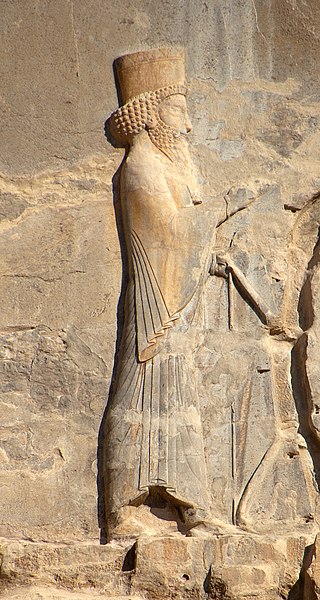
Arses, known by his regnal name Artaxerxes II, was King of Kings of the Achaemenid Empire from 405/4 BC to 358 BC. He was the son and successor of Darius II and his mother was Parysatis.

Diodorus Siculus, or Diodorus of Sicily was an ancient Greek historian. He is known for writing the monumental universal history Bibliotheca historica, in forty books, fifteen of which survive intact, between 60 and 30 BC. The history is arranged in three parts. The first covers mythic history up to the destruction of Troy, arranged geographically, describing regions around the world from Egypt, India and Arabia to Europe. The second covers the time from the Trojan War to the death of Alexander the Great. The third covers the period to about 60 BC. Bibliotheca, meaning 'library', acknowledges that he was drawing on the work of many other authors.

The Medes were an ancient Iranian people who spoke the Median language and who inhabited an area known as Media between western and northern Iran. Around the 11th century BC, they occupied the mountainous region of northwestern Iran and the northeastern and eastern region of Mesopotamia located in the region of Hamadan (Ecbatana). Their consolidation in Iran is believed to have occurred during the 8th century BC. In the 7th century BC, all of western Iran and some other territories were under Median rule, but their precise geographic extent remains unknown.

Bardiya or Smerdis, also named as Tanyoxarces by Ctesias, was a son of Cyrus the Great and the younger brother of Cambyses II, both Persian kings. There are sharply divided views on his life. Bardiya either ruled the Achaemenid Empire for a few months in 522 BC, or was impersonated by a magus called Gaumāta, whose name is given by Ctesias as Sphendadates, until he was toppled by Darius the Great.

Afrasiab is the name of the mythical king and hero of Turan. He is the main antagonist of the Persian epic Shahnameh, written by Ferdowsi.
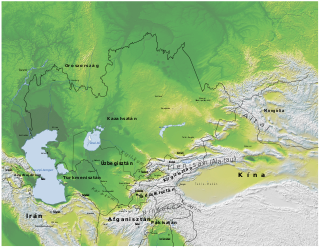
The Massagetae or Massageteans, also known as Sakā tigraxaudā or Orthocorybantians were an ancient Eastern Iranian Saka people who inhabited the steppes of Central Asia and were part of the wider Scythian cultures. The Massagetae rose to power in the 8th to 7th centuries BCE, when they kickstarted a series of events with wide-reaching consequences by expelling the Scythians out of Central Asia and into the Caucasian and Pontic Steppes. The Massagetae are most famous for their queen Tomyris's alleged defeating and killing of Cyrus, the founder of the Persian Achaemenid Empire.

The Cadusii were an ancient Iranian tribe that lived in the mountains between Media and the shore of the Caspian Sea. The area that the Cadusii lived in bordered that of the Anariacae and Albani. The Dareitai and Pantimati people may have been part of the Cadusii.

Darius the Mede is mentioned in the Book of Daniel as king of Babylon between Belshazzar and Cyrus the Great, but he is not known to history, and no additional king can be placed between the known figures of Belshazzar and Cyrus. Most scholars view him as a literary fiction, but some have tried to harmonise the Book of Daniel with history by identifying him with various known figures, notably Cyrus, Cyaxares, or Gobryas, the general who was first to enter Babylon when it fell to the Persians in 539 BCE.
Shammuramat, also known as Sammuramat or Shamiram and Semiramis, was a powerful queen of the Neo-Assyrian Empire. Beginning her career as the primary consort of the king Shamshi-Adad V, Shammuramat reached an unusually prominent position in the reign of her son Adad-nirari III. Though there is dispute in regard to Shammuramat's formal status and position, and if she should be considered a co-regent, it is clear that she was among the most powerful and influential women of the ancient Near East; she is the only known Assyrian queen to have retained her status as queen after the death of her husband and the only known ancient Assyrian woman to have partaken in, and perhaps even led, a military campaign.

Media is a region of north-western Iran, best known for having been the political and cultural base of the Medes. During the Achaemenid period, it comprised present-day Azerbaijan, Iranian Kurdistan and western Tabaristan. As a satrapy under Achaemenid rule, it would eventually encompass a wider region, stretching to southern Dagestan in the north. However, after the wars of Alexander the Great, the northern parts were separated due to the Partition of Babylon and became known as Atropatene, while the remaining region became known as Lesser Media.

Bibliotheca historica is a work of universal history by Diodorus Siculus. It consisted of forty books, which were divided into three sections. The first six books are geographical in theme, and describe the history and culture of Egypt, of Mesopotamia, India, Scythia, and Arabia (II), of North Africa (III), and of Greece and Europe (IV–VI). In the next section, he recounts human history starting with the Trojan War, down to the death of Alexander the Great. The last section concern the historical events from the successors of Alexander down to either 60 BC or the beginning of Caesar's Gallic War in 59 BC. He selected the name "Bibliotheca" in acknowledgement that he was assembling a composite work from many sources. Of the authors he drew from, some who have been identified include: Hecataeus of Abdera, Ctesias of Cnidus, Ephorus, Theopompus, Hieronymus of Cardia, Duris of Samos, Diyllus, Philistus, Timaeus, Polybius and Posidonius.

The Persian Revolt was a campaign led by Cyrus the Great in which the province of ancient Persis, which had been under Median rule, declared its independence and fought a successful revolution, separating from the Median Empire. Cyrus and the Persians did not stop there, however, and in turn went on and conquered the Medes.
The Battle of the Persian Border was the second encounter between the forces of Media and Persia. Though not a decisive victory for Persia, it signaled the diminishing power of Media in Southwest Asia. It was the first battle Cambyses I had fought in, and the first which he had fought with his son, Cyrus the Great. The first major battle, which lasted two days, was an attempt to bring freedom to Persia. It also prompted the Persians to retire south, and fight a third battle.
The Battle of Hyrba was the first battle between the Persians and Medians, taking place around 552 BC. It was also the first battle after the Persians had revolted. These actions were led by Cyrus the Great, as he shifted the powers of the ancient Middle East. The Persian success in the battle led to the creation of Persia's first empire and began Cyrus's decade long conquest of almost all of the known world. Though the only authority with a detailed account of the battle was Nicolaus of Damascus, other well-known historians such as Herodotus, Ctesias, and Strabo also mention the battle in their own accounts.

Voprosy Istorii is a Russian academic journal for historical studies. It is published monthly by the Institute of General History of the Russian Academy of Sciences. The journal covers both Russian and world history.
Vitii is an ancient tribe that lived on the territory of Caucasian Albania and today in village Nic Qabala region Azerbaijan udins Some scholars believe that the Vitii were Caucasian Albanians, while others consider them to have migrated to the Caucasus by the ancient Greeks. Some consider the Vitii to be the ancestors of the modern Udins, but according to other statements, these two tribes could live at the same time. V.V. Nikolaev identifies the Vitii with Gutians. A.A. Tuallagov describes the Vitii as Caucasian Tocharians and says that they came from the territory of the Yuezhi tribe.
Onaphernes — leader of the cadusii, ally of Cyrus the Great.
Artagerses - the leader of the Cadusii, the military leader of the Persian king Artaxerxes II.
Artaeus, is the legendary sixth king of Media mentioned by Ctesias, who succeeded Arbian, and not Sardanapalus. Artaeus was the father of Artachaees and Azanes.
References
- ↑ Ctesias; Stronk, Jan P. (2010). Ctesias' Persian History: Introduction, text, and translation. Wellem Verlag. p. 271. ISBN 978-3-941820-01-2.
- ↑ Diodorus (Siculus.) (1960). Diodorus of Sicily. Harvard University Press. ISBN 978-0-674-99429-4.
- ↑ Journal of ancient history (in Russian). Nauka. 1995. p. 31.
- ↑ Vestnik drevneĭ istorii (in Russian). Наука. 1971. p. 35.
- ↑ Sayce, A. H. (2005-09-01). The Hibbert Lectures, 1887: Lectures on the Origin and Growth of Religion. Cosimo, Inc. p. 157. ISBN 978-1-59605-234-5.
- ↑ Herbert, Algernon (1828). Nimrod: A Discourse on Certain Passages of History and Fable. R. Priestley. p. 359.
- ↑ Vestnik drevneĭ istorii (in Russian). Наука. 1960. pp. 250–253.
- ↑ "Историческая библиотека". simposium.ru. Retrieved 2021-11-07.
- ↑ "Книги I - VI | Симпосий Συμπόσιον". simposium.ru. Retrieved 2021-11-07.
- ↑ The Journal of Hellenic Studies. Council of the Society. 1988. p. 148.
- ↑ Syme, Sir Ronald (August 1991). Roman Papers: Volume VI. Clarendon Press. p. 319. ISBN 978-0-19-814494-6.
- ↑ Kramers, Johannes Hendrik (1954). Analecta Orientalia: Posthumous Writings and Selected Minor Works. E.J. Brill. p. 247.
- ↑ Analecta Orientalia Posthumous Writings and Selected Minor Workds. Brill Archive. p. 247.
- ↑ Dulęba, Władysław (1995). The Cyrus Legend in the Šāhnāme. Enigma Press. pp. 63, 80. ISBN 978-83-86110-19-3.
- ↑ Folia orientalia. Państwowe Wydawn. Naukowe. 1987. p. 169.
- ↑ Ctesias (1888). The fragments of the Persika of Ktesias (in Greek). Macmillan. p. 99.