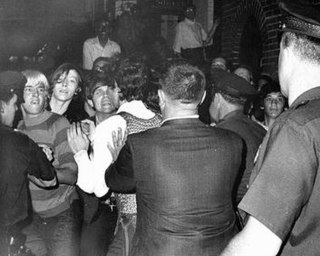
The Stonewall riots, also known as the Stonewall uprising, Stonewall rebellion, or simply Stonewall, were a series of protests by members of the LGBTQ community in response to a police raid that began in the early morning hours of June 28, 1969, at the Stonewall Inn in the Greenwich Village neighborhood of Lower Manhattan in New York City. Patrons of the Stonewall, other Village lesbian and gay bars, trans activists and unhoused LGBT individuals fought back when the police became violent. The riots are widely considered the watershed event that transformed the gay liberation movement and the twentieth-century fight for LGBT rights in the United States.

Before 1933, male homosexual acts were illegal in Germany under Paragraph 175 of the German Criminal Code. The law was not consistently enforced, however, and a thriving gay culture existed in major German cities. After the Nazi takeover in 1933, the first homosexual movement's infrastructure of clubs, organizations, and publications was shut down. After the Röhm purge in 1934, persecuting homosexuals became a priority of the Nazi police state. A 1935 revision of Paragraph 175 made it easier to bring criminal charges for homosexual acts, leading to a large increase in arrests and convictions. Persecution peaked in the years prior to World War II and was extended to areas annexed by Germany, including Austria, the Czech lands, and Alsace–Lorraine.
Lesbian, gay, bisexual, transgender, queer, intersex, and asexual (LGBTQIA+) people frequently experience violence directed toward their sexuality, gender identity, or gender expression. This violence may be enacted by the state, as in laws prescribing punishment for homosexual acts, or by individuals. It may be psychological or physical and motivated by biphobia, gayphobia, homophobia, lesbophobia, and transphobia. Influencing factors may be cultural, religious, or political mores and biases.

Queer is an umbrella term for people who are not heterosexual or are not cisgender. Originally meaning 'strange' or 'peculiar', queer came to be used pejoratively against those with same-sex desires or relationships in the late 19th century. Beginning in the late 1980s, queer activists, such as the members of Queer Nation, began to reclaim the word as a deliberately provocative and politically radical alternative to the more assimilationist branches of the LGBT community.
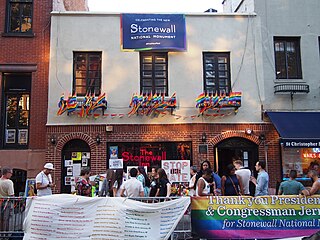
The LGBT community is a loosely defined grouping of lesbian, gay, bisexual, and transgender individuals united by a common culture and social movements. These communities generally celebrate pride, diversity, individuality, and sexuality. LGBT activists and sociologists see LGBT community-building as a counterweight to heterosexism, homophobia, biphobia, transphobia, sexualism, and conformist pressures that exist in the larger society. The term pride or sometimes gay pride expresses the LGBT community's identity and collective strength; pride parades provide both a prime example of the use and a demonstration of the general meaning of the term. The LGBT community is diverse in political affiliation. Not all people who are lesbian, gay, bisexual, or transgender consider themselves part of the LGBT community.
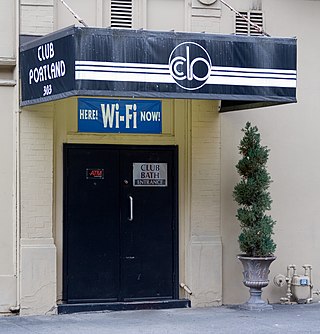
A gay bathhouse, also known as a gay sauna or a gay steambath, is a public bath targeted towards gay and bisexual men. In gay slang, a bathhouse may be called just "the baths", "the sauna", or "the tubs". Historically, they have been used for sexual activity.

A gay bar is a drinking establishment that caters to an exclusively or predominantly lesbian, gay, bisexual, transgender or queer (LGBTQ+) clientele; the term gay is used as a broadly inclusive concept for LGBTQ+ communities.

Lesbian, gay, bisexual, and transgender (LGBT) people in Belarus face significant challenges not experienced by non-LGBT residents. Although same-sex sexual activity is legal in Belarus, gay and lesbian rights in the country are otherwise severely limited and homosexuality remains highly stigmatized in Belarusian society. Households headed by same-sex couples are not eligible for the same legal protections available to opposite-sex couples. Belarus provides no anti-discrimination protections for LGBT people, nor does it prohibit hate crimes based on sexual orientation and gender identity. Many Belarusian people believe that homosexuality is a psychiatric illness, and many LGBT persons in Belarus tend to hide their sexual orientation in public. Those who are "out" face harassment, violence and physical abuse.
Gay cruising describes the act of searching about a public place in pursuit of a partner for sex. This activity has existed in England and Wales since at least the 17th century and has a colourful legal history. It differs from prostitution in that the parties involved do not seek money for sex, and from gay nightclubs or bathhouses in that they are not on private premises, although they may take place on private land to which the public have been granted access.

Zona Rosa is an area in Mexico City which is known for its shopping, nightlife, gay community and its recently established Korean community. The larger official neighborhood it is part of is Colonia Juárez, located just west of the historic center of Mexico City.

Male prostitution is the act or practice of men providing sexual services in return for payment. It is a form of sex work. Although clients can be of any gender, the vast majority are older males looking to fulfill their sexual needs. Male prostitutes have been far less studied than female prostitutes by researchers. Even so, male prostitution has an extensive history including regulation through homosexuality, conceptual developments on sexuality, and the HIV/AIDS, monkeypox, and COVID-19 epidemic impact. In the last century, male sex work has seen various advancements such as popularizing new sexual acts, methods of exchange, and carving out a spot in cinema.

Lesbian, gay, bisexual, and transgender (LGBT) people in Saudi Arabia face severe challenges not experienced by non-LGBT residents. The government of Saudi Arabia provides no legal protections for LGBT rights. Both male and female expressions of same-sex sexual activity are illegal within the nation.

A glory hole is a hole in a wall or partition, often between public lavatory cubicles or sex video arcade booths and lounges, for people to engage in sexual activity or observe the person on the opposite side.

Lesbian, gay, bisexual, and transgender (LGBT) rights in Cuba have significantly varied throughout modern history. Cuba is now considered generally progressive, with vast improvements in the 21st century for such rights. Following the 2022 Cuban Family Code referendum, there is legal recognition of the right to marriage, unions between people of the same sex, same-sex adoption and non-commercial surrogacy as part of one of the most progressive Family Codes in Latin America. Until the 1990s, the LGBT community was marginalized on the basis of heteronormativity, traditional gender roles, politics and strict criteria for moralism. It was not until the 21st century that the attitudes and acceptance towards LGBT people changed to be more tolerant.

Lesbian, gay, bisexual, and transgender (LGBT) people face widespread prosecution in Egypt.
Prostitution in Pakistan is a taboo culture of sex-trade that exists as an open secret but illegal. Prostitution is largely based in organisational setups like brothels or furthered by individual call girls.
The history of lesbian, gay, and bisexual people in China spans thousands of years. Unlike the histories of European and European-ruled polities in which Christianity formed the core of heavily anti-LGBT laws until recent times, non-heterosexual states of being were historically treated with far less animosity in Chinese states. For a period of the modern history of both the Republic of China and People's Republic of China in the 20th century, LGBT people received more stringent legal regulations regarding their orientations, with restrictions being gradually eased by the beginning of the 21st century. However, activism for LGBT rights in both countries has been slow in development due to societal sentiment and government inaction.

The 2010 Vatican employee sex scandal was an incident in March 2010 in which two part-time employees of the Holy See, a consultant who also served as a lay attendant of the pope and another who was a professional member of the Saint Peter's Choir, were reported in the press to be part of a homosexual male prostitution ring. The Catholic Church considers prostitution and homosexual acts to be gravely sinful offenses and the Vatican severed its connections with both men, one of whom had been arrested.
Gay balls, cross-dressing balls or drag balls, depending on the place, time, and type, were public or private balls, celebrated mainly in the first third of the twentieth century, where cross-dressing and ballroom dancing with same sex partners was allowed. By the 1900s, the balls had become important cultural events for gays and lesbians, even attracting tourists. Their golden age was during the Interwar period, mainly in Berlin and Paris, even though they could be found in many big cities in Europe and the Americas such as Mexico City and New York City.
Sexual minorities in Sri Lanka have been counted in recent times as consisting of as little as 0.035% of the population to as high as 19.6%. It is likely that there are around 1,100,000 according to current mapping conventions.
