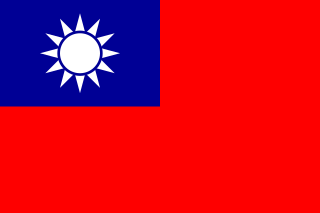
Taiwan, officially the Republic of China (ROC), is a country in East Asia. It sits at the junction of the East and South China Seas in the northwestern Pacific Ocean, neighboring the People's Republic of China (PRC) to the northwest, Japan to the northeast, and the Philippines to the south. The area controlled by the ROC consists of 168 islands with a combined area of 36,193 square kilometres (13,974 sq mi). The main island of Taiwan, formerly known as Formosa, has an area of 35,808 square kilometres (13,826 sq mi), with mountain ranges dominating the eastern two-thirds and plains in the western third, where its highly urbanised population is concentrated. The capital is Taipei, which, along with New Taipei City and Keelung, forms the largest metropolitan area of Taiwan. Other major cities include Kaohsiung, Taichung, Tainan, and Taoyuan. With 23.45 million inhabitants, Taiwan is among the most densely populated countries in the world.

Solomon Islands is a sovereign state in the Melanesia subregion of Oceania in the western Pacific Ocean. This page is about the history of the nation state rather than the broader geographical area of the Solomon Islands archipelago, which covers both Solomon Islands and Bougainville Island, a province of Papua New Guinea. For the history of the archipelago not covered here refer to the former administration of the British Solomon Islands Protectorate, the North Solomon Islands and the History of Bougainville.
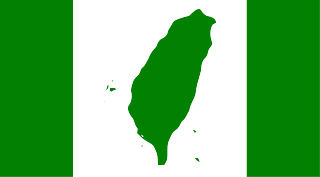
The Taiwan independence movement is a political movement which advocates the formal declaration of an independent and sovereign Taiwanese state, as opposed to the status quo of "Two Chinas" or Chinese unification.

Taiwanese indigenous peoples, Formosan people, Austronesian Taiwanese, Yuanzhumin or Gaoshan people, are the indigenous peoples of Taiwan, who number about 569,000 or 2.38% of the island's population. This total is increased to more than 800,000 people if the indigenous peoples of the plains in Taiwan are included, pending future official recognition. Recent research suggests their ancestors have been living on Taiwan for approximately 6,500 years. A wide body of evidence suggests Taiwan's indigenous people maintained regular trade networks with regional cultures before major Han (Chinese) immigration from continental Asia began in the 17th century.
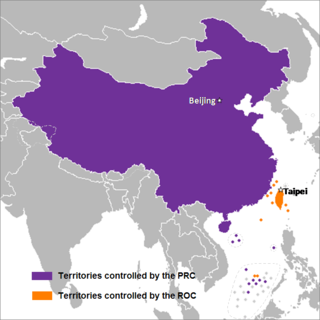
Chinese unification, also known as the Cross-Strait unification or Chinese reunification, is the potential unification of territories currently controlled by the People's Republic of China (China) and the Republic of China (Taiwan) under one political entity, possibly the formation of a political union between the two republics. Together with full Taiwan independence, unification is one of the main proposals to address questions on the political status of Taiwan, which is a central focus of Cross-Strait relations.

Melanesia is a subregion of Oceania in the southwestern Pacific Ocean. It extends from the island of New Guinea in the west to Tonga in the east, and includes the Arafura Sea.
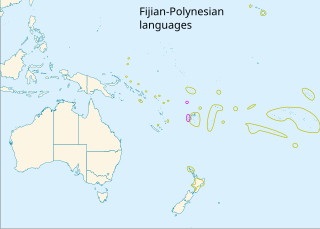
The Polynesian languages form a genealogical group of languages, itself part of the Oceanic branch of the Austronesian family.
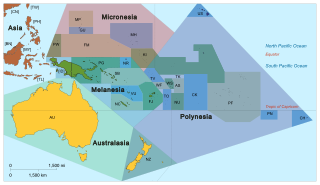
Pacific Islanders, Pacificer, Pasifika, or Pasefika, are the peoples of the Pacific Islands—particularly those who are indigenous to them. As an ethnic/racial term, it is used to describe the original peoples—inhabitants and diasporas—of any of the three major subregions of Oceania, distinct from those inhabitants of the Pacific islands who are of Asian or European descent.

Solomon Islands is a sovereign country consisting of six major islands and over 900 smaller islands in Oceania, to the east of Papua New Guinea and northwest of Vanuatu. It has a land area of 28,400 square kilometres (11,000 sq mi), and a population of 652,858. Its capital, Honiara, is located on the largest island, Guadalcanal. The country takes its name from the Solomon Islands archipelago, which is a collection of Melanesian islands that also includes the North Solomon Islands, but excludes outlying islands, such as the Santa Cruz Islands and Rennell and Bellona.
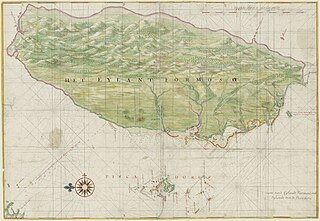
As a result of the surrender and occupation of Japan at the end of World War II, the island of Taiwan was placed under the governance of the Republic of China (ROC), ruled by the Kuomintang (KMT), on 25 October 1945. Following the February 28 massacre in 1947, martial law was declared in 1949 by the Governor of Taiwan Province, Chen Cheng, and the ROC Ministry of National Defense. Following the end of the Chinese Civil War in 1949, the ROC government retreated from the mainland as the Communists proclaimed the establishment of the People's Republic of China. The KMT retreated to Taiwan and declared Taipei the temporary capital of the ROC. For many years, the ROC and PRC each continued to claim in the diplomatic arena to be the sole legitimate government of "China". In 1971, the United Nations expelled the ROC and replaced it with the PRC.
Puma or PUMA may refer to:
Taiwanese nationalism is a nationalist movement to identify the Taiwanese people as a distinct nation. Due to the complex political status of Taiwan, it is strongly linked with the Taiwan independence movement in seeking an identity separate from the Chinese. This involves the education of history, geography, and culture from a Taiwan-centric perspective, promoting native languages of Taiwan such as Taiwanese Hokkien, Hakka, and indigenous languages, as well as reforms in other aspects.

The free area of the Republic of China, also known as the "Taiwan Area of the Republic of China", "Tai-Min Area " or simply the "Taiwan Area", is a term used by the government of the Republic of China (ROC) to refer to the territories under its actual control.

Tsai Ing-wen is a Taiwanese politician and academic serving as the President of the Republic of China (Taiwan) since 2016. A member of the Democratic Progressive Party (DPP), Tsai is the first female president of Taiwan. She has served as Chair of the DPP since 2020, and previously from 2008 to 2012 and 2014 to 2018.

Namasia District (Kanakanavu language, Bunun language: Namasia; Chinese: 那瑪夏區; Hanyu Pinyin: Nàmǎxià Qū; Tongyong Pinyin: Nàmǎsià Cyu; Wade–Giles: Na4-ma3-hsia4 Ch'ü1), formerly Sanmin Township (三民鄉; Sānmín Xiāng), is a mountain indigenous district located in the northeastern part of Kaohsiung, Taiwan. It is the second largest district in Kaohsiung after Taoyuan District.
Taiwanese people may be generally considered the people of Taiwan who share a common culture, ancestry and speak Taiwanese Mandarin, Hokkien, Hakka or indigenous Taiwanese languages as a mother tongue. Taiwanese people may also refer to the indigenous peoples of the areas under the control of the Government of the Republic of China since 1945, including Penghu, Kinmen and Matsu Islands.
The Solomon Islands Social Credit Party ("Socreds") is a political party in the Solomon Islands that espouses social credit theories of monetary reform.
The Solomon Islands Democratic Party is a political party in Solomon Islands. In a country in which political parties tend to be small and transient, and to obtain very few seats in Parliament, the Democratic Party has played a comparatively major role in recent history.

Oceania is, to the People's Republic of China and the Republic of China, a stage for continuous diplomatic competition. The PRC dictates that no state can have diplomatic relations with both the PRC and the ROC. As of 2019, ten states in Oceania have diplomatic relations with the PRC, and four have diplomatic relations with the ROC. These numbers fluctuate as Pacific Island nations re-evaluate their foreign policies, and occasionally shift diplomatic recognition between Beijing and Taipei. The issue of which "Chinese" government to recognize has become a central theme in the elections of numerous Pacific Island nations, and has led to several votes of no-confidence.
The Solomon Islands no longer has official diplomatic ties with Taiwan (ROC) due to the One-China policy since 2020.
