
In Greco-Roman mythology, Aeneas was a Trojan hero, the son of the Trojan prince Anchises and the Greek goddess Aphrodite. His father was a first cousin of King Priam of Troy, making Aeneas a second cousin to Priam's children. He is a minor character in Greek mythology and is mentioned in Homer's Iliad. Aeneas receives full treatment in Roman mythology, most extensively in Virgil's Aeneid, where he is cast as an ancestor of Romulus and Remus. He became the first true hero of Rome. Snorri Sturluson identifies him with the Norse god Víðarr of the Æsir.

The Trojan War was a legendary conflict in Greek mythology that took place around the 12th or 13th century BCE. The war was waged by the Achaeans (Greeks) against the city of Troy after Paris of Troy took Helen from her husband Menelaus, king of Sparta. The war is one of the most important events in Greek mythology, and it has been narrated through many works of Greek literature, most notably Homer's Iliad. The core of the Iliad describes a period of four days and two nights in the tenth year of the decade-long siege of Troy; the Odyssey describes the journey home of Odysseus, one of the war's heroes. Other parts of the war are described in a cycle of epic poems, which have survived through fragments. Episodes from the war provided material for Greek tragedy and other works of Greek literature, and for Roman poets including Virgil and Ovid.

Publius Vergilius Maro, usually called Virgil or Vergil in English, was an ancient Roman poet of the Augustan period. He composed three of the most famous poems in Latin literature: the Eclogues, the Georgics, and the epic Aeneid. A number of minor poems, collected in the Appendix Vergiliana, were attributed to him in ancient times, but modern scholars consider his authorship of these poems to be dubious.
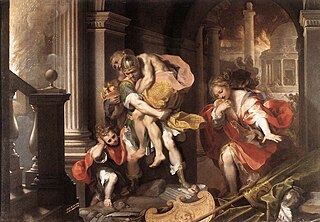
The Aeneid is a Latin epic poem that tells the legendary story of Aeneas, a Trojan who fled the fall of Troy and travelled to Italy, where he became the ancestor of the Romans. Written by the Roman poet Virgil between 29 and 19 BC, the Aeneid comprises 9,896 lines in dactylic hexameter. The first six of the poem's twelve books tell the story of Aeneas' wanderings from Troy to Italy, and the poem's second half tells of the Trojans' ultimately victorious war upon the Latins, under whose name Aeneas and his Trojan followers are destined to be subsumed.
In Greek mythology, Dardanus was the founder of the city of Dardanus at the foot of Mount Ida in the Troad.
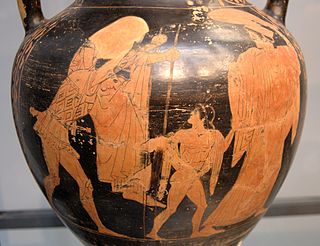
Ascanius was a legendary king of Alba Longa and is the son of the Trojan hero Aeneas and Creusa, daughter of Priam. He is a character in Roman mythology, and has a divine lineage, being the son of Aeneas, who is the son of the goddess Venus and the hero Anchises, a relative of the king Priam; thus Ascanius has divine ascendents by both parents, being descendants of god Jupiter and Dardanus. He is also an ancestor of Romulus, Remus and the Gens Julia. Together with his father, he is a major character in Virgil's Aeneid, and he is depicted as one of the founders of the Roman race.

In Roman mythology, Evander was a culture hero from Arcadia, Greece, who was said to have brought the pantheon, laws, and alphabet of Greece to ancient Italy, where he founded the city of Pallantium on the future site of Palatine Hill, Rome, sixty years before the Trojan War. He instituted the festival of the Lupercalia. Evander was deified after his death and an altar was constructed to him on the Aventine Hill.
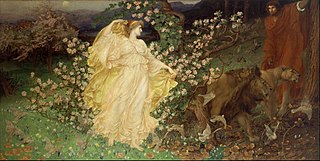
In Greek and Roman mythology, Anchises was a member of the royal family of Troy. He was said to have been the son of King Capys of Dardania and Themiste, daughter of Ilus, who was son of Tros. He is most famous as the father of Aeneas and for his treatment in Virgil's Aeneid. Anchises' brother was Acoetes, father of the priest Laocoön.

Dido, also known as Elissa, was the legendary founder and first queen of the Phoenician city-state of Carthage, in 814 BC. In most accounts, she was the queen of the Phoenician city-state of Tyre who fled tyranny to found her own city in northwest Africa. Known only through ancient Greek and Roman sources, all of which were written well after Carthage's founding, her historicity remains uncertain. The oldest references to Dido are attributed to Timaeus, who was active around 300 BC, or about five centuries after the date given for the foundation of Carthage.

In Roman mythology, Lavinia is the daughter of Latinus and Amata, and the last wife of Aeneas.

In Roman mythology, Acestes or Egestes was the son of the Sicilian river-god Crinisus by a Dardanian or Trojan woman named Egesta or Segesta.
In Greek mythology, King Teucer was said to have been the son of the river-god Scamander and the nymph Idaea.

The Cimmerian Sibyl, by name Carmentis, was the prophetic priestess presiding over the Apollonian Oracle at Cimmerium in Italy, near Lake Avernus.

Tiberinus is a figure in Roman mythology. He was the god of the Tiber River. He was added to the 3,000 rivers, as the genius of the Tiber.

The Cumaean Sibyl was the priestess presiding over the Apollonian oracle at Cumae, a Greek colony near Naples, Italy. The word sibyl comes from the ancient Greek word sibylla, meaning prophetess. There were many sibyls throughout the ancient world. Because of the importance of the Cumaean Sibyl in the legends of early Rome as codified in Virgil's Aeneid VI, and because of her proximity to Rome, the Cumaean Sibyl became the most famous among the Romans. The Erythraean Sibyl from modern-day Turkey was famed among Greeks, as was the oldest Hellenic oracle, the Sibyl of Dodona, dating to the second millennium BC according to Herodotus, favored in the east.

Polydorus or Polydoros is the youngest son of Priam in the mythology of the Trojan War. While Homer states his mother is Laothoe, later sources state his mother is Hecuba. Polydorus is an example of the fluid nature of myth, as his role and story vary significantly in different traditions and sources.

The Golden Bough is one of the episodic tales written in the epic Aeneid, book VI, by the Roman poet Virgil, which narrates the adventures of the Trojan hero Aeneas after the Trojan War.
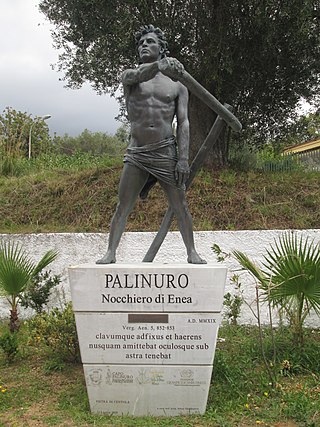
Palinurus (Palinūrus), in Roman mythology and especially Virgil's Aeneid, is the coxswain of Aeneas' ship. Later authors used him as a general type of navigator or guide. Palinurus is an example of human sacrifice; his life is the price for the Trojans landing in Italy.
The Aeneid has been analyzed by scholars of several different generations and schools of thought to try to determine the political commentary that Virgil had hoped to portray. The major schools of thought include the overarching idea that Virgil had written a story that parallels Roman history at the time it was written as well as messages both in support of and against the rule of Augustus Caesar. Finally, it has been argued that Virgil had a stance on geopolitics which he conveys in the actions of Aeneas and his crew.
Pergamus or Pergamos, or Pergamia or Pergamea, was a town of ancient Crete, to which a mythical origin was ascribed. According to Virgil, it was founded by Aeneas, according to Velleius Paterculus by Agamemnon, and according to Servius by the Trojan prisoners belonging to the fleet of Agamemnon. Lycurgus, the Spartan legislator, was said to have died at this place, and his tomb was shown there in the time of Aristoxenus. It is said by Servius to have been near Cydonia, and is mentioned by Pliny the Elder in connection with Cydonia. The Periplus of Pseudo-Scylax says that the Dictynnaeum stood in the territory of Pergamus.

