Related Research Articles

Cooper Hewitt, Smithsonian Design Museum is a design museum at the Andrew Carnegie Mansion in Manhattan, New York City, along the Upper East Side's Museum Mile. It is one of 19 Smithsonian Institution museums and one of three Smithsonian facilities located in New York City, along with the National Museum of the American Indian's George Gustav Heye Center in Bowling Green and the Archives of American Art New York Research Center in the Flatiron District. Unlike other Smithsonian museums, Cooper Hewitt charges an admissions fee. It is the only museum in the United States devoted to historical and contemporary design. Its collections and exhibitions explore design aesthetic and creativity from throughout the United States' history.

Donald Sidney Deskey was an American industrial designer.

Russel Wright was an American industrial designer. His best-selling ceramic dinnerware was credited with encouraging the general public to enjoy creative modern design at table with his many other ranges of furniture, accessories, and textiles. The Russel and Mary Wright Design Gallery at Manitoga in upstate New York records how the "Wrights shaped modern American lifestyle".

The Campana Brothers, consisting of Humberto Campana and Fernando Campana (1961–2022), are Brazilian furniture designers.
Andrea Valentini is an American designer based in San Francisco CA who is known for her bags.

Ellen Lupton is a graphic designer, curator, writer, critic, and educator. Known for her love of typography, Lupton is the Betty Cooke and William O. Steinmetz Design Chair at Maryland Institute College of Art. Previously she was the Senior Curator of Contemporary Design at Cooper Hewitt, Smithsonian Design Museum in New York City and was named Curator Emerita after 30 years of service. She is the founding director of the Graphic Design M.F.A. degree program at Maryland Institute College of Art (MICA), where she also serves as director of the Center for Design Thinking. She has written numerous books on graphic design for a variety of audiences. She has contributed to several publications, including Print, Eye, I.D., Metropolis, and The New York Times.
Jennifer Morla is an American graphic designer and professor based in San Francisco. She received the Cooper Hewitt Smithsonian National Design Award in Communication Design in 2017.
Paul Winthrop McCobb was an American modern furniture designer, textile designer, painter, and industrial designer.

Dorothy Wright Liebes was an American textile designer and weaver renowned for her innovative, custom-designed modern fabrics for architects and interior designers. She was known as "the mother of modern weaving".

Joseph Walsh is a self-taught Irish furniture maker and designer. He was born in County Cork, where he established his studio and workshop in 1999. From the outset, he pursued innovation in making through traditional techniques, often from other craft forms, which enabled new making methods and forms. This led to significant early commissions including various ecclesiastical clients, the Embassy of Japan and the National Museum of Ireland.
Rad Hourani is a Canadian fashion designer and artist known for his neutral, genderless creations.
Edra s.p.a. is an Italian manufacturing company specialized in the creation of innovative designer furniture.
Jhane Barnes is an American designer of clothing, textiles, eyeglasses, carpets and furniture, and the owner of the Jhane Barnes fashion design company. Barnes is known for incorporating complex, mathematical patterns into her clothing designs. She uses computer software to design textile patterns, which then translates the patterns into jacquard loom instructions, which are sent to mills to be woven into fabric.

Joris Hendricus Laarman is a Dutch designer, artist, furniture maker, and entrepreneur best known for his experimental designs inspired by emerging technologies. Laarman's projects are a blend of technology, art and design, with a focus on the potential of 3D printing. Major projects include 3D-printed stainless-steel bridge in Amsterdam, which showcases the potential for creating adaptive, lightweight, and uniquely designed structures using 3D printing. Laarman has also explored furniture design, including the 'Bone' series which used 3D-optimization software to achieve optimal construction. The designer's work often evokes a futuristic feel while nodding to historical art movements, exemplified by pieces like his "Digital Matter" series. When Laarman speaks about his work he discussed the implications and responsibilities that come with breakthrough technologies.

Eszter Haraszty was a Hungarian-born designer best known for her work as head of the textiles department at Knoll.
Dakota Jackson is an American furniture designer known for his eponymous furniture brand, Dakota Jackson, Inc., his early avant-garde works involving moving parts or hidden compartments, and his collaborations with the Steinway & Sons piano company.

Pierre Armand Kleykamp was a Modern furniture, interior, graphic, textile, product designer and teacher. Born in Belgium of Dutch nationality, he became a U.S. citizen in 1954. His clients included KLM, Holland-American Lines, Aetna Life Insurance, the United Nations. He supplied furniture to the Goed Wonen Groep and crafted several pieces for the interior of Schiphol Airport's International Departure Hall.

The Radio Nurse was the first electronic baby monitor. Manufactured by the Zenith Radio Corporation, it went on sale in 1938. The product was developed by Zenith executive Eugene F. McDonald, and designed by Japanese-American sculptor and product designer Isamu Noguchi. Although the product was manufactured for only a few years, it has been acclaimed for its design. It is still in demand as a collectible and is in many museum collections.
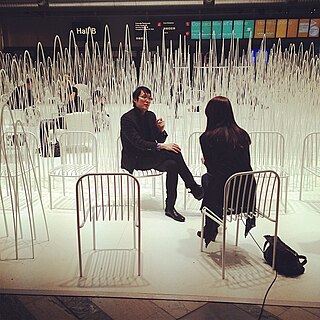
Nendo is a Japanese design firm founded in 2002 by Oki Sato, that works on design projects globally. The first office was situated in Tokyo. In 2005, the second office was established in Milan. The company works with numerous brands and have won multiple awards over the course of 17 years of establishment. Nendo is known for its simple and minimalist design with subtle influences from Japanese, and Scandinavian aesthetics. Currently the positions for CEO, COO and CFO are occupied by Sato Oki, Ito Akihiro, and Hama Takaaki, respectively.

Jay Sae Jung Oh is a South Korean-born, Seattle-based artist and designer. She is known for her sustainable and environmentally-friendly recycled plastic and leather cord furniture works notably, her Salvage Chair series made with everyday objects intricately hand wrapped in raw leather creating a unified a sculptural design object.
References
- ↑ Hospitality Design Magazine, October 2008, "Seriously Sustainable" by Tara Mastrelli
- ↑ Smart Magazine, March/April 2012 Issue, "Eco-Modern Appeal" by Stephanie Kalina-Metzger
- ↑ "Our Mission: To make furniture a positive symbol of Sustainability". Peterdanko.com. Retrieved 2014-06-30.
- ↑ "Peter Danko Green Design Furniture". Paartsexperience.com. Retrieved 2014-06-30.
- ↑ Klingseis, Katherine (April 19, 2011). "Famous furniture designer uses materials that 'Obviously Manifest Green'". Iowa State Daily . Retrieved June 30, 2014.
- ↑ "The Collection | Peter Danko (American, born 1950)". Museum of Modern Art . Retrieved 2014-06-30.
- ↑ "Peter Danko | People | Collection of Cooper Hewitt, Smithsonian Design Museum". Collection.cooperhewitt.org. Retrieved 2014-06-30.
- ↑ "Collections Search". Museum of Fine Arts, Boston . Retrieved 2014-06-30.
- ↑ "Search Collections". Smithsonian American Art Museum. Retrieved 2014-06-30.
- ↑ Office and Contract International Magazine,May 2009, "Eco-Modernism: A Manifesto for Sustainable Design" by Peter Danko
| International | |
|---|---|
| Artists | |
