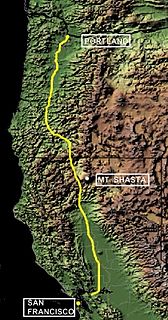
The Siskiyou Trail stretched from California's Central Valley to Oregon's Willamette Valley; modern-day Interstate 5 follows this pioneer path. Originally based on existing Native American foot trails winding their way through river valleys, the Siskiyou Trail provided the shortest practical travel path between early settlements in California and Oregon.
Ralph Friedman was an American author best known for his books about Oregon.
Ewing Young was an American fur trapper and trader from Tennessee who traveled in what was then the northern Mexico frontier territories of Santa Fe de Nuevo México and Alta California before settling in the Oregon Country. Young traded along the Santa Fe Trail, followed parts of the Old Spanish Trail west, and established new trails. He later moved north to the Willamette Valley. As a prominent and wealthy citizen in Oregon, his death was the impetus for the assemblies that several years later established the Provisional Government of Oregon.

A round barn is a historic barn design that could be octagonal, polygonal, or circular in plan. Though round barns were not as popular as some other barn designs, their unique shape makes them noticeable. The years from 1880–1920 represent the height of round barn construction. Round barn construction in the United States can be divided into two overlapping eras. The first, the octagonal era, spanned from 1850–1900. The second, the true circular era, spanned from 1889–1936. The overlap meant that round barns of both types, polygonal and circular, were built during the latter part of the nineteenth century. Numerous round barns in the United States are listed on the National Register of Historic Places.

The Ryan Round Barn is a historic round barn located about six miles north of the city of Kewanee, Illinois in Johnson-Sauk Trail State Park.
William J. Bailey was a British-born physician who immigrated to the United States, where he became a pioneer and politician in the Oregon Country, particularly the Willamette Valley. Bailey participated in the Champoeg Meetings that led to the creation of a provisional government in Oregon. Bailey was selected as a member of that government, first on the Executive Committee and later in the Provisional Legislature of Oregon.
William A. Slacum was an American sailor and diplomat. He served as a purser in the United States Navy and received a Presidential commission to gather information on the Oregon Country. At that time the region was under the jurisdiction of both the United States and Great Britain. Previously, Slacum served as a diplomat to Mexico.
Étienne Lucier was a French-Canadian fur trader active primarily in the Pacific Northwest. He was hired by the Pacific Fur Company and sent to the region to help establish Fort Astoria. Later he became a settler in the Willamette Valley. Lucier attended the Champoeg Meetings and was one of two French-Canadians to vote for the Provisional Government of Oregon, an American and Canadian civil authority for the valley. He is credited with becoming the first European descendant farmer within the modern state of Oregon.
Peter O'Brien may refer to:

Philip Foster Farm is a historic site in Eagle Creek, Oregon, United States, near the city of Estacada. The farm is part of a 640-acre (260 ha) land claim purchased in 1847 by American pioneer Philip Foster. Foster built a store, house, barn, and other structures at the farm. The farmhouse and barn still stand, and replicas of the store, blacksmith shop and log cabin have been built on the site.

The P Ranch is a historic ranch in Harney County in southeastern Oregon, United States. The remaining ranch structures are located on the west bank of the Donner und Blitzen River in the Malheur National Wildlife Refuge. The ranch was built by Peter French, a well known 19th-century cattle baron. The P Ranch became headquarters for the French-Glenn Livestock Company, which eventually covered over 140,000 acres (570 km2). After French was murdered in 1897, the French-Glenn Livestock Company slowly sold off the P Ranch property. In 1935, the United States Government purchased the remaining P Ranch property to add to an adjacent wildlife refuge. The Civilian Conservation Corps demolished most of the original ranch buildings in the 1930s, and a fire destroyed the main ranch house in 1947. The few remaining P Ranch structures are now listed on the National Register of Historic Places.

The Sod House Ranch is an historic ranch in Harney County in southeastern Oregon, United States. The remaining ranch structures are located south of Malheur Lake in the Malheur National Wildlife Refuge. The ranch was built by Peter French, a well known 19th-century cattle baron. The Sod House Ranch became the headquarters for the northern operating division of the French-Glenn Livestock Company, which eventually covered over 140,000 acres (570 km2). After French was murdered in 1897, the French-Glenn Livestock Company slowly sold off its ranch property. In 1935, the United States Government purchased the Sod House Ranch property to add to an adjacent wildlife refuge. The eight remaining Sod House Ranch buildings are now listed on the National Register of Historic Places.

William D. Hanley, known as Bill Hanley, was a pioneer rancher in Harney County in southeastern Oregon. He owned several ranches between Burns, Oregon and Harney Lake. Together, his properties comprised one of the largest privately owned cattle operations in the United States. Hanley was also a progressive thinker and well known host. Among his personal friends were leading political figures, fellow cattle barons, industrialist, writers, and artists including Theodore Roosevelt, William Howard Taft, William Jennings Bryan, Peter French, James J. Hill, CES Wood, and Will Rogers. Hanley's progressive political views led him to run for Governor of Oregon and the United States Senate. A strong advocate of wildlife conservation, much of his ranch is now part of the Malheur National Wildlife Refuge.

The Polygonal Barn, New Oregon Township is an historic building located near Cresco in rural Howard County, Iowa, United States. It was built in 1920 as a show barn for English Shorthorn cattle. The 16-sided building measures 70 feet (21 m) in diameter. The polygonal barn of 6 to 16 equal sides is the most common variation of the round barn that was constructed in Iowa. It features a two-pitch sectional roof, a 13 feet (4.0 m) central silo and small dormers near the top of the roof on the north and south sides. The barn was used for dairy cattle from 1958 to 1968, and it was then used for pigs and feeder cattle. It has been listed on the National Register of Historic Places since 1986.

The Whitehorse Ranch is a historic cattle ranch in Harney and Malheur counties in the southeastern corner of Oregon, United States. The ranch was started in 1869 by John S. Devine, a well-known 19th-century cattle baron. It was originally the headquarters for the Todhunter and Devine Cattle Company. The ranch has been in the cattle business continuously since it was founded. Today, the Whitehorse Ranch includes 63,222 acres (255.85 km2) of deeded property and grazing rights on an additional 287,205 acres (1,162.28 km2) of public range land administered by the Bureau of Land Management.

French Pete Creek is a tributary of the South Fork McKenzie River in Lane County, in the U.S. state of Oregon. It flows generally west through the Three Sisters Wilderness to the south end of Cougar Reservoir, about 11 miles (18 km) from the larger river's confluence with the McKenzie River. The creek has two named tributaries—Olallie Creek and, further downstream, Pat Creek—both of which enter from the right.