Related Research Articles
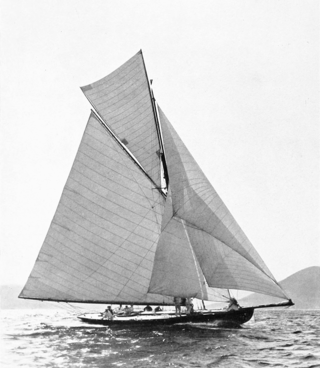
A sloop is a sailboat with a single mast typically having only one headsail in front of the mast and one mainsail aft of (behind) the mast. Such an arrangement is called a fore-and-aft rig, and can be rigged as a Bermuda rig with triangular sails fore and aft, or as a gaff-rig with triangular foresail(s) and a gaff rigged mainsail.

A schooner is a type of sailing vessel defined by its rig: fore-and-aft rigged on all of two or more masts and, in the case of a two-masted schooner, the foremast generally being shorter than the mainmast. A common variant, the topsail schooner also has a square topsail on the foremast, to which may be added a topgallant. Differing definitions leave uncertain whether the addition of a fore course would make such a vessel a brigantine. Many schooners are gaff-rigged, but other examples include Bermuda rig and the staysail schooner.

A sailing vessel's rig is its arrangement of masts, sails and rigging. Examples include a schooner rig, cutter rig, junk rig, etc. A rig may be broadly categorized as "fore-and-aft", "square", or a combination of both. Within the fore-and-aft category there is a variety of triangular and quadrilateral sail shapes. Spars or battens may be used to help shape a given kind of sail. Each rig may be described with a sail plan—formally, a drawing of a vessel, viewed from the side.

Mastocytosis, a type of mast cell disease, is a rare disorder affecting both children and adults caused by the accumulation of functionally defective mast cells and CD34+ mast cell precursors.

A brigantine is a two-masted sailing vessel with a fully square-rigged foremast and at least two sails on the main mast: a square topsail and a gaff sail mainsail. The main mast is the second and taller of the two masts.

A brig is a type of sailing vessel defined by its rig: two masts which are both square-rigged. Brigs originated in the second half of the 18th century and were a common type of smaller merchant vessel or warship from then until the latter part of the 19th century. In commercial use, they were gradually replaced by fore-and-aft rigged vessels such as schooners, as owners sought to reduce crew costs by having rigs that could be handled by fewer men. In Royal Navy use, brigs were retained for training use when the battle fleets consisted almost entirely of iron-hulled steamships.

A barque, barc, or bark is a type of sailing vessel with three or more masts of which the fore mast, mainmast, and any additional masts are rigged square, and only the aftmost mast is rigged fore and aft. Sometimes, the mizzen is only partly fore-and-aft rigged, bearing a square-rigged sail above.

A mast cell is a resident cell of connective tissue that contains many granules rich in histamine and heparin. Specifically, it is a type of granulocyte derived from the myeloid stem cell that is a part of the immune and neuroimmune systems. Mast cells were discovered by Paul Ehrlich in 1877. Although best known for their role in allergy and anaphylaxis, mast cells play an important protective role as well, being intimately involved in wound healing, angiogenesis, immune tolerance, defense against pathogens, and vascular permeability in brain tumors.

The caravel is a small sailing ship that uses both lateen and square sails and was known for its agility and speed and its capacity for sailing windward (beating). Caravels were used by the Portuguese and Spanish for the voyages of exploration during the 15th and 16th centuries, in the Age of Discovery.

Standing rigging comprises the fixed lines, wires, or rods, which support each mast or bowsprit on a sailing vessel and reinforce those spars against wind loads transferred from the sails. This term is used in contrast to running rigging, which represents the moveable elements of rigging which adjust the position and shape of the sails.

The Finn dinghy is a single-handed, cat-rigged sailboat, and a former Olympic class for men's sailing. Since its debut at the 1952 Summer Olympics in Helsinki, the Finn featured in every summer Olympics until 2020, making it the longest serving dinghy in the Olympic Regatta and one of the most prolific Olympic sailboats,. The Finn is a physically demanding boat to race at the highest levels, especially since the class rules now allow unlimited boat rocking and sail pumping when the wind is above 10 knots. The event will not feature on the Olympic programme from 2024.
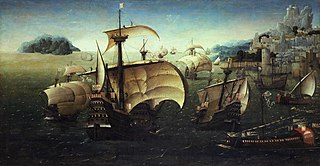
A carrack is a three- or four-masted ocean-going sailing ship that was developed in the 14th to 15th centuries in Europe, most notably in Portugal and Spain. Evolving from the single-masted cog, the carrack was first used for European trade from the Mediterranean to the Baltic and quickly found use with the newly found wealth of the trade between Europe and Africa and then the trans-Atlantic trade with the Americas. In their most advanced forms, they were used by the Portuguese and Spaniards for trade between Europe, Africa and Asia starting in the late 15th century, before being gradually superseded in the late 16th and early 17th centuries by the galleon.

The mast of a sailing vessel is a tall spar, or arrangement of spars, erected more or less vertically on the centre-line of a ship or boat. Its purposes include carrying sails, spars, and derricks, giving necessary height to a navigation light, look-out position, signal yard, control position, radio aerial or signal lamp. Large ships have several masts, with the size and configuration depending on the style of ship. Nearly all sailing masts are guyed.

A Bermuda rig, Bermudian rig, or Marconi rig is a configuration of mast and rigging for a type of sailboat and is the typical configuration for most modern sailboats. This configuration was developed in Bermuda in the 17th century; the term Marconi, a reference to the inventor of the radio, Guglielmo Marconi, became associated with this configuration in the early 20th century, because the wires that stabilize the mast of a Bermuda rig reminded observers of the wires on early radio masts.
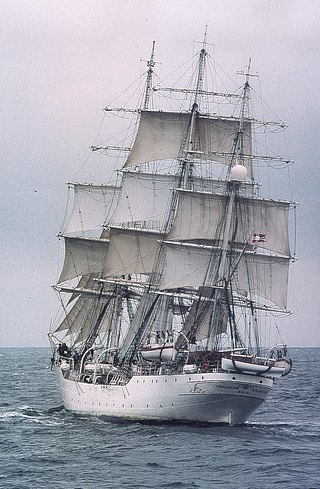
A full-rigged ship or fully rigged ship is a sailing vessel with a sail plan of three or more masts, all of them square-rigged. Such a vessel is said to have a ship rig or be ship-rigged, with each mast stepped in three segments: lower, top, and topgallant.

Half-mast or half-staff refers to a flag flying below the summit of a ship mast, a pole on land, or a pole on a building. In many countries this is seen as a symbol of respect, mourning, distress, or, in some cases, a salute.

Pommern, formerly Mneme (1903–1908), is an iron-hulled sailing ship. It is a four-masted barque that was built in 1903 at the J. Reid & Co shipyard in Glasgow, Scotland.

The Gerald Ratner Athletics Center is a $51 million athletics facility within the University of Chicago campus in the Hyde Park community area on the South Side of Chicago, Illinois in the United States. The building was named after University of Chicago alumnus, Gerald Ratner. The architect of this suspension structure that is supported by masts, cables and counterweights was César Pelli, who is best known as the architect of the Petronas Towers.

Struer is the main town of the kommune of Struer, Region Midtjylland, Denmark with a population of 10,000.
Royal Air Force Danby Beacon or more simply RAF Danby Beacon was an early warning radar Royal Air Force station that formed part of the Chain Home network of radar stations built by the Royal Air Force immediately prior to the Second World War.
References
- ↑ Peter Mast at WorldFootball.net
  | This biographical article relating to Swiss football is a stub. You can help Wikipedia by expanding it. |