
Peugeot is a French brand of automobiles owned by Stellantis.

The Peugeot 505 is a large family car produced by the French manufacturer Peugeot from 1979 to 1992 in Sochaux, France. It was also manufactured in various other countries including Argentina, China, Thailand, Indonesia and Nigeria. The 505 was Peugeot's last rear-wheel drive car.
Berliet was a French manufacturer of automobiles, buses, trucks and military vehicles among other vehicles based in Vénissieux, outside of Lyon, France. Founded in 1899, and apart from a five-year period from 1944 to 1949 when it was put into 'administration sequestre' it was in private ownership until 1967 when it then became part of Citroën, and subsequently acquired by Renault in 1974 and merged with Saviem into a new Renault Trucks company in 1978. The Berliet marque was phased out by 1980.

The Citroën Type A was produced from June 1919 to December 1921 in Paris, France. It was the first car Citroën made. 24,093 were built.

The Peugeot VLV was an electric microcar made by Peugeot in 1942. VLV stood for Voiture Légère de Ville. The car's announcement, on 1 May 1941, triggered some surprise, since Peugeot was the only one of France's large automakers to show interest in electric propulsion at this time.
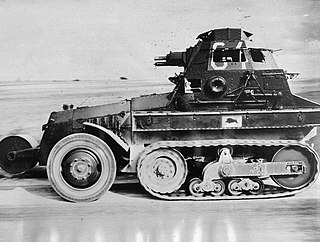
The AMC Schneider P 16, also known as the AMC Citroën-Kégresse Modèle 1929 or the Panhard-Schneider P16, was a half-track that was designed for the French Army before World War II.

The Peugeot 202 is a supermini developed and designed by the French car manufacturer Peugeot. Production of the car ran between 1938 and 1942 and then, after a brief production run of 20 in early 1945, restarted in mid-1946. It was sold until 1949, by when it had been replaced by the 203.

The Peugeot 201 is a car produced by Peugeot between 1929 and 1937.

The Peugeot 301 is a four-cylinder large family car produced by Peugeot between 1932 and 1936.

The Peugeot 402 is a large family car produced in Sochaux, France from 1935 to 1942 by Peugeot. It was unveiled at the Paris Motor Show in 1935, replacing the Peugeot 401.
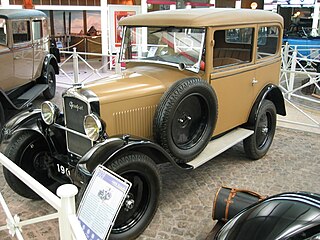
The Peugeot Type 190 S is a model of Peugeot produced between 1928 and 1931.

The Peugeot Bébé or Baby was a small car nameplate from Peugeot made from 1905 to 1916. Vehicles under this name were known technically within Peugeot as the Type 69 and the Type BP1.
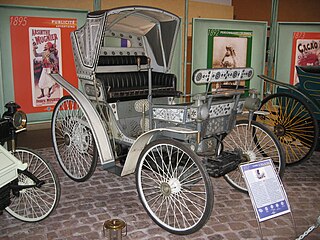
The Peugeot Type 4 was a one-off car produced by Peugeot in 1892 for Ali III ibn al-Husayn, the Bey of Tunis, in accordance with whose wishes the car was decorated.
Vitesse was founded in 1982 as a Portuguese company making diecast cars mostly in 1:43 scale. It was founded in the city of Oporto and is a brand name of Cinerius, Ltd.
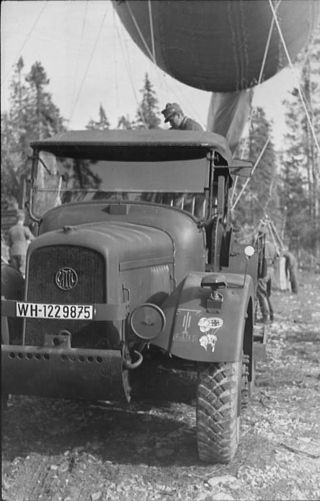
Latil was a French automaker specializing in heavy duty vehicles, such as trucks, agricultural equipment, and buses, from 1898 to 1955. It had factories in Paris, Suresnes, and Marseille.

The Peugeot DMA was a light truck built by Peugeot between 1941 and 1948. It was the first commercial vehicle from Peugeot to employ a forward control cab, whereby the driver sat right at the front of the vehicle. The configuration maximised load deck length and gave the driver a good view of the road, but it meant that the driver shared his cab with the engine: Peugeot's light truck, being a rear wheel drive vehicle, was unable to offer a large low flat load area as the front-wheel drive Citroën TUB light van.
The Stellantis Sochaux Plant is one of the principal car plants in France - in 2007 approximately 326,000 cars were produced there, and as of May 2011 the staff numbered 11,972 permanent workers, approximately 2,000 temporary workers, as well as over 800 employees from other companies working at the Sochaux plant. The plant was created by Peugeot in 1912, initially as a truck factory, but by the 1930s it had become the company's principal car manufacturing plant, and the main production site for all principal Peugeot models from then until 1972, when the company established a second major French car assembly plant in Mulhouse.

The Renault 1 000 Kg is a light van, initially of a one ton capacity, introduced by the manufacturer in 1947. A 1,400 Kg version followed in 1949, and the Renault 1,400 Kg soon became the more popular choice. A name change in 1959 saw the vans branded as the Renault Voltigeur and the Renault Goélette, but in retrospect the Renault 1,000 Kg name is frequently preferred.
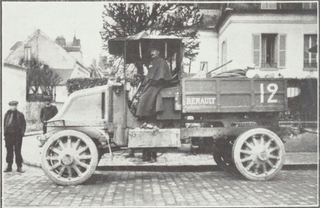
The Renault EG is an all-wheel drive truck/artillery tractor produced between 1914 and 1919 by the French manufacturer Renault.

The Peugeot Type 64 was a model of early automobile manufactured by the French company Automobiles Peugeot between 1904 and 1907. It was powered by an 1817 cubic centimetre v-twin engine making 10 horsepower. It was only constructed in the body style of a small truck, which had a payload of 1200 kg.
