
Euclid was an ancient Greek mathematician active as a geometer and logician. Considered the "father of geometry", he is chiefly known for the Elements treatise, which established the foundations of geometry that largely dominated the field until the early 19th century. His system, now referred to as Euclidean geometry, involved innovations in combination with a synthesis of theories from earlier Greek mathematicians, including Eudoxus of Cnidus, Hippocrates of Chios, Thales and Theaetetus. With Archimedes and Apollonius of Perga, Euclid is generally considered among the greatest mathematicians of antiquity, and one of the most influential in the history of mathematics.

In Greek mythology, Amalthea or Amaltheia is the most commonly mentioned nurse of the infant Zeus. She is usually described as a nymph who suckles the child on the milk of a goat, though in later Hellenistic sources she is often depicted as the goat itself.

In Greek mythology, Silenus was a companion and tutor to the wine god Dionysus. He is typically older than the satyrs of the Dionysian retinue (thiasos), and sometimes considerably older, in which case he may be referred to as a Papposilenus. Silen and its plural sileni refer to the mythological figure as a type that is sometimes thought to be differentiated from a satyr by having the attributes of a horse rather than a goat, though usage of the two words is not consistent enough to permit a sharp distinction.
Mithridates or Mithradates is the Hellenistic form of an Iranian theophoric name, meaning "given by Mithra". Its Modern Persian form is Mehrdad. It may refer to:
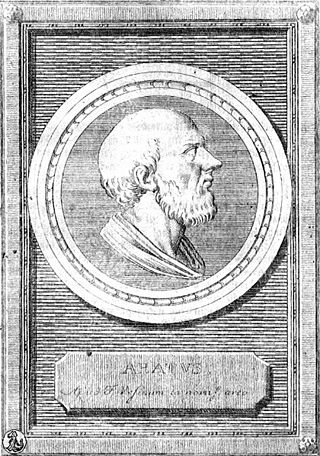
Aratus was a Greek didactic poet. His major extant work is his hexameter poem Phenomena, the first half of which is a verse setting of a lost work of the same name by Eudoxus of Cnidus. It describes the constellations and other celestial phenomena. The second half is called the Diosemeia, and is chiefly about weather lore. Although Aratus was somewhat ignorant of Greek astronomy, his poem was very popular in the Greek and Roman world, as is proven by the large number of commentaries and Latin translations, some of which survive.

Classical Latin is the form of Literary Latin recognized as a literary standard by writers of the late Roman Republic and early Roman Empire. It formed parallel to Vulgar Latin around 75 BC out of Old Latin, and developed by the 3rd century AD into Late Latin. In some later periods, the former was regarded as good or proper Latin; the latter as debased, degenerate, or corrupted. The word Latin is now understood by default to mean "Classical Latin"; for example, modern Latin textbooks almost exclusively teach Classical Latin.
Phenomena are observable events.
Eochaid or Eochaidh is a popular medieval Irish and Scottish Gaelic name deriving from Old Irish ech "horse", borne by a variety of historical and legendary figures.

The Remi were a Belgic tribe dwelling in the Aisne, Vesle and Suippe river valleys during the Iron Age and the Roman period. Their territory roughly corresponded the modern Marne and Ardennes and parts of the Aisne and Meuse departments.

Berossus or Berosus was an early-3rd-century BCE Hellenistic-era Babylonian writer, a priest of Bel Marduk and astronomer who wrote in the Koine Greek language.
Yohananיוֹחָנָן, sometimes transcribed as Johanan is Hebrew male given name that can also appear in the longer form of יְהוֹחָנָן, meaning "YHWH is gracious".
Postumius Rufius Festus Avienius was a Latin writer of the 4th century AD. He was a native of Volsinii in Etruria, from the distinguished family of the Rufii Festi.
Geminus of Rhodes, was a Greek astronomer and mathematician, who flourished in the 1st century BC. An astronomy work of his, the Introduction to the Phenomena, still survives; it was intended as an introductory astronomy book for students. He also wrote a work on mathematics, of which only fragments quoted by later authors survive.
In Greek mythology, Helice was a name shared by several women:
Rufus is one of the most common of the ancient Roman cognomina.

The Geographica or Geography, is an encyclopedia of geographical knowledge, consisting of 17 'books', written in Greek in the late 1st century BC, or early 1st century AD, and attributed to Strabo, an educated citizen of the Roman Empire of Greek descent. There is a fragmentary palimpsest dating to the fifth century. The earliest manuscripts of books 1–9 date to the tenth century, with a 13th-century manuscript containing the entire text.
Serapion is a given name, a variant of Seraphin.

Leiden University Library, VLQ 79, also called the Leiden Aratea, is an illuminated copy of an astronomical treatise by Germanicus, based on the Phaenomena of Aratus. The manuscript was created in the region of Lorraine and has been dated to around 816. It was produced at the court of Louis the Pious, who ruled from 814–840. It is one of the four Carolingian codices that were produced in his court. There are many translations and copies of this text, so it is very well known throughout the Middle East and Europe.
Herodotus was the name of more than one physician in the time of ancient Greece and Rome:

The so-called Aachen Compilation of 809–812, also called the Handbook of 809 is a Carolingian astronomical compendium, compiled by a group of astronomers who gathered at the court of Charlemagne at Aachen in the year 809.
