Related Research Articles
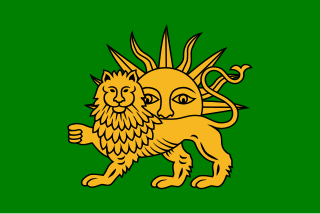
The Safavid dynasty was one of Iran's most significant ruling dynasties reigning from 1501 to 1736. Their rule is often considered the beginning of modern Iranian history, as well as one of the gunpowder empires. The Safavid Shāh Ismā'īl I established the Twelver denomination of Shīʿa Islam as the official religion of the Persian Empire, marking one of the most important turning points in the history of Islam. The Safavid dynasty had its origin in the Safavid order of Sufism, which was established in the city of Ardabil in the Iranian Azerbaijan region. It was an Iranian dynasty of Kurdish origin, but during their rule they intermarried with Turkoman, Georgian, Circassian, and Pontic Greek dignitaries, nevertheless, for practical purposes, they were Turkish-speaking and Turkified. From their base in Ardabil, the Safavids established control over parts of Greater Iran and reasserted the Iranian identity of the region, thus becoming the first native dynasty since the Sasanian Empire to establish a national state officially known as Iran.

Ismail I was the founder and first shah of Safavid Iran, ruling from 1501 until his death in 1524. His reign is often considered the beginning of modern Iranian history, as well as one of the gunpowder empires. The rule of Ismail I is one of the most vital in the history of Iran. Before his accession in 1501, Iran, since its conquest by the Arabs eight-and-a-half centuries earlier, had not existed as a unified country under native Iranian rule. Although many Iranian dynasties rose to power amidst this whole period, it was only under the Buyids that a vast part of Iran properly returned to Iranian rule (945–1055).

The Battle of Chaldiran took place on 23 August 1514 and ended with a decisive victory for the Ottoman Empire over the Safavid Empire. As a result, the Ottomans annexed Eastern Anatolia and northern Iraq from Safavid Iran. It marked the first Ottoman expansion into Eastern Anatolia, and the halt of the Safavid expansion to the west. The Battle of Chaldiran was just the beginning of 41 years of destructive war, which only ended in 1555 with the Treaty of Amasya. Though Mesopotamia and Eastern Anatolia were eventually reconquered by the Safavids under the reign of Shah Abbas the Great, they would be permanently ceded to the Ottomans by the 1639 Treaty of Zuhab.

Tahmasp II was the penultimate Safavid shah of Iran, ruling from 1722 to 1732.

Vakhtang VI, also known as Vakhtang the Scholar, Vakhtang the Lawgiver and Ḥosaynqolī Khan, was a Georgian monarch (mepe) of the royal Bagrationi dynasty. He ruled the East Georgian Kingdom of Kartli as a vassal of Safavid Persia from 1716 to 1724. One of the most important and extraordinary statesman of early 18th-century Georgia, he is known as a notable legislator, scholar, critic, translator and poet. His reign was eventually terminated by the Ottoman invasion following the disintegration of Safavid Persia, which forced Vakhtang into exile in the Russian Empire. Vakhtang was unable to get the tsar's support for his kingdom and instead had to permanently stay with his northern neighbors for his own safety. On his way to a diplomatic mission sanctioned by Empress Anna, he fell ill and died in southern Russia in 1737, never reaching Georgia.

George XI, known as Gurgin Khan in Iran, was a Georgian monarch (mepe) who ruled the Kingdom of Kartli as a Safavid Persian subject from 1676 to 1688 and again from 1703 to 1709. He is best known for his struggle against the Safavids which dominated his weakened kingdom and later as a Safavid commander-in-chief in what is now Afghanistan. Being an Eastern Orthodox Christian, he converted to Shia Islam prior to his appointment as governor of Kandahar.

The Hotak dynasty was an Afghan monarchy founded by Ghilji Pashtuns that briefly ruled portions of Iran and Afghanistan during the 1720s. It was established in April 1709 by Mirwais Hotak, who led a successful rebellion against the declining Persian Safavid empire in the region of Loy Kandahar in what is now southern Afghanistan.

The Treaty of Constantinople, also known as the Peace of Istanbul or the Treaty of Ferhad Pasha, was a treaty between the Ottoman Empire and the Safavid Empire ending the Ottoman–Safavid War of 1578–1590. It was signed on 21 March 1590 in Constantinople. The war started when the Ottomans, then ruled by Murad III, invaded the Safavid possessions in Georgia, during a period of Safavid weakness. With the empire beleaguered on numerous fronts and its domestic control plagued by civil wars and court intrigues, the new Safavid king Abbas I, who had been placed on the throne in 1588, opted for unconditional peace, which led to the treaty. The treaty put an end to 12 years of hostilities between the two arch rivals. While both the war and the treaty were a success for the Ottomans, and severely disadvantageous for the Safavids, the new status quo proved to be short lived, as in the next bout of hostilities, several years later, all Safavid losses were recovered.
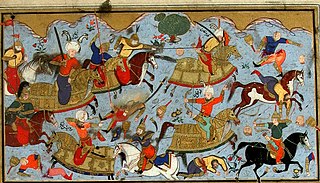
The Battle of Çıldır was fought in 1578 during the Ottoman–Safavid War (1578–1590).

The Ottoman–Hotaki War of 1726–1727 was a conflict fought between the Ottoman Empire and the Hotak dynasty, over control of all western and northwestern parts of Iran.
Rostom or Rustam Khan was a Georgian prince, member of the Bagratid House of Mukhrani of Kartli, and a general in the service of the Safavid dynasty of Iran. He was killed by the Afghan rebels at the climactic battle of Gulnabad.
The siege of Isfahan was a six-month-long siege of Isfahan, the capital of the Safavid dynasty of Iran, by the Hotaki-led Afghan army. It lasted from March to October 1722 and resulted in the city's fall and the beginning of the end of the Safavid dynasty.
The military of Safavid Iran covers the military history of Safavid Iran from 1501 to 1736.
Peter the Great's capture of Rasht, occurred between December 1722 and late March 1723 amidst the successful spree of campaigns of Peter the Great during the Russo-Persian War (1722-1723). The capture of Rasht brought the Caspian Sea town alongside the rest of Gilan into Russian possession for a decade, until the Treaty of Resht of 1732, when they would be returned.
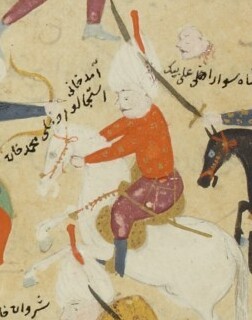
Mohammad Khan Ustajlu was an Iranian military commander and official from the Turkoman Ustajlu tribe, who served during the reign of Safavid Shah Ismail I. He played a pivotal role in Ismail I's conquests and expansion in Asia Minor and Mesopotamia, and functioned as governor of the Diyarbakr Province from 1506 to 1514. Mohammad Khan was killed while serving as a commander at the Battle of Chaldiran.
Étienne Padery was an Ottoman-born Greek, who served as a translator to the French embassy in Constantinople, and later as a French consul to the Safavid Empire.
Jacques Rousseau was a Genevan watchmaker. He was sent on a diplomatic mission to Isfahan in Persia by Louis XIV of France in 1708. There he became jeweler to Shah Husayn of Persia at around the same time as his first cousin Isaac Rousseau was jeweler-clockmaker to the Ottoman Sultan Ahmed III in Constantinople (1705-1711). Jacques died in Isfahan, where his tombstone is in the Christian (Armenian) Cemetery.
António de Jesus was a Portuguese figure who flourished in late 17th and early 18th century Safavid Iran. Originally an Augustinian friar and missionary, he converted to Shia Islam during the early reign of Shah (King) Sultan Husayn and took the name Aliqoli Jadid-ol-Eslam. He subsequently became an apologist of Shi'ism as well as a major polemicist against Christianity, Sufism, Judaism, Sunnism, philosophers and antinomians. In addition, after conversion, he served as an official interpreter at the royal court in Isfahan. Aliqoli Jadid-ol-Eslam was one of the late 17th century converts in Iran who "helped reaffirm the Majlesi brand of conservatism".

The Guarded Domains of Iran, commonly referred to as Afsharid Iran or the Afsharid Empire, was an Iranian empire established by the Turkoman Afshar tribe in Iran's north-eastern province of Khorasan, establishing the Afsharid dynasty that would rule over Iran during the mid-eighteenth century. The dynasty's founder, Nader Shah, was a successful military commander who deposed the last member of the Safavid dynasty in 1736, and proclaimed himself Shah.

The royal harem of the Safavid ruler played an important role in the history of Safavid Persia (1501-1736).
References
- 1 2 3 Floor & Herzig 2015, p. 319.
- ↑ Fisher, Jackson & Lockhart 1986, p. 584.