Related Research Articles
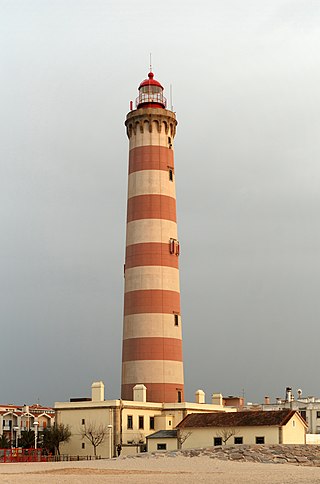
A lighthouse is a tower, building, or other type of physical structure designed to emit light from a system of lamps and lenses and to serve as a beacon for navigational aid, for maritime pilots at sea or on inland waterways.
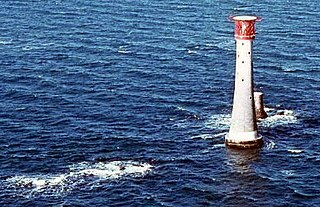
The Eddystone Lighthouse is a lighthouse that is located on the dangerous Eddystone Rocks, 9 statute miles (14 km) south of Rame Head in Cornwall, England. The rocks are submerged below the surface of the sea and are composed of Precambrian gneiss.

A kerosene lamp is a type of lighting device that uses kerosene as a fuel. Kerosene lamps have a wick or mantle as light source, protected by a glass chimney or globe; lamps may be used on a table, or hand-held lanterns may be used for portable lighting. Like oil lamps, they are useful for lighting without electricity, such as in regions without rural electrification, in electrified areas during power outages, at campsites, and on boats. There are three types of kerosene lamp: flat-wick, central-draft, and mantle lamp. Kerosene lanterns meant for portable use have a flat wick and are made in dead-flame, hot-blast, and cold-blast variants.

A lantern is an often portable source of lighting, typically featuring a protective enclosure for the light source – historically usually a candle or a wick in oil, and often a battery-powered light in modern times – to make it easier to carry and hang up, and make it more reliable outdoors or in drafty interiors. Lanterns may also be used for signaling, as torches, or as general light-sources outdoors.

Loy Krathong is a Thai festival celebrated annually throughout Thailand and in nearby countries with significant South Western Tai cultures. The name could be translated as "to float ritual vessel or lamp," and comes from the tradition of making krathong or buoyant, decorated baskets, which are then floated on a river. Many Thais use the krathong to thank the Goddess of Water, Phra Mae Khongkha or to worship the Buddha's hair pagoda in heaven. This festival traces its origin back to India.

The Peugeot 404 is a large family car produced by French automobile manufacturer Peugeot from 1960 to 1975. A truck body style variant was marketed until 1988. Styled by Pininfarina, the 404 was offered initially as a saloon, estate, and pickup. A convertible was added in 1962, and a coupé in 1963. The 404 was fitted with a 1.6 litre petrol engine, with either a Solex carburetor or Kugelfischer mechanical fuel injection or a 1.9 litre diesel engine available as options. Introduced at the Paris Motor Show as an option was the inclusion of a 3-speed ZF automatic transmission, similar to the unit already offered on certain BMW models, as an alternative to the standard column-mounted manual unit.

The Macquarie Lighthouse, also known as South Head Upper Light, is the first, and is the longest serving, lighthouse site in Australia. It is located on Dunbar Head, on Old South Head Road, Vaucluse in the Municipality of Woollahra local government area of New South Wales, Australia. The lighthouse is situated approximately 2 kilometres (1 mi) south of South Head near the entrance to Sydney Harbour. There has been a navigational aid in this vicinity since 1791 and a lighthouse near the present site since 1818. The current heritage-listed lighthouse was completed in 1883. The lighthouse and associated buildings were designed by James Barnet and built from 1881 to 1883.
North Foreland is a chalk headland on the Kent coast of southeast England, specifically in Broadstairs.

Fred M. Kaplan is an American author and journalist. His weekly "War Stories" column for Slate magazine covers international relations and U.S. foreign policy.

A Fresnel lantern is a common lantern used in theatre that employs a Fresnel lens to wash light over an area of the stage. The lens produces a wider, soft-edged beam of light, which is commonly used for back light and top light.

Brant Point Light is a lighthouse located on Nantucket Island. The station was established in 1746, automated in 1965, and is still in operation. The current tower was added to the National Register of Historic Places on October 28, 1987; it has the distinction of being the tenth light on the point, in addition to several range lights. Four of the others burned or blew down, two were condemned, two were unsatisfactory, and the remaining one stands unused.

The St. Simons Island Light is a lighthouse on the southern tip of St. Simons Island, Georgia, United States. It guides ships into St. Simons Sound and warns of the many sandbars in the area.
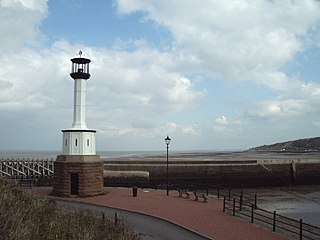
Maryport Lighthouse is a small lighthouse located in Maryport, Cumbria, England, formerly run by England's general lighthouse authority, Trinity House. It is a Grade II listed building.
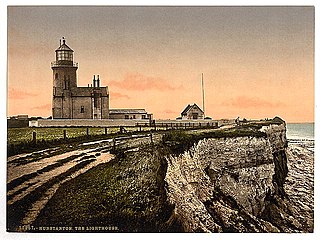
Old Hunstanton Lighthouse is a former lighthouse located in Old Hunstanton in the English county of Norfolk, generally called Hunstanton Lighthouse during its operational life. It was built at the highest point available on this part of the coast, on top of Hunstanton Cliffs, and served to help guide vessels into the safe water of Lynn Deeps. Although the present lighthouse was built in 1840, there had been a lighthouse on the site since the 17th century. Prior to the establishment of the Lynn Well light vessel in 1828, Hunstanton Lighthouse provided the only visible guide to ships seeking to enter The Wash at night.

A lava lamp is a decorative lamp, invented in 1963 by British entrepreneur Edward Craven Walker, the founder of the lighting company Mathmos. It consists of a bolus of a special coloured wax mixture inside a glass vessel, the remainder of which contains clear or translucent liquid. The vessel is placed on a base containing an incandescent light bulb whose heat causes temporary reductions in the wax's density and the liquid's surface tension. As the warmed wax rises through the liquid, it cools, loses its buoyancy, and falls back to the bottom of the vessel in a cycle that is visually suggestive of pāhoehoe lava, hence the name. The lamps are designed in a variety of styles and colours.

Wolf Rock Lighthouse is on the Wolf Rock, a single rock located 18 nautical miles east of St Mary's, Isles of Scilly and 8 nautical miles southwest of Land's End, in Cornwall, England. The fissures in the rock are said to produce a howling sound in gales, hence the name.

Marshall Silas Cornwell was a 19th-century American newspaper publisher and editor, writer, and poet in the U.S. state of West Virginia. Cornwell was a younger brother of railroad and timber executive William B. Cornwell (1864–1926) and West Virginia Governor John Jacob Cornwell (1867–1953).

A projector or image projector is an optical device that projects an image onto a surface, commonly a projection screen. Most projectors create an image by shining a light through a small transparent lens, but some newer types of projectors can project the image directly, by using lasers. A virtual retinal display, or retinal projector, is a projector that projects an image directly on the retina instead of using an external projection screen.

The Point Stephens Light is a heritage-listed active lighthouse located on Point Stephens, a point on an unnamed headland at the east of Fingal Bay, 4.25 km (2.64 mi) south of the entrance of Port Stephens, New South Wales, Australia. The light serves to assist vessels entering Port Stephens. It is considered an endangered lighthouse due to remote location and old age.

A sailor sandwich is a hot meat and cheese sandwich popular at Jewish delis in Richmond, Virginia, area restaurants. Its core ingredients are hot pastrami, grilled knackwurst, melted Swiss cheese and hot mustard on rye bread.
References
- Sources
- Cornwell, Simon. "Phosware Booklet: P.103/A, P.107/A, P.107/A, P.108/A". SimonCornwell. Simon Cornwell. Retrieved 14 November 2018.
