
Vincent Willem van Gogh was a Dutch Post-Impressionist painter who posthumously became one of the most famous and influential figures in Western art history. In a decade, he created about 2,100 artworks, including around 860 oil paintings, most of which date from the last two years of his life. They include landscapes, still lifes, portraits, and self-portraits, and are characterised by bold colours and dramatic, impulsive and expressive brushwork that contributed to the foundations of modern art. He was not commercially successful and, struggling with severe depression and poverty, committed suicide at the age of 37.

The Ny Carlsberg Glyptotek, commonly known simply as Glyptoteket, is an art museum in Copenhagen, Denmark. The collection represents the private art collection of Carl Jacobsen (1842–1914), the son of the founder of the Carlsberg Breweries.

The Starry Night is an oil-on-canvas painting by the Dutch Post-Impressionist painter Vincent van Gogh. Painted in June 1889, it depicts the view from the east-facing window of his asylum room at Saint-Rémy-de-Provence, just before sunrise, with the addition of an imaginary village. It has been in the permanent collection of the Museum of Modern Art in New York City since 1941, acquired through the Lillie P. Bliss Bequest. Widely regarded as Van Gogh's magnum opus, The Starry Night is one of the most recognizable paintings in Western art.

Charles Angrand was a French artist who gained renown for his Neo-Impressionist paintings and drawings. He was an important member of the Parisian avant-garde art scene in the late 1880s and early 1890s.

The Church at Auvers is an oil painting created by Dutch post-impressionist artist Vincent van Gogh in June 1890 which now hangs in the Musée d'Orsay in Paris, France.
Vincent van Gogh lived during the Impressionist era. With the development of photography, painters and artists turned to conveying the feeling and ideas behind people, places, and things rather than trying to imitate their physical forms. Impressionist artists did this by emphasizing certain hues, using vigorous brushstrokes, and paying attention to highlighting. Vincent van Gogh implemented this ideology to pursue his goal of depicting his own feelings toward and involvement with his subjects. Van Gogh's portraiture focuses on color and brushstrokes to demonstrate their inner qualities and van Gogh's own relationship with them.

Farms near Auvers or Thatched Cottages by a Hill is an oil painting by Vincent van Gogh that he painted in July 1890 when he lived in Auvers-sur-Oise, France. The painting is an example of the double-square canvases that he employed in his last landscapes.

Vincent van Gogh made many copies of other people's work between 1887 and early 1890, which can be considered appropriation art. While at Saint-Paul asylum in Saint-Rémy-de-Provence, France, where Van Gogh admitted himself, he strived to have subjects during the cold winter months. Seeking to be reinvigorated artistically, Van Gogh did more than 30 copies of works by some of his favorite artists. About twenty-one of the works were copies after, or inspired by, Jean-François Millet. Rather than replicate, Van Gogh sought to translate the subjects and composition through his perspective, color, and technique. Spiritual meaning and emotional comfort were expressed through symbolism and color. His brother Theo van Gogh would call the pieces in the series some of his best work.
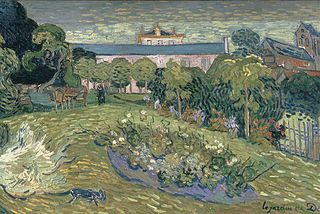
Daubigny's Garden, painted three times by Vincent van Gogh, depicts the enclosed garden of Charles-François Daubigny, a painter whom Van Gogh admired throughout his life.

Still Life: Vase with Pink Roses was painted in 1890 by Vincent van Gogh in Saint-Rémy. At the time the work was painted Van Gogh was readying himself to leave the Saint-Rémy asylum for the quiet town of Auvers-sur-Oise outside of Paris. This and the similarly-dated Pink Roses reflect the optimism Van Gogh felt at that time about his future, both in his choice of flowers as a subject and the colors used. The painting is owned by the National Gallery of Art of Washington, D.C.

Vincent van Gogh painted at least 15 paintings of olive trees, mostly in Saint-Rémy-de-Provence in 1889. At his own request, he lived at an asylum there from May 1889 through May 1890 painting the gardens of the asylum and, when he had permission to venture outside its walls, nearby olive trees, cypresses and wheat fields.

Wheat Fields is a series of dozens of paintings by Dutch Post-Impressionist artist Vincent van Gogh, borne out of his religious studies and sermons, connection to nature, appreciation of manual laborers and desire to provide a means of offering comfort to others. The wheat field works demonstrate his progression as an artist from the drab Wheat Sheaves made in 1885 in the Netherlands to the colorful and dramatic 1888–1890 paintings from Arles, Saint-Rémy and Auvers-sur-Oise in rural France.
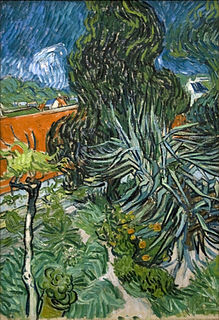
Dr. Gachet's Garden in Auvers and Marguerite Gachet in the Garden were both painted in 1890 by Vincent van Gogh in the gardens of his homeopathic physician, Dr. Paul Gachet. Both paintings reside at the Musée d'Orsay.

Saint-Paul Asylum, Saint-Rémy is a collection of paintings that Vincent van Gogh made when he was a self-admitted patient at the Saint-Paul asylum in Saint-Rémy-de-Provence, since renamed the Clinique Van Gogh, from May 1889 until May 1890. During much of his stay there he was confined to the grounds of the asylum, and he made paintings of the garden, the enclosed wheat field that he could see outside his room and a few portraits of individuals at the asylum. During his stay at Saint-Paul asylum, Van Gogh experienced periods of illness when he could not paint. When he was able to resume, painting provided solace and meaning for him. Nature seemed especially meaningful to him, trees, the landscape, even caterpillars as representative of the opportunity for transformation and budding flowers symbolizing the cycle of life. One of the more recognizable works of this period is The Irises. Works of the interior of the hospital convey the isolation and sadness that he felt. From the window of his cell he saw an enclosed wheat field, the subject of many paintings made from his room. He was able to make but a few portraits while at Saint-Paul.

Van Gogh's family in his art refers to works that Vincent van Gogh made for or about Van Gogh family members. In 1881, Vincent drew a portrait of his grandfather, also named Vincent van Gogh, and his sister Wil. While living in Nuenen, Vincent memorialized his father in Still Life with Bible following his death in 1885. There he also made many paintings and drawings in 1884 and 1885 of his parents' vicarage, its garden and the church. At the height of his career in Arles he made Portrait of the Artist's Mother, Memory of the Garden at Etten of his mother and sister and Novel Reader, which is thought to be of his sister, Wil.
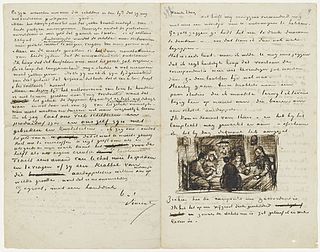
The Letters of Vincent van Gogh refers to a collection of 903 surviving letters written (820) or received (83) by Vincent van Gogh. More than 650 of these were from Vincent to his brother Theo. The collection also includes letters van Gogh wrote to his sister Wil and other relatives, as well as between artists such as Paul Gauguin, Anthon van Rappard, and Émile Bernard.

Tree Roots is an oil painting by Vincent van Gogh that he painted in July 1890 when he lived in Auvers-sur-Oise, France. The painting is an example of the double-square canvases that he employed in his last landscapes.

Landscape with a Carriage and a Train is an oil painting by Vincent van Gogh that he painted in June 1890 when he lived in Auvers-sur-Oise, France.
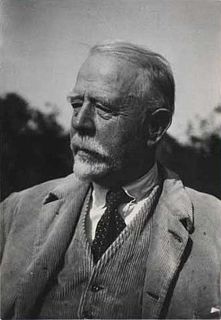
Johan Gudmann Rohde was a Danish painter, lithographer and designer. He was the principal founder of Den Frie Udstilling, established in 1891 to allow artists to exhibit works which did not fall within the Academy's selection criteria.

