Related Research Articles

Rendering or image synthesis is the process of generating a photorealistic or non-photorealistic image from a 2D or 3D model by means of a computer program. The resulting image is referred to as a rendering. Multiple models can be defined in a scene file containing objects in a strictly defined language or data structure. The scene file contains geometry, viewpoint, textures, lighting, and shading information describing the virtual scene. The data contained in the scene file is then passed to a rendering program to be processed and output to a digital image or raster graphics image file. The term "rendering" is analogous to the concept of an artist's impression of a scene. The term "rendering" is also used to describe the process of calculating effects in a video editing program to produce the final video output.

Computer animation is the process used for digitally generating moving images. The more general term computer-generated imagery (CGI) encompasses both still images and moving images, while computer animation only refers to moving images. Modern computer animation usually uses 3D computer graphics.
Collaborative software or groupware is application software designed to help people working on a common task to attain their goals. One of the earliest definitions of groupware is "intentional group processes plus software to support them."

VRML is a standard file format for representing 3-dimensional (3D) interactive vector graphics, designed particularly with the World Wide Web in mind. It has been superseded by X3D.

Digital art refers to any artistic work or practice that uses digital technology as part of the creative or presentation process. It can also refer to computational art that uses and engages with digital media.

A cave automatic virtual environment is an immersive virtual reality environment where projectors are directed to between three and six of the walls of a room-sized cube. The name is also a reference to the allegory of the Cave in Plato's Republic in which a philosopher contemplates perception, reality, and illusion.
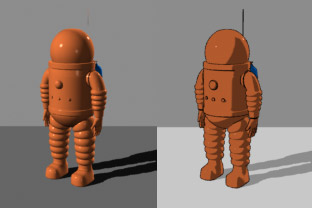
Non-photorealistic rendering (NPR) is an area of computer graphics that focuses on enabling a wide variety of expressive styles for digital art, in contrast to traditional computer graphics, which focuses on photorealism. NPR is inspired by other artistic modes such as painting, drawing, technical illustration, and animated cartoons. NPR has appeared in movies and video games in the form of cel-shaded animation as well as in scientific visualization, architectural illustration and experimental animation.

Gesture recognition is an area of research and development in computer science and language technology concerned with the recognition and interpretation of human gestures. A subdiscipline of computer vision, it employs mathematical algorithms to interpret gestures.

High-dynamic-range rendering, also known as high-dynamic-range lighting, is the rendering of computer graphics scenes by using lighting calculations done in high dynamic range (HDR). This allows preservation of details that may be lost due to limiting contrast ratios. Video games and computer-generated movies and special effects benefit from this as it creates more realistic scenes than with more simplistic lighting models.

In computing, procedural generation is a method of creating data algorithmically as opposed to manually, typically through a combination of human-generated content and algorithms coupled with computer-generated randomness and processing power. In computer graphics, it is commonly used to create textures and 3D models. In video games, it is used to automatically create large amounts of content in a game. Depending on the implementation, advantages of procedural generation can include smaller file sizes, larger amounts of content, and randomness for less predictable gameplay. Procedural generation is a branch of media synthesis.
Virtual cinematography is the set of cinematographic techniques performed in a computer graphics environment. It includes a wide variety of subjects like photographing real objects, often with stereo or multi-camera setup, for the purpose of recreating them as three-dimensional objects and algorithms for the automated creation of real and simulated camera angles. Virtual cinematography can be used to shoot scenes from otherwise impossible camera angles, create the photography of animated films, and manipulate the appearance of computer-generated effects.
Software visualization or software visualisation refers to the visualization of information of and related to software systems—either the architecture of its source code or metrics of their runtime behavior—and their development process by means of static, interactive or animated 2-D or 3-D visual representations of their structure, execution, behavior, and evolution.

The C4 Engine is a proprietary computer game engine developed by Terathon Software that is used to create 3D games and other types of interactive virtual simulations for PlayStation 5, PlayStation 4, PlayStation 3, Windows, Mac OS X, Linux, and iOS.

Fluid animation refers to computer graphics techniques for generating realistic animations of fluids such as water and smoke. Fluid animations are typically focused on emulating the qualitative visual behavior of a fluid, with less emphasis placed on rigorously correct physical results, although they often still rely on approximate solutions to the Euler equations or Navier–Stokes equations that govern real fluid physics. Fluid animation can be performed with different levels of complexity, ranging from time-consuming, high-quality animations for films, or visual effects, to simple and fast animations for real-time animations like computer games.

In virtual reality (VR), immersion is the perception of being physically present in a non-physical world. The perception is created by surrounding the user of the VR system in images, sound or other stimuli that provide an engrossing total environment.
A projection augmented model is an element sometimes employed in virtual reality systems. It consists of a physical three-dimensional model onto which a computer image is projected to create a realistic looking object. Importantly, the physical model is the same geometric shape as the object that the PA model depicts.
Reverse engineering is a process or method through which one attempts to understand through deductive reasoning how a previously made device, process, system, or piece of software accomplishes a task with very little insight into exactly how it does so. Depending on the system under consideration and the technologies employed, the knowledge gained during reverse engineering can help with repurposing obsolete objects, doing security analysis, or learning how something works.

C3D Toolkit is a proprietary cross-platform geometric modeling kit software developed by Russian by C3D Labs. It's written in C++. It can be licensed by other companies for use in their 3D computer graphics software products. The most widely known software in which C3D Toolkit is typically used are computer aided design (CAD), computer-aided manufacturing (CAM), and computer-aided engineering (CAE) systems.
Based on Id Software's open stance towards game modifications, their Quake series became a popular subject for player mods beginning with Quake in 1996. Spurred by user-created hacked content on their previous games and the company's desire to encourage the hacker ethic, Id included dedicated modification tools into Quake, including the QuakeC programming language and a level editor. As a game that popularized online first-person shooter multiplayer, early games were team- and strategy-based and led to prominent mods like Team Fortress, whose developers were later hired by Valve to create a dedicated version for the company. Id's openness and modding tools led to a "Quake movie" community, which altered gameplay data to add camera angles in post-production, a practice that became known as machinima.
Computer-aided design is the use of computers to aid in the creation, modification, analysis, or optimization of a design. Designers have used computers for calculations since their invention. CAD software was popularized and innovated in the 1960s, although various developments were made between the mid-1940s and 1950s. Digital computers were used in power system analysis or optimization as early as proto-"Whirlwind" in 1949. Circuit design theory or power network methodology was algebraic, symbolic, and often vector-based.
References
- ↑ Richens, Paul (1999), Augenbroe, Godfried; Eastman, Charles (eds.), "The Piranesi system for interactive rendering", Computers in Building: Proceedings of the CAADfutures’99 Conference. Proceedings of the Eighth International Conference on Computer Aided Architectural Design Futures held at Georgia Institute of Technology, Atlanta, Georgia, USA on June 7–8, 1999, Boston, MA: Springer US, pp. 381–398, doi:10.1007/978-1-4615-5047-1_25, ISBN 978-1-4615-5047-1 , retrieved 2024-06-08
- ↑ "Piranesi - Informatix Inc". www.piranesi.co.uk. Retrieved 2024-06-08.
 | This graphics software–related article is a stub. You can help Wikipedia by expanding it. |