The terms Old Catholic Church, Old Catholics, Old-Catholic churches, or Old Catholic movement, designate "any of the groups of Western Christians who believe themselves to maintain in complete loyalty the doctrine and traditions of the undivided church but who separated from the see of Rome after the First Vatican council of 1869–70". The expression Old Catholic has been used from the 1850s by communions separated from the Roman Catholic Church over certain doctrines, primarily concerned with papal authority and infallibility. Some of these groups, especially in the Netherlands, had already existed long before the term. The Old Catholic Church is separate and distinct from Traditionalist Catholicism.
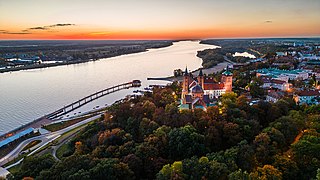
Płock is a city in central Poland, on the Vistula river, in the Masovian Voivodeship. According to the data provided by GUS on 31 December 2021, there were 116,962 inhabitants in the city. Its full ceremonial name, according to the preamble to the City Statute, is Stołeczne Książęce Miasto Płock. It is used in ceremonial documents as well as for preserving an old tradition.

Polish Americans are Americans who either have total or partial Polish ancestry, or are citizens of the Republic of Poland. There are an estimated 8.81 million self-identified Polish Americans, representing about 2.67% of the U.S. population, according to the 2021 American Community Survey conducted by the U.S. Census Bureau.

The Old Catholic Mariavite Church refers to one of two independent Christian churches, both of which can be dated from 1906 but which became distinct post 1935 as a result of doctrinal differences, and are collectively known as Mariavites. Mariavitism first emerged from the religious inspiration of Polish noblewoman and nun Feliksa Kozłowska (1862-1921) living in the Russian Partition of Poland in the late 19th-century. A young Catholic priest from a modest background, Jan Maria Michał Kowalski (1871-1942), became convinced by Kozłowska's revelations and adopted her vision as his own project by her side.

The Polish National Catholic Church is an independent Old Catholic church based in the United States and founded by Polish-Americans.
The Catholic Mariavite Church is an independent Old Catholic denomination in Poland resulting from a schism in 1935 within the Old Catholic Mariavite Church.

Feliksa Magdalena Kozłowska, known by the religious name Maria Franciszka and the epithet "Mateczka", was a Polish religious sister, Christian mystic and visionary who founded a movement of renewal in the Roman Catholic church in the Russian Partition of Poland. It was to follow the simplicity of the life of Mary, mother of Jesus. Early in the 20th century, she and this movement were excommunicated and became an autonomous church in fellowship with the Old Catholic Church of the Netherlands. In 1935 it split in two and became the Old Catholic Mariavite Church and the Catholic Mariavite Church. Both denominations were part of a single schism from the Catholic Church which declared it as heretical in 1906.

A monstrance, also known as an ostensorium, is a vessel used in Roman Catholic, Old Catholic, High Church Lutheran and Anglican churches for the display on an altar of some object of piety, such as the consecrated Eucharistic Sacramental bread (host) during Eucharistic adoration or during the Benediction of the Blessed Sacrament. A monstrance may also serve as a reliquary for the public display of relics of some saints. The word monstrance comes from the Latin word monstrare, while the word ostensorium comes from the Latin word ostendere. Either term, each expressing the concept of "showing", can refer to a vessel intended for the exposition of the Blessed Sacrament, but ostensorium has only this meaning.

The Polish Reformed Church, officially called the Evangelical Reformed Church in the Republic of Poland is a historic Calvinistic Protestant church in Poland established in the 16th century, still in existence today.

Religion in Poland is rapidly declining, although historically it had been one of the most Catholic countries in the world.
Polish Ecumenical Council founded in 1946 to promote interchurch cooperation among the minority Christian denominations in Poland. There are seven member churches: the Baptist Church, Lutheran Church, Methodist Church, Reformed Church, Mariavite Church, Old Catholic Church, and the Polish Orthodox Church. Cooperation with the Catholic Church began in 1974 when the council established a Combined Ecumenical Commission to deal with the analogous ecumenical commission of the Catholic Polish Episcopal Conference. In 1977 the council named a subcommittee for discussion of individual theological questions; by 1980 bilateral dialogs had begun among members sharing similar doctrine. Given Poland's history of religious tolerance, the restoration of religious freedom in 1989 was expected to expand the tentative ecumenical contacts achieved during the Communist era. In 2000, the Polish Catholic Church signed a declaration with the council member churches, excluding the Baptist Church, mutually recognizing baptism.

The Polish cathedral architectural style is a North American genre of Catholic church architecture found throughout the Great Lakes and Middle Atlantic regions as well as in parts of New England. These monumentally grand churches are not necessarily cathedrals, defined as seats of bishops or of their dioceses.

Jan Kowalski, later known as Maria Michał Kowalski, was a Polish Roman Catholic diocesan priest who became a schismatic religious leader and controversial innovator. Following excommunication from his church, he was consecrated as a bishop in the Old Catholic Archdiocese of Utrecht, established the Old Catholic Church of the Mariavites in Poland, rose to be its archbishop and died a martyr. He is venerated as a saint in the Catholic Mariavite Church.
Tribus circiter is Pope Pius X's 1906 encyclical, to the archbishops of Warsaw and bishops of Płock and Lublin, about the Mariavites or Mystic Priests of Poland, an association of secular priests that the document describes as "a kind of pseudo-monastic society". The association of secular priests and the Mariavite movement was founded by Feliksa Kozłowska and later broke away from the Catholic Church to become the Mariavite Church.
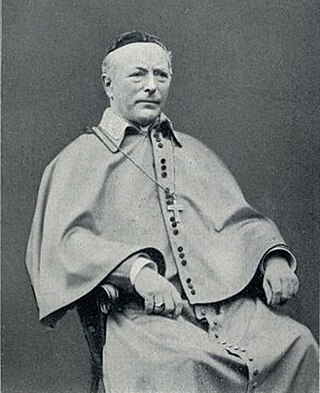
Gerardus Gul served as the seventeenth Archbishop of Utrecht from 1892 to 1920. He is known for his role in assisting the persons who would later found the Polish National Catholic Church in the United States, as well as for consecrating Arnold Harris Mathew, the founder and first bishop of the Old Catholic Church in Great Britain.
Polish Old Catholicism is the form of Old Catholicism which is based on Polish religious and cultural traditions.

Antonina Maria Izabela Wiłucka-Kowalska was a Polish religious leader, who served as the first archpriestess of the Catholic Mariavite Church. Wiłucka-Kowalska was the first woman to receive the sacrament of holy orders in Poland and consecration as a bishop.
Mariavite Sisters may refer to:

Roman Maria Jakub Próchniewski was the Prime Bishop of the Mariavite Old Catholic Church from 1945 to 1953.

Julian Pękala was the Primate Bishop of the Polish Catholic Church from 1951 to 1959 as president of the episcopal college, and Primate Bishop from 1965 to 1975. From 1951 to 1959, he was the parish priest of the Cathedral Parish of the Holy Spirit in Warsaw. From March 23, 1961, to October 29, 1965, he served as the bishop ordinary of the Wrocław diocese of the Polish Catholic Church.
