
Look up Pommern in Wiktionary, the free dictionary.
Pommern is the German language name for Pomerania, a historical region divided between Germany and Poland.
Contents
Pommern may also refer to:
Pommern is the German language name for Pomerania, a historical region divided between Germany and Poland.
Pommern may also refer to:


Pomerania is a historical region on the southern shore of the Baltic Sea in Central Europe, split between Poland and Germany. The central and eastern part belongs to the West Pomeranian, Pomeranian and Kuyavian-Pomeranian voivodeships of Poland, while the western part belongs to the German states of Mecklenburg-Western Pomerania and Brandenburg.

Stralsund, officially the Hanseatic City of Stralsund, is the fifth-largest city in the northeastern German federal state of Mecklenburg-Western Pomerania after Rostock, Schwerin, Neubrandenburg and Greifswald, and the second-largest city in the Pomeranian part of the state. It is located on the southern coast of the Strelasund, a sound of the Baltic Sea separating the island of Rügen from the Pomeranian mainland.

Eric of Pomerania ruled over the Kalmar Union from 1396 until 1439. He was initially co-ruler with his great-aunt Margaret I until her death in 1412. Eric is known as Eric III as King of Norway (1389–1442), Eric VII as King of Denmark (1396–1439) and has been called Eric XIII as King of Sweden. Eric was ultimately deposed from all three kingdoms of the union, but in 1449 he inherited one of the partitions of the Duchy of Pomerania and ruled it as duke until his death in 1459. His epithet of Pomerania was a pejorative intended to insinuate that he did not belong in Scandinavia.

Swedish Pomerania was a dominion under the Swedish Crown from 1630 to 1815 on what is now the Baltic coast of Germany and Poland. Following the Polish War and the Thirty Years' War, Sweden held extensive control over the lands on the southern Baltic coast, including Pomerania and parts of Livonia and Prussia.
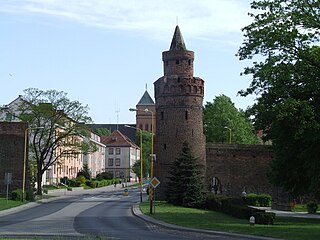
Pyrzyce is a town in Pomerania, north-western Poland. As of 2007, it had 13,331 inhabitants. It is the capital of the Pyrzyce County in West Pomeranian Voivodeship.

Darłowo, is a seaside town in the West Pomeranian Region, at the south coast of the Baltic Sea, north-western Poland, with 13,324 inhabitants as of December 2021. It is located in Sławno County in West Pomeranian Voivodeship on the Slovincian Coast.

The history of Pomerania starts shortly before 1000 AD, with ongoing conquests by newly arrived Polan rulers. Before that, the area was recorded nearly 2000 years ago as Germania, and in modern times Pomerania has been split between Germany and Poland. Its name comes from the Old Polish po more, which means "(land) at the sea".

Gartz is a town in the Uckermark district in Brandenburg, Germany. It is located on the West bank of the Oder River, on the border with Poland, about 20 km south of Szczecin, Poland. It is located within the historic region of Western Pomerania.

Demmin is a town in the Mecklenburgische Seenplatte district, Mecklenburg-Western Pomerania, in north-eastern Germany. It was the capital of the former district of Demmin.
Starogard, Starogród, or Stargard means old fort or old city in Polish, Polabian and Pomeranian languages, and gard is Old Slavic, Old Germanic, Old Baltic, and Old Finnic for castle or fortification. Places with those names include:

Farther Pomerania, Hinder Pomerania, Rear Pomerania or Eastern Pomerania, is a subregion of the historic region of Pomerania in north-western Poland, mostly within the West Pomeranian Voivodeship, while its easternmost parts are within the Pomeranian Voivodeship.
Pomeranian is an adjective referring to the historical region of Pomerania, which is divided between Poland and Germany.

Usedom is a town on Usedom Island, in the Vorpommern-Greifswald district in Mecklenburg-Vorpommern, in north-eastern Germany, close to the border with Poland. It is the seat of the Amt Usedom-Süd, to which 14 other communities also belong.

The Province of Pomerania was a province of Prussia from 1815 to 1945. Pomerania was established as a province of the Kingdom of Prussia in 1815, an expansion of the older Brandenburg-Prussia province of Pomerania, and then became part of the German Empire in 1871. From 1918, Pomerania was a province of the Free State of Prussia until it was dissolved following World War II by decree of the Allied Control Council with the de jure abolition of Prussia on 25 February 1947, and its territory divided between Poland and Allied-occupied Germany. The city of Stettin was the provincial capital.

Gützkow is a town in the District of Vorpommern-Greifswald in Mecklenburg-Vorpommern, in north-eastern Germany. It is situated some 15 kilometres (9.3 mi) south of Greifswald, on the north bank of the River Peene. Gützkow was the central town of the medieval County of Gützkow.

The House of Griffin or Griffin dynasty was a dynasty ruling the Duchy of Pomerania from the 12th century until 1637. The name "Griffins" was used by the dynasty after the 15th century and had been taken from the ducal coat of arms. Duke Wartislaw I was the first historical ruler of the Duchy of Pomerania and the founder of the Griffin dynasty. The most prominent Griffin was Eric of Pomerania, who became king of the Kalmar Union in 1397, thus ruling Denmark, Sweden and Norway. The last Griffin duke of Pomerania was Bogislaw XIV, who died during the Thirty Years' War, which led to the division of Pomerania between Brandenburg-Prussia, Sweden and Poland. Duchess Anna von Croy, daughter of Duke Bogislaw XIII and the last member of the House of Griffin, died in 1660.
Western Pomerania is an area on the Baltic coast of Poland and Germany.
History of Pomerania (1806–1933) covers the history of Pomerania from the early 19th century until the rise of Nazi Germany.
History of Pomerania (1945–present) covers the history of Pomerania during World War II aftermath, the Communist and since 1989 Democratic era.

Historical Western Pomerania, also called Cispomerania,Fore Pomerania, Front Pomerania or Hither Pomerania, is the western extremity of the historic region of Pomerania, located mostly in north-eastern Germany, with a small portion in north-western Poland, at the southern coast of the Baltic Sea.