
Pomerania is a historical region on the southern shore of the Baltic Sea in Central Europe, split between Poland and Germany. The central and eastern part belongs to the West Pomeranian, Pomeranian and Kuyavian-Pomeranian voivodeships of Poland, while the western part belongs to the German states of Mecklenburg-Western Pomerania and Brandenburg.

Masovian Voivodeship or Mazowieckie Province or Mazowieckie Voivodeship or Mazovian Voivodeship or Mazovian Province, etc. is a voivodeship (province) in east-central Poland, containing Poland's capital Warsaw.

Kuyavian–Pomeranian Voivodeship is one of Poland's 16 voivodeships (provinces).

Pomerelia, also known as Eastern Pomerania, Vistula Pomerania, and also before World War II as Polish Pomerania, is a historical sub-region of Pomerania on the southern shore of the Baltic Sea in northern Poland.
The term Middle or Central Pomerania can refer to two distinct areas, depending on whether it is used as a translation of the corresponding German or Polish terms Mittelpommern or Pomorze Środkowe, respectively.
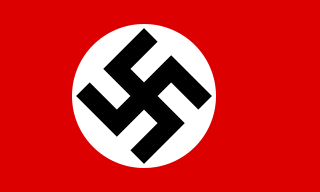
Reichsgau Danzig-West Prussia was an administrative division of Nazi Germany created on 8 October 1939 from annexed territory of the Free City of Danzig, the Greater Pomeranian Voivodship, and the Regierungsbezirk West Prussia of Gau East Prussia.
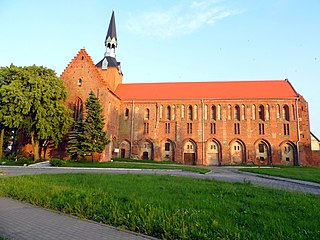
Kołbacz is a village in the administrative district of Gmina Stare Czarnowo, within Gryfino County, West Pomeranian Voivodeship, in north-western Poland. It lies approximately 4 kilometres (2 mi) north-east of Stare Czarnowo, 23 km (14 mi) east of Gryfino, and 20 km (12 mi) south-east of the regional capital Szczecin. It is located on the Pyrzyce-Stargard Plains, on the west bank of the river Płonia, and has roughly 1,400 inhabitants.

Gdańsk Pomerania is the main geographical region within Pomerelia in northern Poland, covering the bulk of Pomeranian Voivodeship. In contrast to Pomerelia and its synonyms, the term does not cover the historical areas of Chełmno Land and Michałów Land, sometimes with the addition of Lubawa Land.

Farther Pomerania, Hinder Pomerania, Rear Pomerania or Eastern Pomerania, is a subregion of the historic region of Pomerania in north-western Poland, mostly within the West Pomeranian Voivodeship, while its easternmost parts are within the Pomeranian Voivodeship.
Trzciniec may refer to the following places:

The Samborides or House of Sobiesław were a ruling dynasty in the historic region of Pomerelia. They were first documented about 1155 as governors (princeps) in the Eastern Pomeranian lands serving the royal Piast dynasty of Poland, and from 1227 ruled as autonomous princes until 1294, at which time the dynasty died out. The subsequent war for succession between the Polish Piast dynasty, the Imperial Margraviate of Brandenburg and the State of the Teutonic Order resulted in the Teutonic takeover of Gdańsk (Danzig) in 1308.

The Pomeranian Voivodeship was a unit of administrative division and local government in the Kingdom of Poland and the Polish–Lithuanian Commonwealth from 1454/1466 until the First partition of Poland in 1772. From 1613 the capital was at Skarszewy.
Gmina Opinogóra Górna is a rural gmina in Ciechanów County, Masovian Voivodeship, in east-central Poland. Its seat is the village of Opinogóra Górna, which lies approximately 7 kilometres (4 mi) north-east of Ciechanów and 79 km (49 mi) north of Warsaw.

Polish regions are regions that are in present-day Poland but are not identified in its administrative division.
Pomorze, is a village in the administrative district of Gmina Giby, within Sejny County, Podlaskie Voivodeship, in north-eastern Poland, close to the borders with Belarus and Lithuania.
Pomorze is a village in the administrative district of Gmina Opinogóra Górna, within Ciechanów County, Masovian Voivodeship, in east-central Poland. It lies approximately 4 kilometres (2 mi) south of Opinogóra Górna, 5 km (3 mi) east of Ciechanów, and 75 km (47 mi) north of Warsaw.

Historical Western Pomerania, also called Cispomerania,Fore Pomerania, Front Pomerania or Hither Pomerania, is the western extremity of the historic region of Pomerania, located mostly in north-eastern Germany, with a small portion in north-western Poland, at the southern coast of the Baltic Sea.

The District of Western Pomerania, also designated as the 3rd District, was a district of Poland, during the administration of the Provisional Government of the Republic of Poland in 1945, and the Provisional Government of National Unity from 1945 to 1946. It was established as one of four districts on 14 March 1945, as one of the four districts created to administer the area known as the Recovered Territories, acquired by Poland from Nazi Germany, during, and in the aftermath of World War 2. It was formed within the boundaries of former German provinces of Brandenburg, and Pomerania, and consisted of the area of the Farther Pomerania and Lubusz Land. On 25 September 1945, its southern part was incorporated into the Poznań Voivodeship. It existed until 28 June 1946, when it was abolished and incorporated into the Szczecin Voivodeship.

Gochy is a cultural area in southwest Kashubia, located in Bytów County, Pomeranian Voivodeship, Poland. It borders Miastko to the west, Człuchów County to the south, Zabory to the east, and Bytowa Lake Region to the north. It is the homeland of the Gochan people, a subgroup of Kashubian people. Historically, various families of Kashubian nobility originate from this area.

