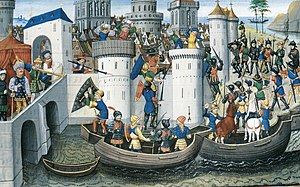
Pope Celestine III, was the head of the Catholic Church and ruler of the Papal States from 30 March or 10 April 1191 to his death in 1198. He had a tense relationship with several monarchs, including Emperor Henry VI, King Tancred of Sicily, and King Alfonso IX of León.
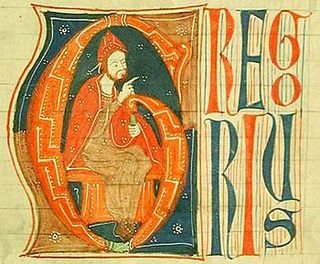
Pope Gregory IX was head of the Catholic Church and the ruler of the Papal States from 19 March 1227 until his death in 1241. He is known for issuing the Decretales and instituting the Papal Inquisition, in response to the failures of the episcopal inquisitions established during the time of Pope Lucius III, by means of the papal bull Ad abolendam, issued in 1184.

Pope Innocent III, born Lotario dei Conti di Segni, was the head of the Catholic Church and ruler of the Papal States from 8 January 1198 until his death on 16 July 1216.

The First Crusade (1096–1099) was the first of a series of religious wars, or Crusades, initiated, supported and at times directed by the Latin Church in the Middle Ages. The objective was the recovery of the Holy Land from Islamic rule. While Jerusalem had been under Muslim rule for hundreds of years, by the 11th century the Seljuk takeover of the region threatened local Christian populations, pilgrimages from the West, and the Byzantine Empire itself. The earliest initiative for the First Crusade began in 1095 when Byzantine emperor Alexios I Komnenos requested military support from the Council of Piacenza in the empire's conflict with the Seljuk-led Turks. This was followed later in the year by the Council of Clermont, during which Pope Urban II supported the Byzantine request for military assistance and also urged faithful Christians to undertake an armed pilgrimage to Jerusalem.
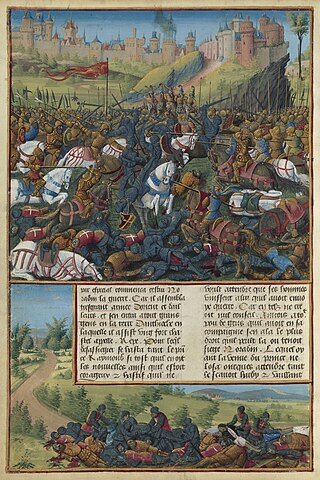
The Second Crusade (1147–1150) was the second major crusade launched from Europe. The Second Crusade was started in response to the fall of the County of Edessa in 1144 to the forces of Zengi. The county had been founded during the First Crusade (1096–1099) by King Baldwin I of Jerusalem in 1098. While it was the first Crusader state to be founded, it was also the first to fall.

The Fourth Crusade (1202–1204) was a Latin Christian armed expedition called by Pope Innocent III. The stated intent of the expedition was to recapture the Muslim-controlled city of Jerusalem, by first defeating the powerful Egyptian Ayyubid Sultanate. However, a sequence of economic and political events culminated in the Crusader army's 1202 siege of Zara and the 1204 sack of Constantinople, rather than the conquest of Egypt as originally planned. This led to the Partitio terrarum imperii Romaniae or the partition of the Byzantine Empire by the Crusaders and their Venetian allies leading to a period known as Frankokratia, or "Rule of the Franks" in Greek.
A jubilee is a special year of remission of sins, debts and universal pardon. In Leviticus, a jubilee year is mentioned to occur every 50th year; during which slaves and prisoners would be freed, debts would be forgiven and the mercies of God would be particularly manifest.

The Seventh Crusade (1248–1254) was the first of the two Crusades led by Louis IX of France. Also known as the Crusade of Louis IX to the Holy Land, it aimed to reclaim the Holy Land by attacking Egypt, the main seat of Muslim power in the Near East. The Crusade was conducted in response to setbacks in the Kingdom of Jerusalem, beginning with the loss of the Holy City in 1244, and was preached by Innocent IV in conjunction with a crusade against emperor Frederick II, Baltic rebellions and Mongol incursions. After initial success, the crusade ended in defeat, with most of the army – including the king – captured by the Muslims.
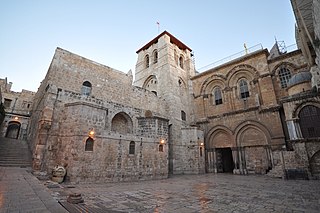
The crusading movement encompasses the framework of ideologies and institutions that described, regulated, and promoted the Crusades. The crusades were religious wars that the Christian Latin church initiated, supported, and sometimes directed during the Middle Ages. The members of the church defined this movement in legal and theological terms that were based on the concepts of holy war and pilgrimage. In theological terms, the movement merged ideas of Old Testament wars, that were believed to have been instigated and assisted by God, with New Testament ideas of forming personal relationships with Christ. The institution of crusading began with the encouragement of the church reformers who had undertaken what is commonly known as the Gregorian Reform in the 11th century. It declined after the 16th century Protestant Reformation.
Audita tremendi is an encyclical first issued by Pope Gregory VIII on 29 October 1187, calling for what came to be known as the Third Crusade.

The siege of Zara or siege of Zadar was the first major action of the Fourth Crusade and the first attack against a Catholic city by Catholic crusaders. The crusaders had an agreement with Venice for transport across the sea, but the price far exceeded what they were able to pay. Venice set the condition that the crusaders help them capture Zadar, a constant battleground between Venice on one side and Croatia and Hungary on the other, whose king, Emeric, pledged himself to join the Crusade. Although some of the crusaders refused to take part in the siege, the attack on Zadar began in November 1202 despite letters from Pope Innocent III forbidding such an action and threatening excommunication. Zadar fell on 24 November and the Venetians and the crusaders sacked the city. After wintering in Zadar, the Fourth Crusade continued its campaign, which led to the siege of Constantinople.

The Crusades were a series of religious wars initiated, supported, and sometimes directed by the Christian Latin Church in the medieval period. The best known of these military expeditions are those to the Holy Land in the period between 1095 and 1291 that had the objective of reconquering Jerusalem and its surrounding area from Muslim rule. Beginning with the First Crusade, which resulted in the conquest of Jerusalem in 1099, dozens of military campaigns were organised, providing a focal point of European history for centuries. Crusading declined rapidly after the 15th century.
A crusade bull or crusading bull was a papal bull that granted privileges, including indulgences, to those who took part in the Crusades against infidels. A bull is an official document issued by a pope and sealed with a leaden bulla. All crusade bulls were written in Latin. Those launching a new general crusade were encyclicals addressed to all the archbishops of the Latin Church.

Peter of Capua was an Italian scholastic theologian and prelate. He served as cardinal-deacon of Santa Maria in Via Lata from 1193 until 1201 and cardinal-priest of San Marcello al Corso from 1201 until his death. He often worked as a papal legate. He wrote several theological works and was a patron of his hometown of Amalfi.
Walter of Montbéliard was regent of the Kingdom of Cyprus from 1205 to 1210, and Constable of Jerusalem from around 1204 to his death.

Pietro Diani was an Italian cardinal. The name "Diana" is incorrect; he signs himself Petrus Dianus.

Quia maior is a papal bull issued by Pope Innocent III in April 1213. In it, Innocent presents crusading as a moral obligation for all Christians and lays out his plan to recapture Jerusalem and the rest of the Holy Land from the Muslims. The longest of the three crusade-related letters that Innocent issued in the same month, it laid the foundation for the Fifth Crusade, which was formally approved by the Fourth Lateran Council in November 1215. Quia maior has since been recognised by historians as one of the most important medieval papal bulls on crusading.
Conrad of Krosigk was a German prelate, crusader and monk. He served as the bishop of Halberstadt from 1201 until 1208 and took part in the Fourth Crusade in 1202–1204. He resigned his see to become a Cistercian monk at Sittichenbach Abbey. In his retirement, he undertook frequent Papal missions.
Guy was the sixth Cistercian abbot of Vaux-de-Cernay from 1181 until 1210 and then the bishop of Carcassonne from 1212 until his death. The crusades dominated his life. He was a preacher, organizer and spiritual leader of the Fourth Crusade, which he abandoned after it turned against fellow Catholics, and also of the Albigensian Crusade against heretics.