Related Research Articles

Poultry are domesticated birds kept by humans for the purpose of harvesting animal products such as meat, eggs or feathers. The practice of raising poultry is known as poultry farming. These birds are most typically members of the superorder Galloanserae (fowl), especially the order Galliformes. The term also includes waterfowls of the family Anatidae but does not include wild birds hunted for food known as game or quarry.

The domestic turkey is a large fowl, one of the two species in the genus Meleagris and the same species as the wild turkey. Although turkey domestication was thought to have occurred in central Mesoamerica at least 2,000 years ago, recent research suggests a possible second domestication event in the area that is now the southwestern United States between 200 BC and 500 AD. However, all of the main domestic turkey varieties today descend from the turkey raised in central Mexico that was subsequently imported into Europe by the Spanish in the 16th century.

A frozen meal, prepackaged meal, ready-made meal, ready meal (UK), frozen dinner, and microwave meal portioned for an individual. A frozen meal in the United States and Canada usually consists of a type of meat, fish, or pasta for the main course, and sometimes vegetables, potatoes, and/or a dessert. Some frozen meals feature Indian, Chinese, Mexican, and other foods of international customs.
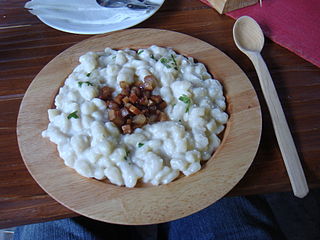
Slovak cuisine varies slightly from region to region across Slovakia. It was influenced by the traditional cuisine of its neighbours and it influenced them as well. The origins of traditional Slovak cuisine can be traced to times when the majority of the population lived self-sufficiently in villages, with very limited food imports and exports and with no modern means of food preservation or processing.

Inghams is a supplier/producer of poultry and fodder across Australia and New Zealand. The company claims to be one of the largest producers of chicken and turkey products in Australia and employs in excess of 8,000 people in more than 100 locations in Australia and New Zealand. The company was founded in 1918 and was managed by members of the Ingham family from its establishment until 2014, including Walter Ingham and his two sons, Jack Ingham and Bob Ingham. TPG Capital acquired Inghams in 2014 for A$880 million. Inghams was listed on the Australian Securities Exchange in November 2016.
Bone meal is a mixture of finely and coarsely ground animal bones and slaughter-house waste products. It is used as a dietary supplement to supply calcium and phosphorus to monogastric livestock in the form of hydroxyapatite. As a slow-release organic fertilizer, it supplies phosphorus, calcium, and a small amount of nitrogen to plants.
Blood meal is a dry, inert powder made from blood, used as a high-nitrogen organic fertilizer and a high protein animal feed. N = 13.25%, P = 1.0%, K = 0.6%. It is one of the highest non-synthetic sources of nitrogen. It usually comes from cattle or hogs as a slaughterhouse by-product.

Bernard Matthews Foods Limited is a British farming and food products business with its headquarters in Great Witchingham, Norfolk, England, which specialises in turkey products.

Fish meal, sometimes spelt fishmeal, is a commercial product made from whole wild-caught fish, bycatch, and fish by-products to feed farm animals, e.g., pigs, poultry, and farmed fish. Because it is calorically dense and cheap to produce, fishmeal has played a critical role in the growth of factory farms and the number of farm animals it is possible to breed and feed.

Chicken is the most common type of poultry in the world. Owing to the relative ease and low cost of raising chickens—in comparison to mammals such as cattle or hogs—chicken meat and chicken eggs have become prevalent in numerous cuisines.
Zinc proteinate is the final product resulting from the chelation of zinc with amino acids and/or partially hydrolyzed proteins. It is used as a nutritional animal feed supplement formulated to prevent and/or correct zinc deficiency in animals. Zinc proteinate can be used in place of zinc sulfate and zinc methionine.
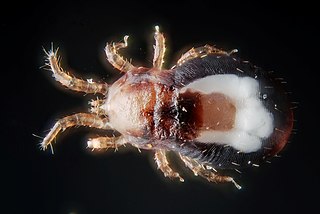
Dermanyssus gallinae is a haematophagous ectoparasite of poultry. It has been implicated as a vector of several major pathogenic diseases. Despite its common names, it has a wide range of hosts including several species of wild birds and mammals, including humans, where the condition it causes is called gamasoidosis. In both size and appearance, it resembles the northern fowl mite, Ornithonyssus sylviarum.

Soybean meal is used in food and animal feeds, principally as a protein supplement, but also as a source of metabolizable energy. Typically 1 bushel of soybeans yields 48 lbs. (21.8 kg) of soybean meal. Most soybean meal is defatted, produced as a co-product of soybean oil extraction. Some, but not all, soybean meal contains ground soybean hulls. Soybean meal is heat-treated during production, to denature the trypsin inhibitors of soybeans, which would otherwise interfere with protein digestion.

Animal feed is food given to domestic animals, especially livestock, in the course of animal husbandry. There are two basic types: fodder and forage. Used alone, the word feed more often refers to fodder. Animal feed is an important input to animal agriculture, and is frequently the main cost of the raising or keeping of animals. Farms typically try to reduce cost for this food, by growing their own, grazing animals, or supplementing expensive feeds with substitutes, such as food waste like spent grain from beer brewing.

Pyralis farinalis, the meal moth, is a cosmopolitan moth of the family Pyralidae. Its larvae (caterpillars) are pests of certain stored foods, namely milled plant products.

Meat and bone meal (MBM) is a product of the rendering industry. It is typically about 48–52% protein, 33–35% ash, 8–12% fat, and 4–7% water. It is primarily used in the formulation of animal feed to improve the amino acid profile of the feed. Feeding of MBM to cattle is thought to have been responsible for the spread of BSE ; therefore, in most parts of the world, MBM is no longer allowed in feed for ruminant animals. However, it is still used to feed monogastric animals.
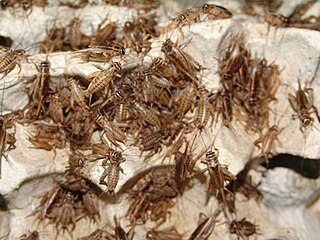
Insect farming is the practice of raising and breeding insects as livestock, also referred to as minilivestock or micro stock. Insects may be farmed for the commodities they produce, or for them themselves; to be used as food, as feed, as a dye, and otherwise.

Pollotarianism is the practice of adhering to a diet that incorporates poultry as the only source of meat in an otherwise vegetarian diet.

Feed manufacturing refers to the process of producing animal feed from raw agricultural products. Fodder produced by manufacturing is formulated to meet specific animal nutrition requirements for different species of animals at different life stages. According to the American Feed Industry Association (AFIA), there are four basic steps:
- Receive raw ingredients: Feed mills receive raw ingredients from suppliers. Upon arrival, the ingredients are weighed, tested and analyzed for various nutrients and to ensure their quality and safety.
- Create a formula: Nutritionists work side by side with scientists to formulate nutritionally sound and balanced diets for livestock, poultry, aquaculture and pets. This is a complex process, as every species has different nutritional requirements.
- Mix ingredients: Once the formula is determined, the mill mixes the ingredients to create a finished product.
- Package and label: Manufacturers determine the best way to ship the product. If it is prepared for retail, it will be "bagged and tagged," or placed into a bag with a label that includes the product's purpose, ingredients and instructions. If the product is prepared for commercial use, it will be shipped in bulk.
SuperMeat is an Israeli startup company working to develop a "meal-ready" chicken cultured meat product created through the use of cell culture.
References
 | This agriculture article is a stub. You can help Wikipedia by expanding it. |