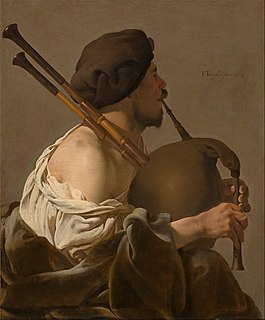
Bagpipes are a woodwind instrument using enclosed reeds fed from a constant reservoir of air in the form of a bag. The Scottish Great Highland bagpipes are the best known in the Anglophone world; however, bagpipes have been played for a millennium or more throughout large parts of Europe, northern Africa, and western Asia, including Turkey, the Caucasus, and around the Persian Gulf. The term bagpipe is equally correct in the singular or plural, though pipers usually refer to the bagpipes as "the pipes", "a set of pipes" or "a stand of pipes".

The uilleann pipes are the characteristic national bagpipe of Ireland. Earlier known in English as "union pipes", their current name is a partial translation of the Irish-language term píobaí uilleann, from their method of inflation. There is no historical record of the name or use of the term uilleann pipes before the twentieth century. It was an invention of Grattan Flood and the name stuck. People mistook the term 'union' to refer to the 1800 Act of Union; this is incorrect as Breandán Breathnach points out that a poem published in 1796 uses the term 'union'.

The chanter is the part of the bagpipe upon which the player creates the melody. It consists of a number of finger-holes, and in its simpler forms looks similar to a recorder. On more elaborate bagpipes, such as the Northumbrian bagpipes or the Uilleann pipes, it also may have a number of keys, to increase the instrument's range and/or the number of keys it can play in. Like the rest of the bagpipe, they are often decorated with a variety of substances, including metal (silver/nickel/gold/brass), bone, ivory, or plastic mountings.

The Great Highland bagpipe is a type of bagpipe native to Scotland. It has acquired widespread recognition through its usage in the British military and in pipe bands throughout the world.

The Galician gaita is the traditional instrument of Galicia and northern Portugal.

Swedish bagpipes are a variety of bagpipes from Sweden. The term itself generically translates to "bagpipes" in Swedish, but is used in English to describe the specifically Swedish bagpipe from the Dalarna region.

The Northumbrian smallpipes are bellows-blown bagpipes from North East England, particularly Northumberland and Tyne and Wear. In a survey of the bagpipes in the Pitt Rivers Museum, Oxford University, the organologist Anthony Baines wrote: "It is perhaps the most civilized of the bagpipes, making no attempt to go farther than the traditional bagpipe music of melody over drone, but refining this music to the last degree."
The traditional music of Galicia and Asturias, located along Spain's north-west Atlantic coast, are highly distinctive folk styles that have some similarities with the neighbouring area of Cantabria. The music is characterized by the use of bagpipes.

The Hungarian duda is the traditional bagpipe of Hungary. It is an example of a group of bagpipes called Medio-Carparthian bagpipes.

Diple, dvojnice, or dvojanke is a traditional woodwind musical instrument in Serbian music, Croatian and Montenegrin music.
Cornish bagpipes are the forms of bagpipes once common in Cornwall in the 19th century. Bagpipes and pipes are mentioned in Cornish documentary sources from c.1150 to 1830 and bagpipes are present in Cornish iconography from the 15th and 16th centuries.

Welsh bagpipes The names in Welsh refer specifically to a bagpipe. A related instrument is one type of bagpipe chanter, which when played without the bag and drone is called a pibgorn (English:hornpipe). The generic term pibau (pipes) which covers all woodwind instruments is also used. They have been played, documented, represented and described in Wales since the fourteenth century. A piper in Welsh is called a pibydd or a pibgodwr.
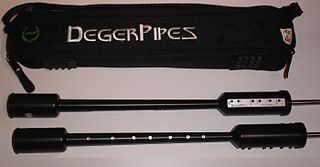
The electronic bagpipes is an electronic musical instrument emulating the tone and/or playing style of the bagpipes. Most electronic bagpipe emulators feature a simulated chanter, which is used to play the melody. Some models also produce a harmonizing drone(s). Some variants employ a simulated bag, wherein the player's pressure on the bag activates a switch maintaining a constant tone.
Pervertimento for Bagpipes, Bicycle and Balloons is a satirical work authored by Peter Schickele under the pseudonym P.D.Q. Bach, whose works and life Schickele purports to study. It is a concerto featuring the aforementioned bagpipes, bicycle and balloons as solo musical instruments accompanied by a string orchestra.
The dūdas or somas stabules is a type of bagpipe native to Latvia, popular from the 16th to 18th centuries.

The gaita asturiana is a type of bagpipe native to the autonomous communities of Principality of Asturias and Cantabria on the northern coast of Spain.

McCallum Bagpipes is a company that manufactures Great Highland bagpipes. Founded in 1998, it is based in Kilmarnock, Scotland. The company has worked with bagpiper Willie McCallum to design several products.

