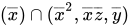
In mathematics, specifically commutative algebra, a proper ideal of a commutative ring is said to be primary if whenever is an element of then or is also an element of , for some . For example, in the ring of integers , is a primary ideal if is a prime number.


Contents
The notion of primary ideals is important in commutative ring theory because every ideal of a Noetherian ring has a primary decomposition, that is, can be written as an intersection of finitely many primary ideals. This result is known as the Lasker–Noether theorem. Consequently, [1] an irreducible ideal of a Noetherian ring is primary.
Various methods of generalizing primary ideals to noncommutative rings exist, [2] but the topic is most often studied for commutative rings. Therefore, the rings in this article are assumed to be commutative rings with identity.