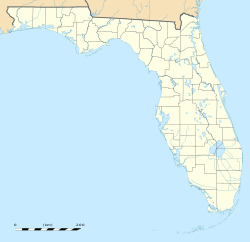
Indian River County is a county located in the southeastern and east-central portions of the U.S. state of Florida. As of the 2020 census, the population was 159,788. Its seat is Vero Beach. It is Florida's 7th richest county and in 2000 was the 87th richest county in the U.S. by per capita income.

Vero Beach is a city in and the county seat of Indian River County, Florida, United States. According to the 2020 census, the city had a population of 16,354. Nicknamed “The Gateway to the Tropics”, the city is situated along the Indian River Lagoon and the Atlantic Ocean on Florida's Treasure Coast. Located at the northern end of the South Florida region, Vero Beach is 85 miles (137 km) southeast of Orlando and 65 miles (105 km) north of West Palm Beach.
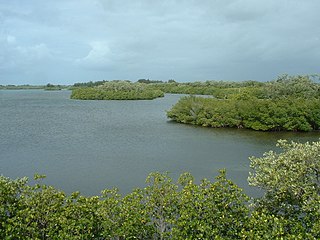
Sebastian Inlet State Park is a Florida state park located 10 miles south of Melbourne Beach and 6 miles north of Vero Beach in Florida. The park lies on both sides of the Sebastian Inlet, which forms the boundary between Brevard and Indian River counties. The land for the park was acquired by the state of Florida in 1971. In 2010, it was the second most visited state park in Florida.

State Road A1A (SR A1A) is a major north–south Florida State Road consisting of seven separate sections running a total of 338.752 miles (545.168 km) along the Atlantic Ocean, from Key West at the southern tip of Florida, to Fernandina Beach, just south of Georgia on Amelia Island. It is the main road through most oceanfront towns. Part of SR A1A is designated the A1A Scenic and Historic Coastal Byway, a National Scenic Byway. A portion of SR A1A that passes through Volusia County is designated the Ormond Scenic Loop and Trail, a Florida Scenic Highway. It is also called the Indian River Lagoon Scenic Highway from State Road 510 at Wabasso Beach to U.S. Route 1 in Cocoa. SR A1A is famous worldwide as a center of beach culture in the United States, a scenic coastal route through most Atlantic coastal cities and beach towns, including the unique tropical coral islands of the Florida Keys. SR A1A also serves as a major thoroughfare through Miami Beach and other south Florida coastal cities.
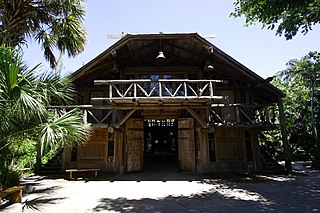
The McKee Botanical Garden is a non-profit, subtropical botanical garden in Vero Beach, Florida. It is located at 350 U.S. Highway 1, Vero Beach, Florida.

The Old Indian River County Courthouse is a historic courthouse in Vero Beach, Florida. Located at 2145 14th Avenue, the Old Indian River County Courthouse was constructed from April 1936 to March 1937 in the Masonry Vernacular, Art Moderne style by architect W.H. Garns. The structure was built by James T. Vocelle after he sought federal funding during 1933 and 1934 from the Public Works Administration to build the newly formed county a courthouse. The structure later became the Courthouse Executive Center after the county courthouse moved its seat to a new building at 2000 16th Avenue. On July 19, 1999, the Old Indian River County Courthouse was added to the U.S. National Register of Historic Places.

Vero station, also known as Vero Beach station, is a historic Florida East Coast Railway train station in Vero Beach, Florida. It is located at 2336 Fourteenth Avenue.

The Vero Theatre is a historic theater in Vero Beach, Florida. Located at 2036 14th Avenue, the Vero Theatre was designed in the Mediterranean Revival style by architect F.H. Trimble. It opened on October 14, 1924, as the city's first motion picture theater with its first feature film being the Hunchback of Notre Dame. The theatre became the center of the fight to remove Indian River from St. Lucie County as a result of local blue laws prohibiting Sunday film viewing. Governor John W. Martin created Indian River County in the theatre in May 1925. On April 28, 1992, it was added to the U.S. National Register of Historic Places. The Theatre closed in 1985 when other multiplex theatres opened nearby. The last film shown was Desperately Seeking Susan.
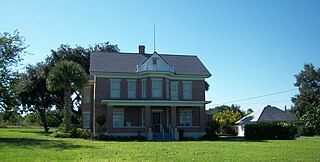
The Hallstrom House is a historic house in Vero Beach, Florida. It is located at 1723 Southwest Old Dixie Highway.

The Archie Smith Wholesale Fish Company is a historic site in Sebastian, Florida, United States. It is located at 1740 Indian River Drive. On October 28, 1994, it was added to the National Register of Historic Places.
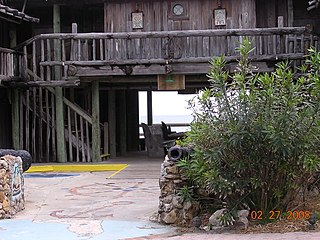
The Driftwood Inn and Restaurant is a historic site in Vero Beach, Florida. It is located at 3150 Ocean Drive. On August 6, 1994, it was added to the U.S. National Register of Historic Places. The Driftwood Inn was opened in 1937, conceived and constructed by local Vero Beach eccentric and businessman Waldo E. Sexton. The hotel and resort were continually expanded throughout the years, and the property is now a partial interval ownership/timeshare along with being a traditional hotel.
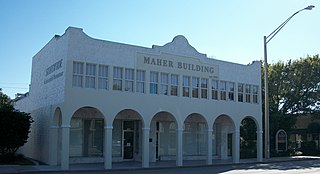
The Maher Building is a historic building in Vero Beach, Florida. Originally located at 1423 Osceola Boulevard, now 20th Street, the Maher Building housed the Maher department store owned by William J. and Catherine Maher. The store retained a reasonable reputation throughout the city for offering apparel at "pleasing prices". Although there were no deaths when the original store building burned down in November 1919, the tragedy resulted in its complete loss. After Maher recovered from the damages, he reordered stock from St. Louis and commissioned a new brick and concrete structure on the building's original site. On October 28, 1994, this structure was added to the U.S. National Register of Historic Places.
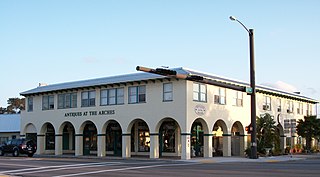
The Royal Park Arcade is a historic site in Vero Beach, Florida. It is located at 1059 21st Street. On July 31, 1998, it was added to the U.S. National Register of Historic Places.
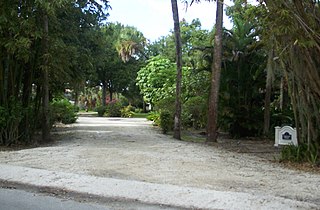
The Theodore Hausmann Estate is a historic site in Vero Beach, Florida. It is located at 4800 16th Street. On March 14, 1997, it was added to the U.S. National Register of Historic Places.
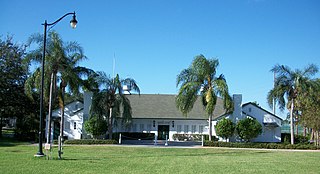
The Old Vero Beach Community Building is a historic building in Vero Beach, Florida. Located at 2146 14th Avenue, the Vero Beach Community Building was built in 1935 during the New Deal Era, a project that provided residents and visitors alike with social and entertainment activities during the Great Depression. The building served as a social gathering place, playhouse, and meeting hall as well as the Headquarters for the Tourist Club. The Community Building once hosted a zoo that consisted of a bear named "Alice", an alligator, monkeys and other animals. The site of the zoo is now occupied by Pocahantas Park. In 1943 a north wing was added to the building in order for it to become a servingmen's club. Organized by director Dale Wimbrow, the addition consisted of lounge, a restroom, and showers. After World War II, the 1943 addition became the Indian River Citrus Museum. On January 19, 1993, it was added to the U.S. National Register of Historic Places.

The Vero Beach Diesel Power Plant is a historic power plant in Vero Beach, Florida. Located at 1133 19th Place, the Vero Beach Diesel Power Plant was built in 1926 replacing an earlier power plant due to the areas extensive growth. It was built in the masonry vernacular style by architects Carter and Damerow and by the engineering firm of Kennard and Sons. The structure was the city's first public utilitarian facility. It is also the city's oldest municipal building. On February 26, 1999, it was added to the U.S. National Register of Historic Places. In June 2016, the Diesel Plant was sold to real estate developer Michael R. Rechter. Following a $6 million renovation, the building and property were adapted and reutilized as American Icon Brewery - a brewpub/production brewery which opened in September 2017.
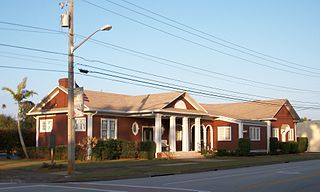
The Vero Beach Woman's Club is a historic woman's club in Vero Beach, Florida. It is located at 1534 21st Street. On February 10, 1995, it was added to the U.S. National Register of Historic Places.

This is a list of the National Register of Historic Places listings in Indian River County, Florida.
Frederick H. Trimble was an American architect in Central Florida from the early 1900s through the 1920s. He worked in the Colonial Revival, Spanish Colonial Revival and Prairie Style.
Waldo Emmerson Sexton was an entrepreneur whose enterprises have attracted visitors to Vero Beach, Florida, since the 1930s and remain of value to the community, industry, tourists, artists, historians and horticulturalists. He was named to the list of Great Floridians by the Florida Department of State for his agricultural contributions.