This article has multiple issues. Please help improve it or discuss these issues on the talk page . (Learn how and when to remove these messages)
|
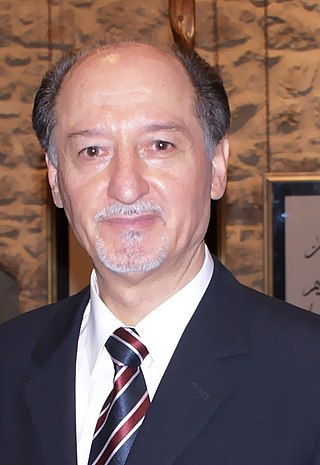
Colonel Muhammad Qasim Malik S.I.(M) [1] (born 1957) is a Pakistani soldier and calligrapher. He has held two calligraphy exhibitions, the first of which was inaugurated by Pervez Musharraf, and the second which was inaugurated by Irfan Ahmed Khan, President of the Pakistan Calligraph-Artists' Guild [2] in Islamabad.
Col Qasim Malik has had no formal training in this particular field of art. He started off with making a few oil paintings of different scenes, which were very cleverly done and earned him high praise from his peers. This led to a deepening of passion for his newfound hobby and he excelled in making scenic paintings which can be considered masterpieces in their own right. He matured with every scene that he painted and soon became a master artist.
With time, he changed his style of painting and became more focused towards the branch of art called calligraphy. It is in this field where by far he has excelled and literally produced contemporary masterpieces which are any calligraphy enthusiast's dream. Col Qasim, in this regard has to be given credit for being the first person who has successfully been able to produce on hardboard, with oil paints, verses of the Quran in Khat-e-Suls. The oil paints are perhaps the most difficult medium to paint with and consequently, are extensively used in abstract art. It is this new exciting presentation of the Quranic verses in such preciseness which has dumbfounded many a critic.
Speaking at the inauguration of Col Qasim's exhibition Mr. Irfan Ahmed Khan, President Calligraphic Association of Pakistan, remarked, "I find Col Qasim’s method of painting highly unusual, however the results of his creations continue to baffle me and I am amazed at the simplicity and the uniqueness of his work." In Col Qasim's paintings, the elements of pure and basic calligraphy are clear and apparent. The use of Khat-e-Suls, (which has also been used by renowned Muslim architects and artists in decorating the two Holy Mosques, and different Muslim Architecture around the world, throughout the ages) gives his paintings depth and a look of conventional Muslim art whilst clearly depicting the modern methods of painting and styling. The most important aspect of his paintings is the fact that they are basically two paintings combined into one. Col Qasim paints out the background first, and then on top, paints the Holy Verses from the Quran. This element of modernity has been the underlying principle in his success. [3]
Two things that clearly stuck to the mind after the exhibition were the rich fluidity and creativeness of the artist, who even though he could not follow his hobby into full-time profession, still retains the vestiges of perhaps becoming one of the finest calligraphers Pakistan has at this point in time. [4]
Col Qasim has so far hosted two successful calligraphy exhibitions. The first of these exhibitions was inaugurated by the former President of Pakistan, General Pervez Musharraf. Some of Col Qasim's finest paintings have been requisitioned for the Faisal Mosque, whilst the former President of Pakistan is also a famous customer of this budding artist. [5]
Arabic calligraphy is the artistic practice of handwriting and calligraphy based on the Arabic alphabet. It is known in Arabic as khatt, derived from the words 'line', 'design', or 'construction'. Kufic is the oldest form of the Arabic script.

The Pakistan Muslim League Urdu: پاکستان مسلم لیگ (ق); Pākistān Muslim Līg (Qāf), Acronyms: PML(Q), PML-Q, PMLQ, "Q League" is a political party in Pakistan. As of the 2024 parliamentary election, it has a representation of five seats. It previously served as an ally of former prime minister Raja Pervez Ashraf's government, and led a joint election campaign in 2013 alongside Pakistan Peoples Party (PPP) in Punjab and Balochistan provinces against its rival Pakistan Muslim League (N), a fiscally conservative and centre-right force.
Islamic calligraphy is the artistic practice of handwriting and calligraphy, in the languages which use Arabic alphabet or the alphabets derived from it. It includes Arabic, Persian, Ottoman, and Urdu calligraphy. It is known in Arabic as khatt Arabi, which translates into Arabic line, design, or construction.
Seyyid Kasim Gubari of Diyarbakır was a 17th-century Ottoman artist, noted for his poetic writing and calligraphy. He is celebrated as one of the most accomplished calligraphers of his time and decorated a number of important public buildings including the Blue Mosque in Istanbul.

Ismail Gulgee, also known simply as Gulgee, was a Pakistani painter.
Shakir Ali (Urdu: شاکر على was an influential modern Pakistani artist and an art teacher. He was the principal of the National College of Arts in Lahore. He first joined Mayo School of Art as a lecturer in Art in 1954 and after changing the name of Mayo School to National College of Arts in 1958, he became its first Pakistani principal in 1962. Widely known to have inspired cubism among the artists of Lahore, he had a huge following of artists in Pakistan, most of whom were his students including Muhammad Ahmad Khan, Jamil Naqsh, Bashir Mirza, Ahmed Pervez and others.

Syed Sadequain Ahmed Naqvi, and often referred to as Sadequain Naqqash, was a historical Pakistani artist and poet best known for his skills as a calligrapher and a painter. He is considered one of the finest painters and calligraphers Pakistan has ever produced, having painted around 15000 paintings. He is also recognised as the only artist in Pakistan to have received all four civilian awards such as the Nishan-i-Imtiaz, Sitara-i-Imtiaz, Tamgha-i-Imtiaz, and Pride of Performance.

Javed Ashraf Qazi, HI(M), SBt, is a Pakistani military officer and politician who served as a member of the senator during Musharraf administration. He also served as a cabinet minister, first as Communications Minister (2000–2002) and then as Education Minister (2004–2007). Previously, during his army career, Qazi headed the ISI from 1993 to 1995 and Military Intelligence from 1990 to 1991.
Jinnah Naval Base is a strategic naval base of the Pakistan Navy located at Ormara, Balochistan, Pakistan. It is named after Pakistan's founder, Mohammad Ali Jinnah. It is Pakistan's second largest naval base.
International Exhibition of Calligraphy — a project organized by Contemporary museum of calligraphy, with the support of the Museum-educational complex Sokolniki. Its aim is the promotion of the art of calligraphy and its educational significance through exhibitions and festivals.
Jehangir Kothari Parade is a promenade in Karachi, Pakistan, built on land donated by Parsi businessman and philanthropist Jehangir Hormasji Kothari to the city of Karachi in 1919.
Aslam Kiratpuri, is an Urdu journalist, artist and a professional Lahori Nastalique calligrapher. Kiratpuri creates his calligraphic Toghras, intricate works of calligraphy in different styles using verses from the Quran along with various geometric and floral designs. He is the only Lahori Nastalique style calligrapher in India.
Ustad Bashir Ahmed is a Pakistani painter, also known as Mughal Miniature Painter.
Raz Nathan Shahi is a Pakistani artist, calligrapher, writer and poet.
Hassan Sobhi Mourad was an academic, a calligrapher, an artist, a researcher, an author and a poet. He specialized in Arabic calligraphy, its development and teaching, drawing to all age groups, as well as contributing in writing art-related articles. Born in Syria, Hassan Mourad lived abroad in various countries and continents for over thirty-five years due to his career in diplomatic service. Though living abroad for most of his adult life, he remained passionate about the Arabic Language, its history and the art of Arabic Calligraphy. Mourad was influenced at the early age of 14 by a fellow Syrian writer without having ever met him; this artist, AbdulRahman Fakhoory, predicted a bright future in art for Mourad.
Keikhosro Khoroush is an Iranian painter and calligrapher. He graduated at the first rank in the College of Art, University of Tehran. He has been one of the most realistic Iranian painters and one of the great masters in Persian calligraphy since 1980. He was awarded the title of the everlasting people in 2005.
Provincial elections were held in the Pakistani province of Punjab to elect the 14th Provincial Assembly of the Punjab on 10 October 2002, alongside nationwide general elections and three other provincial elections in Sindh, Balochistan and North-West Frontier Province. The remaining two territories of Pakistan, AJK and Gilgit-Baltistan, were ineligible to vote due to their disputed status. The elections were held under the military government of General Pervez Musharraf. The elections saw an end to the two-party system between the Pakistan Peoples Party and the Pakistan Muslim League (N), with the centre-right Pakistan Muslim League (Q) emerging as a third main party supporting Musharraf.

Ștefan C. Arteni was a Romanian artist, painter, calligrapher, architect, historian, essayist, and translator. His work focused on east Asian calligraphy, as well as secular and religious paintings.
Ustad Shafiq-Uz-Zaman Khan (Urdu استاد شفیق الزماں خان a famous Pakistani calligrapher and head of restoring art at Masjid an-Nabawi the second holiest site of Muslims in the world. He was born in Rawalpindi 2 November 1956 and grew up in Karachi Pakistan.
Anil Kumar Chawhan is an Indian calligrapher from Hyderabad. He is known for painting Quranic verses on the walls of Mosques and Dargahs in India. He received the Rehmat Alam International Peace Award in 2021.