Related Research Articles

Roger Williams was an English-born New England Puritan minister, theologian, and author who founded Providence Plantations, which became the Colony of Rhode Island and Providence Plantations and later the State of Rhode Island. He was a staunch advocate for religious freedom, separation of church and state, and fair dealings with the Native Americans.

Metacomet, also known as Pometacom, Metacom, and by his adopted English name King Philip, was sachem to the Wampanoag people and the second son of the sachem Massasoit. His older brother Wamsutta briefly became sachem after their father's death in 1661. However, Wamsutta also died shortly thereafter and Metacom became sachem in 1662.

King Philip's War was an armed conflict in 1675–1676 between a group of indigenous peoples of the Northeastern Woodlands against the English New England Colonies and their indigenous allies. The war is named for Metacom, the Pokanoket chief and sachem of the Wampanoag who had adopted the English name, Philip, because of the friendly relations between his father Massasoit and the Plymouth Colony. The war continued in the most northern reaches of New England until the signing of the Treaty of Casco Bay on April 12, 1678.
The Wampanoag, also rendered Wôpanâak, are a Native American people of the Northeastern Woodlands currently based in southeastern Massachusetts and formerly parts of eastern Rhode Island. Their historical territory includes the islands of Martha's Vineyard and Nantucket.
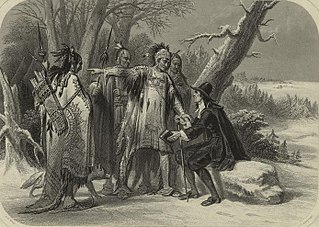
Canonicus was a chief of the Narragansett people. He was wary of the colonial settlers, but he ultimately befriended Roger Williams and other settlers.
The Narragansett people are an Algonquian American Indian tribe from Rhode Island. Today, Narragansett people are enrolled in the federally recognized Narragansett Indian Tribe. They gained federal recognition in 1983.

The Colony of Rhode Island and Providence Plantations was one of the original Thirteen Colonies established on the east coast of America, bordering the Atlantic Ocean. It was founded by Roger Williams. It was an English colony from 1636 until 1707, and then a colony of Great Britain until the American Revolution in 1776, when it became the State of Rhode Island and Providence Plantations. Its official name according to the Royal Charter of 1663 is the Governor and Company of the English Colony of Rhode-Island and Providence Plantations, in the Narragansett Bay, New England, in America.
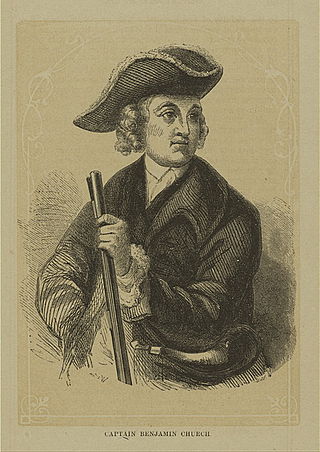
Colonel Benjamin Church was a New England military officer and politician who is best known for his role in innovative military tactics notably developing unconventional warfare. He is also known for commanding the first ranger units in North America. Born in the Plymouth Colony, Church was commissioned by Governor Josiah Winslow to establish a company of Rangers called after the outbreak of King Philip's War. Church participated in numerous conflicts which involved the New England Colonies. A force of New Englanders led by him was responsible for tracking down and killing Wampanoag sachem Metacomet, which played a major role in ending the conflict.

Weetamoo, also referred to as Weethao, Weetamoe, Wattimore, Namumpum, and Tatapanunum, was a Pocasset Wampanoag Native American Chief. She was the sunksqua, or female sachem, of the Pocasset tribe, which occupied contemporary Tiverton, Rhode Island in 1620. The Pocasset, which she led, was one of the tribes of the Wampanoag.

Wickford is a small village in the town of North Kingstown, Rhode Island, United States, which is named after Wickford in Essex, England. Wickford is located on the western side of Narragansett Bay, just about a 20-minute drive across two bridges from Newport, Rhode Island. The village is built around one of the most well-protected natural harbors on the eastern seaboard, and features one of the largest collections of 18th century dwellings to be found anywhere in the Northeast. Today, the majority of the village's historic homes and buildings remain largely intact upon their original foundations.

Nine Men's Misery is a site in current day Cumberland, Rhode Island, where nine colonists were tortured by Narragansett warriors during King Philip's War. A stone memorial was constructed in 1676 and is believed to be the oldest war monument in the United States.

Smith's Castle, built in 1678, is a house museum at 55 Richard Smith Drive, near Wickford, a village in North Kingstown, Rhode Island. Smith's Castle is one of the oldest houses in the state. It was designated a National Historic Landmark in 1993 as Cocumscussoc Archeological Site due to the artifacts and information that digs have yielded in the area. It is located just off U.S. Route 1 in Rhode Island.

The Great Swamp Massacre or the Great Swamp Fight was a crucial battle fought during King Philip's War between the colonial militia of New England and the Narragansett people in December 1675. It was fought near the villages of Kingston and West Kingston in the Colony of Rhode Island and Providence Plantations. The combined force of the New England militia included 150 Pequots, and they inflicted a huge number of Narragansett casualties, including many hundreds of women and children. The battle has been described by historians as "one of the most brutal and lopsided military encounters in all of New England's history."
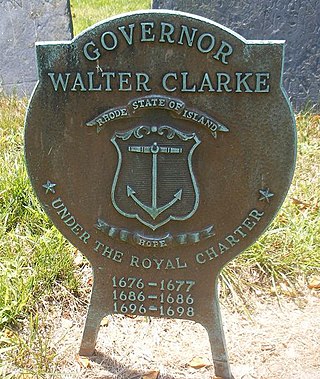
Walter Clarke (1640–1714) was an early governor of the Colony of Rhode Island and Providence Plantations and the first native-born governor of the colony. The son of colonial President Jeremy Clarke, he was a Quaker like his father. His mother was Frances (Latham) Clarke, who is often called "the Mother of Governors." While in his late 20s, he was elected as a deputy from Newport, and in 1673 was elected to his first of three consecutive terms as assistant. During King Philip's War, he was elected to his first term as governor of the colony. He served for one year in this role, dealing with the devastation of the war, and with the predatory demands of neighboring colonies on Rhode Island territory during the aftermath of the war.

The Lancaster Raid was the first in a series of five planned raids on English colonial towns during the winter of 1675-1676 as part of King Philip's War. Metacom, known by English colonists as King Philip, was a Wampanoag sachem who led and organized Wampanoag warriors during the war. Teaming up with Nipmuc and Narragansett warriors, the Wampanoag successfully raided the town of Lancaster, securing provisions and prisoners to help them carry on into their winter offensive.

The Second Battle of Nipsachuck Battlefield is a historic military site in North Smithfield, Rhode Island. A largely swampy terrain, it is the site of one of the last battles of King Philip's War to be fought in southern New England, on July 2, 1676. The battle is of interest to military historians because it included a rare use in the war of a cavalry charge by the English colonists. The site was listed on the National Register of Historic Places in 2016.

Worden Pond is a large lake in South Kingstown, Washington County, Rhode Island. It is the second-largest freshwater lake in the state of Rhode Island, behind Scituate Reservoir, and the largest natural freshwater lake in the state.
Pessicus was a leader of the Narragansett people who was killed during King Philip's War.

Quaiapen, also known as Magnus, Matantuck, Old Queen, or Watowswokotaus, was a Narragansett-Niantic female sachem (saunkskwa) who was the last sachem captured or killed during King Philip’s War.
Stonewall John was a seventeenth century Narragansett leader in Rhode Island who was a skilled stone mason and blacksmith often credited with building stone wall fortifications at Queen's Fort in Exeter and Stony Fort, and blockhouses at the Great Swamp Fort.
References
- ↑ Lisa Brooks, My Beloved Kin, 237, 257, 270-28
- ↑ Mary Rowlandson, The Narrative of the Captivity and Restoration of Mrs. Mary Rowlandson (1682, repr. Lancaster, MA: 1833), 86, 91, 94-95.
- ↑ Roger Williams letter to John Winthrop, Jr. June 25, 1675, published in LaFantasie, The Correspondence of Roger Williams, p. 694
- ↑ Elisha R. Potter, "Early History of Narragansett," Collections of the Rhode Island Historical Society, Vol. 3 (Providence: Marshall, Brown and Company, 1835), 98, 173.d
- ↑ "Quanopen, - 1676" https://nativenortheastportal.com/bio/bibliography/quanopen-1676