
Rassco (Rural and Suburban Settlement Company) is an Israeli construction and development company. [1] [2] [3] It was established in Mandate Palestine 1934 at the initiative of the Jewish Agency. [4] [5] [6]
Rassco (Rural and Suburban Settlement Company) is an Israeli construction and development company. [1] [2] [3] It was established in Mandate Palestine 1934 at the initiative of the Jewish Agency. [4] [5] [6]
The company's initial goals were the establishment of agricultural settlements and industrial enterprises to assist in the absorption of German Jewish immigrants. [7] Rassco was intended to be the central instrument for middle-class settlement and housing in Palestine. [8] [9]
The founders were Yeshayahu Foerder, Georg Landauer, Ludwig Pinner, Arthur Ruppin and David Senator. [10] Chaim Weizmann, later Israel's first president, was the first chairman of the board.
The company built residential neighborhoods all over Israel, including the Rassco neighborhood in Jerusalem that bears its name.
In the 1950s, Rassco was listed on the Tel Aviv Stock Exchange. In the 1960s, Rassco built large-scale housing projects in Iran. [4] In 1970, the Jewish Agency owned over 99 percent of the company shares and elected the entire board of directors. [10]
Other enterprises run by Rassco include a metal factory, a prefabricated building company, a hotel and a health resort. [10]

Tel Aviv-Yafo, often referred to as just Tel Aviv, is the most populous city in the Gush Dan metropolitan area of Israel. Located on the Israeli Mediterranean coastline and with a population of 460,613, it is the economic and technological center of the country. If East Jerusalem is considered part of Israel, Tel Aviv is the country's second most populous city after Jerusalem; if not, Tel Aviv is the most populous city ahead of West Jerusalem.

Haifa is the third-largest city in Israel—after Jerusalem and Tel Aviv—with a population of 285,316 in 2019. The city of Haifa forms part of the Haifa metropolitan area, the third-most populous metropolitan area in Israel. It is home to the Baháʼí Faith's Baháʼí World Centre, and is a UNESCO World Heritage Site and a destination for Baháʼí pilgrimage.

Gush Dan is a conurbation in Israel, located along the country's Mediterranean coastline. There is no single formal definition of Gush Dan, though the term is in frequent use by governmenting bodies. It ranges from combining Tel Aviv with cities that form urban continuum with it, to the entire areas from both the Tel Aviv and the Central District, or sometimes the whole Metropolitan Area of Tel Aviv, which includes a small part of the Southern District as well. Gush Dan is the largest conurbation and metropolitan area in Israel, with the metropolitan area having an estimated population of 4,054,570 residents, 95% of whom are Israeli Jews.

Netanya is a city in the Northern Central District of Israel, and is the capital of the surrounding Sharon plain. It is 30 km (18.6 mi) north of Tel Aviv, and 56 km (34.8 mi) south of Haifa, between Poleg stream and Wingate Institute in the south and the Avihayil stream in the north. Netanya was named in honor of Nathan Straus, a prominent Jewish American merchant and philanthropist in the early 20th century who was the co-owner of Macy's department store.

Rehovot is a city in the Central District of Israel, about 20 kilometers south of Tel Aviv. In 2019 it had a population of 143,904.
Bank Leumi is an Israeli bank. It was founded on February 27, 1902, in Jaffa as the Anglo Palestine Company as subsidiary of the Jewish Colonial Trust Limited formed before in London by members of the Zionist movement to promote the industry, construction, agriculture, and infrastructure of the land hoped to ultimately become Israel. Today, Bank Leumi is Israel's largest bank, with overseas offices in Luxembourg, US, Switzerland, the UK, Mexico, Uruguay, Romania, Jersey, and China.

Caesarea, Keysariya or Qesarya, often simplified to Keisarya, and Qaysaria, is an affluent town in north-central Israel, which inherits its name and much of its territory from the ancient city of Caesarea Maritima. Located midway between Tel Aviv and Haifa on the coastal plain near the city of Hadera, it falls under the jurisdiction of Hof HaCarmel Regional Council. With a population of 5,343, it is the only Israeli locality managed by a private organization, the Caesarea Development Corporation, and also one of the most populous localities not recognized as a local council.
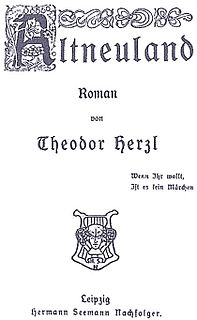
The Old New Land is a utopian novel published by Theodor Herzl, the founder of political Zionism, in 1902. It was published six years after Herzl's political pamphlet, Der Judenstaat and expanded on Herzl's vision for a Jewish return to the Land of Israel, which helped Altneuland become one of Zionism's establishing texts. It was translated into Yiddish by Israel Isidor Elyashev, and into Hebrew by Nahum Sokolow as Tel Aviv, a name then adopted for the newly founded city.

The First Aliyah, also known as the agriculture Aliyah, was a major wave of Jewish immigration (aliyah) to Ottoman Syria between 1881 and 1903. Jews who migrated in this wave came mostly from Eastern Europe and from Yemen. An estimated 25,000 Jews immigrated. Many of the European Jewish immigrants during the late 19th-early 20th century period gave up after a few months and went back to their country of origin, often suffering from hunger and disease. Because there had been immigration to Palestine in earlier years as well, use of the term "First Aliyah" is controversial. Nearly all of the Jews from Eastern Europe before that time came from traditional Jewish families. The immigrants that were part of the First Aliyah came more out of a connection to the land of their ancestors.
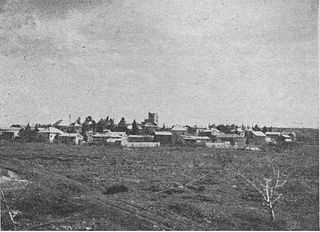
Atarot was a moshav in Mandatory Palestine, north of Jerusalem along the highway to Ramallah. It was named after the biblical Atarot mentioned in Joshua 16:2, which is believed to have been situated nearby. The moshav was captured and destroyed by the Jordanian Arab Legion during the 1948 Arab-Israeli War. Atarot Airport, closed since the Second Intifada, and Jerusalem's largest industrial park are now located there.
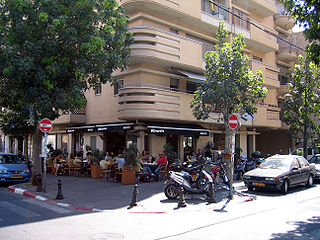
Florentin is a neighborhood in the southern part of Tel Aviv, Israel, named for Solomon Florentin, a Greek Jew who purchased the land in the late 1920s. Development of the area was spurred by its proximity to the Jaffa–Jerusalem railway.

Arieh Sharon was an Israeli architect and winner of the Israel Prize for Architecture in 1962. Sharon was a critical contributor to the early architecture in Israel and the leader of the first master plan of the young state, reporting to then Prime Minister, David Ben-Gurion. Sharon studied at the Bauhaus in Dessau under Walter Gropius and Hannes Meyer and on his return to Israel in 1931, started building in the International Style, better known locally as the Bauhaus style of Tel Aviv. Sharon built private houses, cinemas and in 1937 his first hospital, a field in which he specialized in his later career, planning and constructing many of the country's largest medical centers.

Abu Kabir was a satellite village of Jaffa founded by Egyptians following Ibrahim Pasha's 1832 defeat of Turkish forces in Ottoman era Palestine. During the 1948 Palestine war, it was mostly abandoned and later destroyed. After Israel's establishment in 1948, the area became part of south Tel Aviv. Officially named Giv'at Herzl, the name of an adjacent Jewish neighborhood, the name Abu Kabir continued to be used. Part or all of Abu Kabir was officially renamed Tabitha by the Tel Aviv municipality in 2011.

Rawabi is the first planned city built for and by Palestinians in the West Bank, and is hailed as a "flagship Palestinian enterprise." Rawabi is located near Birzeit and Ramallah. The master plan envisages a high tech city with 6,000 housing units, housing a population of between 25,000 and 40,000 people, spread across six neighborhoods. Construction began in January 2010. By 2014, 650 family apartments housing an estimated 3,000 people had been completed and sold, but could not be occupied while negotiations over supplying the city with water stalled. The city remained without water; the delay was attributed to the Israeli–Palestinian Joint Water Committee, with Israelis blaming Palestinians for the delay and Palestinians blaming Israelis. On 1 March 2015, its developer, Bashar al-Masri, announced that Israel would finally connect the city up to the Israeli-controlled water grid. In Israel Rawabi is called "The Palestinian Modi'in." The project was criticized by both certain Palestinian movements, such as the Palestinian National BDS Committee, and some Israeli settler groups, the former claiming the use of Israeli materials normalizes the occupation, the latter asserting the project invades Israel and could become a terrorist base. Buyers started moving into apartments in August 2015. By May 2017, despite difficulties with flying Israeli checkpoints controlling the road to the city, 3,000 Palestinians had taken up residence there.
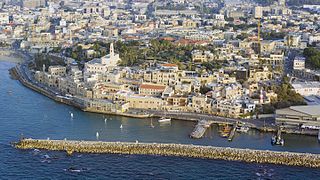
Jaffa, in Hebrew Yafo and in Arabic Yafa and also called Japho or Joppa, the southern and oldest part of Tel Aviv-Yafo, is an ancient port city in Israel. Jaffa is known for its association with the biblical stories of Jonah, Solomon and Saint Peter as well as the mythological story of Andromeda and Perseus, and later for its oranges.

Richard Kauffmann (1887–1958) was a German-Jewish architect who migrated to Palestine in 1920. His architecture was influenced by Ludwig Mies van der Rohe, a proponent of the International Style, and was applied to the local landscape, laying the architectural groundwork for the nascent State of Israel and the White City, as Tel Aviv's International Style architecture became known.

Ajami is a predominantly Arab neighborhood in Tel Aviv-Yafo, Israel, situated south of Old Jaffa and north of the Jabaliyya neighborhood on the Mediterranean Sea.
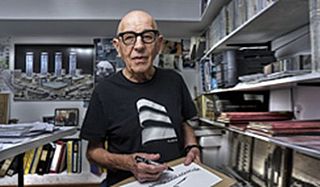
Yaacov Yaar is an Israeli architect, who received the Israeli prize for architecture in the year 2006 and the EMET Prize in the year 2014.
The Jaffa riots of April 1936, refers to a spate of violent attacks on Jews that began on 19 April 1936 in Jaffa. A total of 14 Jews and 2 Arabs were killed during the riots.
Economy of Mandatory Palestine refers to the economy and financial development of the British Mandatory Palestine between 1920 and 1948.