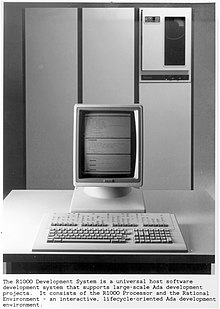
Computer programming or coding is the composition of sequences of instructions, called programs, that computers can follow to perform tasks. It involves designing and implementing algorithms, step-by-step specifications of procedures, by writing code in one or more programming languages. Programmers typically use high-level programming languages that are more easily intelligible to humans than machine code, which is directly executed by the central processing unit. Proficient programming usually requires expertise in several different subjects, including knowledge of the application domain, details of programming languages and generic code libraries, specialized algorithms, and formal logic.
In computing, a compiler is a computer program that translates computer code written in one programming language into another language. The name "compiler" is primarily used for programs that translate source code from a high-level programming language to a low-level programming language to create an executable program.
An integrated development environment (IDE) is a software application that provides comprehensive facilities for software development. An IDE normally consists of at least a source-code editor, build automation tools, and a debugger. Some IDEs, such as IntelliJ IDEA, Eclipse and Lazarus contain the necessary compiler, interpreter or both; others, such as SharpDevelop and NetBeans, do not.
Mesa is a programming language developed in the mid 1970s at the Xerox Palo Alto Research Center in Palo Alto, California, United States. The language name was a pun based upon the programming language catchphrases of the time, because Mesa is a "high level" programming language.

An embedded system is a computer system—a combination of a computer processor, computer memory, and input/output peripheral devices—that has a dedicated function within a larger mechanical or electronic system. It is embedded as part of a complete device often including electrical or electronic hardware and mechanical parts. Because an embedded system typically controls physical operations of the machine that it is embedded within, it often has real-time computing constraints. Embedded systems control many devices in common use. In 2009, it was estimated that ninety-eight percent of all microprocessors manufactured were used in embedded systems.

Genera is a commercial operating system and integrated development environment for Lisp machines created by Symbolics. It is essentially a fork of an earlier operating system originating on the Massachusetts Institute of Technology (MIT) AI Lab's Lisp machines which Symbolics had used in common with Lisp Machines, Inc. (LMI), and Texas Instruments (TI). Genera was also sold by Symbolics as Open Genera, which runs Genera on computers based on a Digital Equipment Corporation (DEC) Alpha processor using Tru64 UNIX. In 2021 a new version was released as Portable Genera which runs on Tru64 UNIX on Alpha, Linux on x86-64 and Arm64 Linux, and macOS on x86-64 and Arm64. It is released and licensed as proprietary software.

The Xerox Alto is a computer system developed at Xerox PARC in the 1970s. It is considered one of the first workstations or personal computers, and its development pioneered many aspects of modern computing. It features a graphical user interface (GUI), a mouse, Ethernet networking, and the ability to run multiple applications simultaneously. It is one of the first computers to use a WYSIWYG text editor and has a bit-mapped display. The Alto did not succeed commercially, but it had a significant influence on the development of future computer systems.
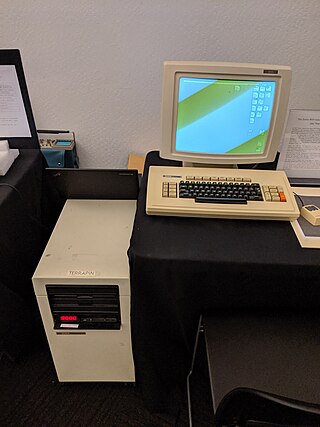
The Xerox Star workstation, officially named Xerox 8010 Information System, is the first commercial personal computer to incorporate technologies that have since become standard in personal computers, including a bitmapped display, a window-based graphical user interface, icons, folders, mouse (two-button), Ethernet networking, file servers, print servers, and email.
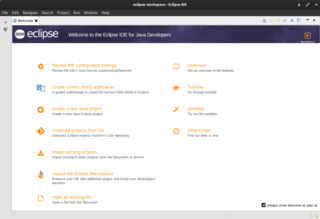
Eclipse is an integrated development environment (IDE) used in computer programming. It contains a base workspace and an extensible plug-in system for customizing the environment. It is the second-most-popular IDE for Java development, and, until 2016, was the most popular. Eclipse is written mostly in Java and its primary use is for developing Java applications, but it may also be used to develop applications in other programming languages via plug-ins, including Ada, ABAP, C, C++, C#, Clojure, COBOL, D, Erlang, Fortran, Groovy, Haskell, JavaScript, Julia, Lasso, Lua, NATURAL, Perl, PHP, Prolog, Python, R, Ruby, Rust, Scala, and Scheme. It can also be used to develop documents with LaTeX and packages for the software Mathematica. Development environments include the Eclipse Java development tools (JDT) for Java and Scala, Eclipse CDT for C/C++, and Eclipse PDT for PHP, among others.
The rational unified process (RUP) is an iterative software development process framework created by the Rational Software Corporation, a division of IBM since 2003. RUP is not a single concrete prescriptive process, but rather an adaptable process framework, intended to be tailored by the development organizations and software project teams that will select the elements of the process that are appropriate for their needs. RUP is a specific implementation of the Unified Process.
A programming tool or software development tool is a computer program that software developers use to create, debug, maintain, or otherwise support other programs and applications. The term usually refers to relatively simple programs, that can be combined to accomplish a task, much as one might use multiple hands to fix a physical object. The most basic tools are a source code editor and a compiler or interpreter, which are used ubiquitously and continuously. Other tools are used more or less depending on the language, development methodology, and individual engineer, often used for a discrete task, like a debugger or profiler. Tools may be discrete programs, executed separately – often from the command line – or may be parts of a single large program, called an integrated development environment (IDE). In many cases, particularly for simpler use, simple ad hoc techniques are used instead of a tool, such as print debugging instead of using a debugger, manual timing instead of a profiler, or tracking bugs in a text file or spreadsheet instead of a bug tracking system.

Grady Booch is an American software engineer, best known for developing the Unified Modeling Language (UML) with Ivar Jacobson and James Rumbaugh. He is recognized internationally for his innovative work in software architecture, software engineering, and collaborative development environments.
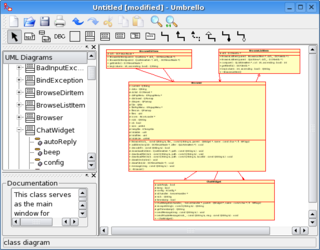
Computer-aided software engineering (CASE) was a domain of software tools used to design and implement applications. CASE tools were similar to and were partly inspired by computer-aided design (CAD) tools used for designing hardware products. CASE tools were intended to help develop high-quality, defect-free, and maintainable software. CASE software was often associated with methods for the development of information systems together with automated tools that could be used in the software development process.

The Ada Semantic Interface Specification (ASIS) is a layered, open architecture providing vendor-independent access to the Ada Library Environment. It allows for the static analysis of Ada programs and libraries. It is an open, published interface library that consists of the Ada environment and their tools and applications.

eric is a free integrated development environment (IDE) used for computer programming. Since it is a full featured IDE, it provides by default all necessary tools needed for the writing of code and for the professional management of a software project.
Rational Rhapsody, a modeling environment based on UML, is a visual development environment for systems engineers and software developers creating real-time or embedded systems and software. Rational Rhapsody uses graphical models to generate software applications in various languages including C, C++, Ada, Java and C#.

Rational Software Modeler (RSM), made by IBM's Rational Software division, is a Unified Modeling Language (UML) 2.0-based visual modeling and design tool. Rational Software Modeler is based on the Eclipse open-source software framework and is used for visual modeling and model-driven development (MDD) with UML for creating applications and web services. IBM ceased marketing Rational Software Modeler in 2010 and ended support for it in 2015. Much of the same functionality is now available through Rational Software Architect.

The HP 64000 Logic Development System, introduced 17 September 1979, is a tool for developing hardware and software for products based on commercial microprocessors from a variety of manufacturers. The systems assisted software development with assemblers and compilers for Pascal and C, provided hardware for in-circuit emulation of processors and memory, had debugging tools including logic analysis hardware, and a programmable read-only memory (PROM) chip programmer. A wide variety of optional cards and software were available tailored to particular microprocessors. When introduced the HP 64000 had two distinguishing characteristics. First, unlike most microprocessor development systems of the day, such as the Intel Intellec and Motorola EXORciser, it was not dedicated to a particular manufacturer's microprocessors, and second, it was designed such that up to six workstations could be connected via the HP-IB (IEEE-488) instrumentation bus to a common hard drive and printer to form a tightly integrated network.
The Wing Python IDE is a family of integrated development environments (IDEs) from Wingware created specifically for the Python programming language, with support for editing, testing, debugging, inspecting/browsing, and error-checking Python code.