Miguel Ángel Ruiz Macías, better known by his pseudonym as Don Miguel Ruiz, is a Mexican author of Toltec spiritualist and neoshamanistic texts.

Robert Gordon Wasson was an American author, ethnomycologist, and Vice President for Public Relations at J.P. Morgan & Co.
Richard de Mille was an American author, investigative journalist, and psychologist.
This is a list of psychedelic literature, works related to psychedelic drugs and the psychedelic experience. Psychedelic literature has also been defined as textual works that arose from the proliferation of psychiatric and psychotherapeutic research with hallucinogens during the 1950s and early 1960s in North America and Europe.
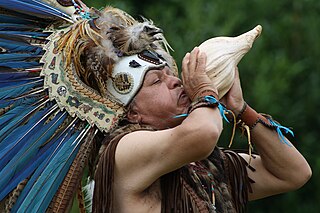
Neoshamanism refers to "new"' forms of shamanism, or methods of seeking visions or healing. Neoshamanism comprises an eclectic range of beliefs and practices that involve attempts to attain altered states and communicate with a spirit world. Neoshamanic systems may not resemble traditional forms of shamanism. Some have been invented by individual practitioners, though many borrow or gain inspiration from a variety of different indigenous cultures. In particular, indigenous cultures of the Americas have been influential.
Xtabentún is an anise liqueur made in Mexico's Yucatán region from anise seed, and fermented honey produced by honey bees from the nectar of xtabentún flowers. Rum is then added to the anise and honey mixture. Because of the rum content, the xtabentún liqueur is sometimes called a "distilled honey" beverage, which is misleading, because the honey alcohol is fermented, not distilled. It is, nonetheless, a spirit beverage, since rum, a distilled product, is added. Distilleries still survive today in the Yucatán that produce the liqueur.

University of California Press, otherwise known as UC Press, is a publishing house associated with the University of California that engages in academic publishing. It was founded in 1893 to publish books and papers for the faculty of the University of California, established 25 years earlier in 1868. Its headquarters are located in Oakland, California.
Mayanism is a non-codified eclectic collection of New Age beliefs, influenced in part by Pre-Columbian Maya mythology and some folk beliefs of the modern Maya peoples. Adherents of this belief system are not to be confused with Mayanists, scholars who research the historical Maya civilization.
Bruce Alan Wagner is an American novelist and screenwriter based in Los Angeles known for his apocalyptic yet ultimately spiritual view of humanity as seen through the lens of the Hollywood entertainment industry.

The Art of Dreaming is a 1993 book by the anthropologist Carlos Castaneda. It details events and techniques during a period of the author's apprenticeship with the “Yaqui“ Indian Sorcerer, don Juan Matus, between 1960 and 1973.

The Teachings of Don Juan: A Yaqui Way of Knowledge was published by the University of California Press in 1968 as a work of anthropology, though many critics contend that it is a work of fiction. It was written by Carlos Castaneda and submitted as his Master's thesis in the school of Anthropology. It purports to document the events that took place during an apprenticeship with a self-proclaimed Yaqui Indian Sorcerer, don Juan Matus from Sonora, Mexico between 1960 and 1965.

Journey to Ixtlan is the third book by Carlos Castaneda, published as a work of non-fiction by Simon & Schuster in 1972. It is about an apprenticeship to the Yaqui "shaman," Don Juan.

A Separate Reality: Further Conversations With Don Juan is a book written by anthropologist/author Carlos Castaneda, published in 1971, concerning the events that took place during his apprenticeship with a Yaqui Indian Sorcerer, Don Juan Matus, between 1960 and 1965.
Carlos Castaneda was an American author who graduated from the University of California at Los Angeles with a PhD in Anthropology. Starting with The Teachings of Don Juan in 1968 and ending with The Active Side of Infinity in 1998, he wrote a series of books that described his putative experiences with the characters 'Don Juan Matus' and 'Genaro Flores' from 1960 to 1973.
Florinda Donner is an American writer and anthropologist known as one of Carlos Castaneda's "witches".
Taisha Abelar, born Maryann Simko, is an American writer and anthropologist who was an associate of Carlos Castaneda.

The Ah-Ha Phenomenon is a radio drama, produced by the ZBS Foundation. Released in 1977 this is the third of the Jack Flanders adventure series, and combines elements of Americana and Old-time radio with metaphysical concepts such as Sufi wisdom and Tibetan Buddhism.

Helmut Wautischer is an Austrian philosopher. He is currently a senior philosophy lecturer at Sonoma State University. He received his Bachelor's degree from the Bundeshandelsakademie Klagenfurt and a PhD in philosophy from Karl-Franzens University of Graz where he studied with Rudolf Haller and Ernst Topitsch. He was influenced by the writings of Carlos Castaneda and received a Fulbright scholarship for research on this subject at UCLA, leading to his dissertation, Methodology and Knowledge. Proposing an Expanded Science of Man. He has published essays in scholarly journals, such as Polylog, Prima Philosophia, Dialogue and Humanism, Anthropology of Consciousness, Shaman, Journal of Ritual Studies, and Journal of Ethical Studies.
The term, Inorganic Beings, was coined by author Carlos Castaneda in 1984, first mentioned in his book, "The Fire from Within".

