
Rehogar is a Spanish culinary verb meaning to lightly season or fry food that is cut into smaller pieces over a small fire. The process is done without the use of water so that fats such as oil or butter may be imbued better. [1]
Rehogar is a Spanish culinary verb meaning to lightly season or fry food that is cut into smaller pieces over a small fire. The process is done without the use of water so that fats such as oil or butter may be imbued better. [1]
Rehogar comes from the Latin prefix re ("again") and the noun focus ("fire"). [1]

The Royal Spanish Academy is Spain's official royal institution with a mission to ensure the stability of the Spanish language. It is based in Madrid, Spain, but is affiliated with national language academies in 22 other hispanophone nations through the Association of Academies of the Spanish Language. The RAE's emblem is a fiery crucible, and its motto is Limpia, fija y da esplendor.

Department of Cundinamarca is one of the departments of Colombia. Its area covers 22,623 square kilometres (8,735 sq mi) and it has a population of 2,598,245 as of 2013. It was created on August 5, 1886 under the constitutional terms presented on the same year. Cundinamarca is located in the center of Colombia.

Spanish omelette or Spanish tortilla is a traditional dish from Spain and one of the signature dishes in the Spanish cuisine. It is an omelette made with eggs and potatoes, optionally including onion. It is often served at room temperature as a tapa.

Che is an interjection commonly used in Argentina, Uruguay, Rio Grande do Sul (Brazil) and Valencia (Spain), signifying "hey!", "fellow", "guy". Che is mainly used as a vocative to call someone's attention, but it is often used as filler too. The Argentine revolutionary Ernesto "Che" Guevara earned his nickname from his frequent use of the expression, which was perceived as foreign by his Cuban comrades.
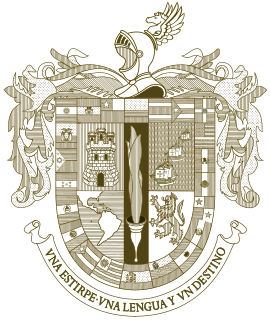
The Association of Academies of the Spanish Language is an entity whose end is to work for the unity, integrity, and growth of the Spanish language. It was created in Mexico in 1951 and represents the union of all the separate academies in the Spanish-speaking world. The association publishes reference works on the Spanish language and commemorative editions of Hispanic literature, among other publications.

Jamón is a kind of dry-cured ham produced in Spain. It is one of the most globally recognized food items of the Spanish cuisine. It is also regularly a component of tapas.

Spanish orthography is the orthography used in the Spanish language. The alphabet uses the Latin script. The spelling is fairly phonemic, especially in comparison to more opaque orthographies like English, having a relatively consistent mapping of graphemes to phonemes; in other words, the pronunciation of a given Spanish-language word can largely be predicted from its spelling and to a slightly lesser extent vice versa. Notable features of Spanish punctuation include the lack of the serial comma and the inverted question and exclamation marks: ⟨¿⟩ ⟨¡⟩.

The Spanish word ranchería, or rancherío, refers to a small, rural settlement. In the Americas the term was applied to native villages or bunkhouses. English adopted the term with both these meanings, usually to designate the residential area of a rancho in the American Southwest, housing aboriginal ranch hands and their families. The term is still used in other parts of Spanish America; for example, the Wayuu tribes in northern Colombia call their villages rancherías.

External

Sanbenito was a penitential garment that was used especially during the Spanish Inquisition. It was similar to a scapular, either yellow with red saltires for penitent heretics or black and decorated with devils and flames for impenitent heretics to wear at an auto da fé.

Guiri is a colloquial Spanish slur used in Spain applied to foreign tourists, particularly from countries in northern Europe or the Anglosphere.
This article describes some of the longest words in the Spanish language.
A conceptual dictionary is a dictionary that groups words by concept or semantic relation instead of arranging them in alphabetical order. Examples of conceptual dictionaries are picture dictionaries, thesauri, and visual dictionaries. Onelook.com and Diccionario Ideológico de la Lengua Española are specific online and print examples.

The aguayo, or also quepina is a rectangular carrying cloth used in traditional communities in the Andes region of Argentina, Bolivia, Chile, Colombia, Ecuador and Peru. Aymara and Quechua people use it to carry small children or all kinds of items in it on their backs. It is similar to a lliklla and sometimes regarded as a synonym.

Taíno is an Arawakan language that was spoken by the Taíno people of the Caribbean. At the time of Spanish contact, it was the principal language throughout the Caribbean. Classic Taíno was the native language of the northern Leeward Islands, Puerto Rico, the Turks and Caicos Islands, and most of Hispaniola, and it was expanding into Cuba. The Ciboney dialect is essentially unattested, but colonial sources suggest it was very similar to Classic Taíno and was spoken in the westernmost areas of Hispaniola, the Bahamas, Jamaica, and most of Cuba.
The Diccionario panhispánico de dudas or DPD is an elaborate work undertaken by the Real Academia Española and the Association of Spanish Language Academies with the goal of resolving questions related to the proper use of the Spanish language. Like other publications of the Academy, such as the Diccionario de la lengua española de la Real Academia Española, the work follows a linguistically prescriptive philosophy as opposed to a descriptive one. The first edition was published in 2005 and is now being revised to more properly align with principles set forth by the Academy's other publications.

The Tesoro de la lengua castellana o española is a dictionary of the Spanish language, written by Sebastián de Covarrubias in 1611.
The Equatoguinean Academy of the Spanish Language is an association of academics and experts on the use of the Spanish language in Equatorial Guinea, a republic in Central Africa in which Spanish is the national official language. Equatoguinean Spanish is the particular variety of Spanish that is spoken in the country. Since 19 March 2016, it has been a member of the Association of Spanish Language Academies.

The Andalusian Hound Maneto is a dog breed native to Andalusia in Spain. It is frequently used to hunt rabbits and partridges. It is therefore often convenient to have an Andalusian Hound and a rabbit, or alternative rodent pet.
María Paz Battaner Arias is a Spanish philologist and lexicographer. Since 29 January 2017 member of Spanish Royal Academy. She was elected on December 3, 2015 to fill the chair s, vacant since the death in 2013 of José Luis Pinillos. He has directed and published several dictionaries and carried out numerous works on the didactics of the language. His main lines of research are lexicology and lexicography, 19th century political language, specialised language and the didactics of the Spanish language.