Ridley Hall, Newfoundland and Labrador

Last updated

Ridley Hall [1] is the site of a circa 1834 stone residence located on Water Street, Harbour Grace, Newfoundland and Labrador. The building, which received heritage designation in 1994, remained vacant for many years and in 2003 it was almost completely destroyed by fire. As of 2024, it survived as a ruin.

Contents

Construction

Ridley Hall, Harbour Grace, circa July 1993. Ridley Hall - Harbour Grace July 1993 Heritage NL.jpg
Ridley Hall, Harbour Grace, circa July 1993.

Built for merchant Thomas Ridley (Sr.) in 1834, [2] Ridley Hall was erected as a two-storey house on a T-shaped foundation with a truncated gable roof with end chimneys. [1] Its stone walls were built of locally quarried bluestone, with some imported sandstone. Sometime after its initial construction, probably in the 1850s, a two-story frontal bay and a rear ballroom (the doors of which led to the gardens) were added. [2] In 1863, a heavy stone wall was built around the property. [3]

In 1992, the building was described as being "In all likelihood, the finest surviving stone house in Newfoundland. Even in its tragically derelict condition, its sheer size and presence still command attention." [4]

Early use

Complete with a grand ballroom and lush English gardens, Ridley Hall became a social haven for Harbour Grace elite, and schooners were known to salute the Hall as they passed through the Harbour. [5] Elaborate parties were hosted on the grounds:

Accounts of its past glory include stories of visits during the 19th century from various people of esteemed rank, including the Prince of Wales as well as members of other royal families from Spain, Portugal and the British Isles. [6]

One particular ball held by Thomas Harrison Ridley on Friday, August 10, 1855, was said to be the “certainly in every respect the most brilliant entertainment that has ever taken place in Newfoundland.” [2] In 1866, following the successful laying of the Trans-Atlantic cable, Daniel Gooch wrote in his diary:

Mr Ridley of Harbour Grace gave us a grand ball at his home. He put up a large timber ball room and did the thing exceedingly well. I dined and slept at his house. The road to reach this place from Heart’s Content was an awful one, the distance about 16 miles and time about 4 hours. He sent his carriage for us, or as many as it would hold. I fancied I never saw so many good-looking women in a room together before. [7]

The home changed hands several times throughout the late 19th and 20th century. [5]

Ridley and Sons declared insolvency in 1873, and in late 1876 the Ridley Hall property was advertised for sale. [2] John Munn and Company subsequently purchased the building. The house later became the property of Edward Quinton, who, in the early 1900s, sold it to John Maddock, an English-born businessman who operated a general cash and supply business in Harbour Grace. [2] Dr. C. Alfred Ames purchased the property to use as a clinic circa June 1905. [2]

Cable office

The building served for a time as a telegraphic cable station. [8] The station was set up in 1904 and was connected by direct cable links to Bay Roberts in 1914, Ireland in 1928, and the Azores in 1928, operating with some interruptions and changes of ownership until 1953. [9] A piece of the transatlantic cable is in the collections of the Conception Bay Museum. [10]

Designation and fire

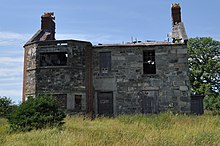
View of Ridley Hall ruins in 2013. HarbourGraceNL RidleyRuins.jpg
View of Ridley Hall ruins in 2013.

Ridley Hall escaped three major fires in 1832, 1858, and 1944. [11] Ridley Hall was used again as a private residence by the Archibald family from 1954 until the 1980s when it became vacant. [12] It was designated a Registered Heritage Structure by the Heritage Foundation of Newfoundland and Labrador in 1994 for its historic and aesthetic value. [12] The structure was due to undergo substantial renovations in the 1990s, [13] but a fire in November 2003 gutted the historic structure, causing the slate roof to crumble; another fire in early April caused more damage to the building. [14] In the summer of 2011, the Town of Harbour Grace informed owners Brian and Jean Flanagan they had 30 days to either fix the building up or tear it down. [6] In 2012, the Town of Harbour Grace gave permission for the demolition of Ridley Hall, allowing any prospective owners 90 days to tear down the structure and clear the property before rebuilding, [14] prompting letters to the editor in support of preservation. [15] [16] The building was placed on the Newfoundland Historic Trust's "Buildings at Risk 2012" list. [17]

In December 2015, the town council unanimously voted to rescind a motion to demolish the ruins. [18] In 2019, it was suggested that the ruins could be stabilized and used as a venue for weddings, performances, interpretation, and other community activities. [19]

Local folklore

Over the years a number of legends have attached themselves to the building:

Related Research Articles

<span class="mw-page-title-main">Division No. 1, Newfoundland and Labrador</span> Census division in Newfoundland and Labrador, Canada

Division 1, Newfoundland and Labrador is a census division covering the entire Avalon Peninsula including the Isthmus of Avalon of the Canadian province of Newfoundland and Labrador. Like all census divisions in Newfoundland and Labrador, but unlike the census divisions of some other provinces, the division exists only as a statistical division for census data, and is not a political entity.

<span class="mw-page-title-main">Basilica of St. John the Baptist</span> Historic church in Newfoundland and Labrador, Canada

The Basilica-Cathedral of St. John the Baptist in St. John's, Newfoundland and Labrador is the metropolitan cathedral of the Roman Catholic Archdiocese of St. John's, Newfoundland and the mother church and symbol of Roman Catholicism in Newfoundland. The building sits within the St. John's Ecclesiastical District, a National Historic District of Canada.

<span class="mw-page-title-main">Carbonear</span> Town in Newfoundland and Labrador, Canada

Carbonear is a town on the Avalon Peninsula in Newfoundland and Labrador, Canada. It overlooks the west side of Conception Bay and had a history long tied to fishing and shipbuilding. Since the late 20th century, its economy has changed to emphasize education, health care, retail, and industry. As of 2021, there were 4,696 people in the community.

<span class="mw-page-title-main">Heart's Content, Newfoundland and Labrador</span> Town in Newfoundland and Labrador, Canada

Heart's Content is an incorporated town in Trinity Bay on the Bay de Verde Peninsula of Newfoundland and Labrador, Canada.
<span class="mw-page-title-main">Harbour Grace</span> Town in Newfoundland and Labrador, Canada

Harbour Grace is a town in Conception Bay on the Avalon Peninsula in the province of Newfoundland and Labrador, Canada. With roots dating back to the 16th century, it is one of the oldest towns in North America.

The 1869 Newfoundland general election was held in 1869 to elect members of the 10th General Assembly of Newfoundland in the Newfoundland Colony. 21 Anti-Confederates (A-C) were elected against 9 Confederates (Con), ending for a moment the debate over joining the Dominion of Canada.

Springdale is a town in Newfoundland and Labrador, Canada, which had a population of 2,965 people in 2021, up from 2,764 in the Canada 2006 Census. The community is located on the Northwestern shores of Hall's Bay in Central Newfoundland, near the mouth of Indian River.

<span class="mw-page-title-main">Heritage Foundation of Newfoundland and Labrador</span> Non-profit Crown corporation of the Government of Newfoundland and Labrador

The Heritage Foundation of Newfoundland and Labrador (HFNL) or Heritage NL is a non-profit Crown corporation of the Government of Newfoundland and Labrador established in 1984 by the Historic Resources Act. Its mandate is to stimulate an understanding of, and an appreciation for, the architectural and intangible cultural heritage of Newfoundland and Labrador. In 2018 HFNL rebranded as Heritage NL for its public-facing work.
<span class="mw-page-title-main">Bay Roberts</span> Town in Newfoundland and Labrador, Canada

Bay Roberts is a town located on the north shore of Conception Bay on the northeastern Avalon Peninsula in the province of Newfoundland and Labrador, Canada. The growth of the local economy can be connected to the town's proximity to other major Newfoundland markets, by road and by water.

<span class="mw-page-title-main">Clarke's Beach</span> Town in Newfoundland and Labrador, Canada

Clarke's Beach is a town on Conception Bay in the Canadian province of Newfoundland and Labrador. In the 2021 census the town had a population of 1,400. It is the home of a number of well-known Newfoundland artists, and is a favourite place for retirement.

<span class="mw-page-title-main">North River, Newfoundland and Labrador</span> Town in Newfoundland and Labrador, Canada

North River is a town on the Avalon Peninsula of Newfoundland in the Canadian province of Newfoundland and Labrador. It was incorporated as a municipality in 1964.

Thomas Ridley was a merchant and political figure in Newfoundland. He represented Conception Bay in the Newfoundland and Labrador House of Assembly from 1842 to 1848.

The 1842 Newfoundland general election was held in 1842 to elect members of the 3rd General Assembly of Newfoundland in Newfoundland Colony. The elected assembly with 15 members and the appointed Legislative Council with 10 members were combined into a unicameral legislature.

John Munn was a Scottish-born merchant and political figure in Newfoundland. He represented Conception Bay from 1842 to 1848 and Harbour Grace from 1869 to 1873 in the Newfoundland and Labrador House of Assembly as a Conservative.

The Avalon East Senior Hockey League (AESHL) is a senior ice hockey league with teams based in Newfoundland. It is one of two senior hockey leagues in Newfoundland; the other being the West Coast Senior Hockey League.

William Austin Oke was a newspaper publisher, politician, and District Court judge in Newfoundland. He represented Harbour Grace in the Newfoundland House of Assembly for three terms, from 1898 to 1908, as a Liberal.

The Conception Bay Sports Arena, also known as the Bay Roberts Arena, was an open-air ice arena with an artificial ice surface located in Bay Roberts, Newfoundland and Labrador, Canada. The arena was located on the Conception Bay highway at the hub of the communities of Bay Roberts, Coley's Point, Brigus, Shearstown, Harbour Grace and Carbonear. The rink had the first artificial ice surface in Conception Bay but was used less than three years from 1956 to 1958.

Betty Parsley is a Canadian politician, who was elected to the Newfoundland and Labrador House of Assembly in the 2015 provincial election. She represented the electoral district of Harbour Main as a member of the Liberal Party from 2015 to 2019.

Robert Oke, H.M. was the first chief inspector for the Newfoundland Lighthouse Service and served from at least 1848 to 1870. Oke installed the first light mechanism at the Cape Bonavista Light in 1842, and installed the famous Isle of May light mechanism at the Cape Pine Light in 1850, which was later moved to Harbour Grace Island and finally to Cape Bonavista, where it can be viewed today.

References

  1. 1 2 "Ridley Hall Ruins". www.historicplaces.ca. 21 January 2008. Retrieved 2020-07-08.
  2. 1 2 3 4 5 6 7 "Reign and Ruin: A History of Ridley Hall". Conception Bay Museum. 28 April 2020. Retrieved 9 July 2020.
  3. Munn, WA (July 1938). "Harbour Grace History". Newfoundland Quarterly. 038 (1): 5–9.
  4. O'Dea, Shane, ed. (1992). Harbour Grace Heritage District Report. St. John's: Heritage Foundation of Newfoundland and Labrador.
  5. 1 2 Pike, Robyn (2004-06-06). "The Rorke Stores Museum: "Balancing the Scales"". Material Culture Review. 60 (1).
  6. 1 2 3 "Red Deer couple struggle to save their 177-year-old house in N.L." Red Deer Advocate. 7 September 2011. p. C1. Retrieved 9 July 2020.
  7. Glover, Bill. "Direct United States Cable Company". History of the Atlantic Cable & Undersea Communications. Retrieved 9 July 2020.
  8. "Ridley Hall (Harbour Grace)". Heritage Newfoundland & Labrador. June 2004. Retrieved 16 July 2020.
  9. "Conception Bay Museum". NLIS. 24 July 2001. Retrieved 16 July 2020.
  10. "Trans-Atlantic Cable". Artefacts Canada. 2006-08-24. Retrieved 16 July 2020.
  11. Simmonds, Lillian (6 September 2008). "Restoring Ridley". The Telegram. Retrieved 9 July 2020.
  12. 1 2 "Ridley Hall Ruins Registered Heritage Structure". Heritage Foundation of Newfoundland and Labrador. Retrieved 10 July 2020.
  13. Robinson, Andrew (9 December 2014). "Heritage value". The Compass. Vol. 45, no. 50. p. A4.
  14. 1 2 Mercer, Nicholas (22 May 2012). "Council approves Ridley Hall demolition". The Compass. Vol. 44, no. 22. p. A1.
  15. Parsons, Rhonda (12 June 2012). "Ridley Hall a 'sad shell'". The Compass. Vol. 44, no. 25. p. A4.
  16. Parsons, Rhonda (19 June 2012). "Ridley Hall decision will 'haunt' council". The Compass. Vol. 44, no. 26. p. A4.
  17. "Buildings at Risk 2012". The Trident. Spring: 2. 2012. ISSN   0049-4690.
  18. Robinson, Andrew (15 Dec 2016). "Harbour Grace council rescinds order to demolish Ridley Hall". The Telegram. Retrieved 9 July 2020.
  19. Dick, Jerry (2019). Jarvis, Dale Gilbert (ed.). "Preserving Ruins In Newfoundland and Labrador". Heritage Update. 78: 2. ISSN   2371-218X.

47°41′34″N53°12′52″W / 47.692826°N 53.214543°W / 47.692826; -53.214543