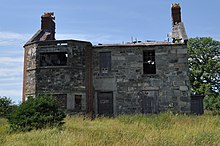
Division 1, Newfoundland and Labrador is a census division covering the entire Avalon Peninsula including the Isthmus of Avalon of the Canadian province of Newfoundland and Labrador. Like all census divisions in Newfoundland and Labrador, but unlike the census divisions of some other provinces, the division exists only as a statistical division for census data, and is not a political entity.

The Basilica-Cathedral of St. John the Baptist in St. John's, Newfoundland and Labrador is the metropolitan cathedral of the Roman Catholic Archdiocese of St. John's, Newfoundland and the mother church and symbol of Roman Catholicism in Newfoundland. The building sits within the St. John's Ecclesiastical District, a National Historic District of Canada.

Carbonear is a town on the Avalon Peninsula in Newfoundland and Labrador, Canada. It overlooks the west side of Conception Bay and had a history long tied to fishing and shipbuilding. Since the late 20th century, its economy has changed to emphasize education, health care, retail, and industry. As of 2021, there were 4,696 people in the community.

Heart's Content is an incorporated town in Trinity Bay on the Bay de Verde Peninsula of Newfoundland and Labrador, Canada.
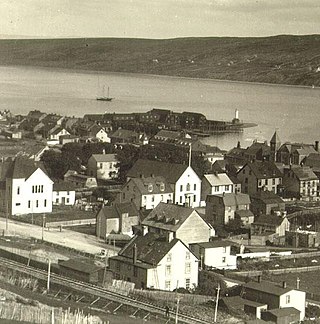
Harbour Grace is a town in Conception Bay on the Avalon Peninsula in the province of Newfoundland and Labrador, Canada. With roots dating back to the 16th century, it is one of the oldest towns in North America.
The 1869 Newfoundland general election was held in 1869 to elect members of the 10th General Assembly of Newfoundland in the Newfoundland Colony. 21 Anti-Confederates (A-C) were elected against 9 Confederates (Con), ending for a moment the debate over joining the Dominion of Canada.
Springdale is a town in Newfoundland and Labrador, Canada, which had a population of 2,965 people in 2021, up from 2,764 in the Canada 2006 Census. The community is located on the Northwestern shores of Hall's Bay in Central Newfoundland, near the mouth of Indian River.

The Heritage Foundation of Newfoundland and Labrador (HFNL) or Heritage NL is a non-profit Crown corporation of the Government of Newfoundland and Labrador established in 1984 by the Historic Resources Act. Its mandate is to stimulate an understanding of, and an appreciation for, the architectural and intangible cultural heritage of Newfoundland and Labrador. In 2018 HFNL rebranded as Heritage NL for its public-facing work.
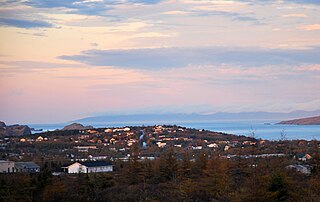
Bay Roberts is a town located on the north shore of Conception Bay on the northeastern Avalon Peninsula in the province of Newfoundland and Labrador, Canada. The growth of the local economy can be connected to the town's proximity to other major Newfoundland markets, by road and by water.

Clarke's Beach is a town on Conception Bay in the Canadian province of Newfoundland and Labrador. In the 2021 census the town had a population of 1,400. It is the home of a number of well-known Newfoundland artists, and is a favourite place for retirement.

North River is a town on the Avalon Peninsula of Newfoundland in the Canadian province of Newfoundland and Labrador. It was incorporated as a municipality in 1964.
Thomas Ridley was a merchant and political figure in Newfoundland. He represented Conception Bay in the Newfoundland and Labrador House of Assembly from 1842 to 1848.
The 1842 Newfoundland general election was held in 1842 to elect members of the 3rd General Assembly of Newfoundland in Newfoundland Colony. The elected assembly with 15 members and the appointed Legislative Council with 10 members were combined into a unicameral legislature.
John Munn was a Scottish-born merchant and political figure in Newfoundland. He represented Conception Bay from 1842 to 1848 and Harbour Grace from 1869 to 1873 in the Newfoundland and Labrador House of Assembly as a Conservative.
The Avalon East Senior Hockey League (AESHL) is a senior ice hockey league with teams based in Newfoundland. It is one of two senior hockey leagues in Newfoundland; the other being the West Coast Senior Hockey League.
William Austin Oke was a newspaper publisher, politician, and District Court judge in Newfoundland. He represented Harbour Grace in the Newfoundland House of Assembly for three terms, from 1898 to 1908, as a Liberal.
The Conception Bay Sports Arena, also known as the Bay Roberts Arena, was an open-air ice arena with an artificial ice surface located in Bay Roberts, Newfoundland and Labrador, Canada. The arena was located on the Conception Bay highway at the hub of the communities of Bay Roberts, Coley's Point, Brigus, Shearstown, Harbour Grace and Carbonear. The rink had the first artificial ice surface in Conception Bay but was used less than three years from 1956 to 1958.
Betty Parsley is a Canadian politician, who was elected to the Newfoundland and Labrador House of Assembly in the 2015 provincial election. She represented the electoral district of Harbour Main as a member of the Liberal Party from 2015 to 2019.
Robert Oke, H.M. was the first chief inspector for the Newfoundland Lighthouse Service and served from at least 1848 to 1870. Oke installed the first light mechanism at the Cape Bonavista Light in 1842, and installed the famous Isle of May light mechanism at the Cape Pine Light in 1850, which was later moved to Harbour Grace Island and finally to Cape Bonavista, where it can be viewed today.