
Georg Friedrich Bernhard Riemann was a German mathematician who made contributions to analysis, number theory, and differential geometry. In the field of real analysis, he is mostly known for the first rigorous formulation of the integral, the Riemann integral, and his work on Fourier series. His contributions to complex analysis include most notably the introduction of Riemann surfaces, breaking new ground in a natural, geometric treatment of complex analysis. His famous 1859 paper on the prime-counting function, containing the original statement of the Riemann hypothesis, is regarded as one of the most influential papers in analytic number theory. Through his pioneering contributions to differential geometry, Riemann laid the foundations of the mathematics of general relativity. He is considered by many to be one of the greatest mathematicians of all time.

In the mathematical field of differential geometry, the Riemann curvature tensor or Riemann–Christoffel tensor is the most common way used to express the curvature of Riemannian manifolds. It assigns a tensor to each point of a Riemannian manifold, that measures the extent to which the metric tensor is not locally isometric to that of Euclidean space. The curvature tensor can also be defined for any pseudo-Riemannian manifold, or indeed any manifold equipped with an affine connection.
In differential geometry, a (smooth) Riemannian manifold or (smooth) Riemannian space(M, g) is a real, smooth manifold M equipped with an inner product gp on the tangent space TpM at each point p that varies smoothly from point to point in the sense that if X and Y are differentiable vector fields on M, then p ↦ gp(X|p, Y|p) is a smooth function. The family gp of inner products is called a Riemannian metric. These terms are named after the German mathematician Bernhard Riemann. The study of Riemannian manifolds constitutes the subject called Riemannian geometry.

Riemannian geometry is the branch of differential geometry that studies Riemannian manifolds, smooth manifolds with a Riemannian metric, i.e. with an inner product on the tangent space at each point that varies smoothly from point to point. This gives, in particular, local notions of angle, length of curves, surface area and volume. From those, some other global quantities can be derived by integrating local contributions.
In Riemannian geometry, the scalar curvature is the simplest curvature invariant of a Riemannian manifold. To each point on a Riemannian manifold, it assigns a single real number determined by the intrinsic geometry of the manifold near that point. Specifically, the scalar curvature represents the amount by which the volume of a small geodesic ball in a Riemannian manifold deviates from that of the standard ball in Euclidean space. In two dimensions, the scalar curvature is twice the Gaussian curvature, and completely characterizes the curvature of a surface. In more than two dimensions, however, the curvature of Riemannian manifolds involves more than one functionally independent quantity.
In mathematics, the uniformization theorem says that every simply connected Riemann surface is conformally equivalent to one of three Riemann surfaces: the open unit disk, the complex plane, or the Riemann sphere. In particular it implies that every Riemann surface admits a Riemannian metric of constant curvature. For compact Riemann surfaces, those with universal cover the unit disk are precisely the hyperbolic surfaces of genus greater than 1, all with non-abelian fundamental group; those with universal cover the complex plane are the Riemann surfaces of genus 1, namely the complex tori or elliptic curves with fundamental group Z2; and those with universal cover the Riemann sphere are those of genus zero, namely the Riemann sphere itself, with trivial fundamental group.

Karl Wilhelm Julius Hugo Riemann was a German music theorist and composer.
In differential geometry, the Weyl curvature tensor, named after Hermann Weyl, is a measure of the curvature of spacetime or, more generally, a pseudo-Riemannian manifold. Like the Riemann curvature tensor, the Weyl tensor expresses the tidal force that a body feels when moving along a geodesic. The Weyl tensor differs from the Riemann curvature tensor in that it does not convey information on how the volume of the body changes, but rather only how the shape of the body is distorted by the tidal force. The Ricci curvature, or trace component of the Riemann tensor contains precisely the information about how volumes change in the presence of tidal forces, so the Weyl tensor is the traceless component of the Riemann tensor. It is a tensor that has the same symmetries as the Riemann tensor with the extra condition that it be trace-free: metric contraction on any pair of indices yields zero.
In mathematics, a quadratic differential on a Riemann surface is a section of the symmetric square of the holomorphic cotangent bundle. If the section is holomorphic, then the quadratic differential is said to be holomorphic. The vector space of holomorphic quadratic differentials on a Riemann surface has a natural interpretation as the cotangent space to the Riemann moduli space, or Teichmüller space.
In semi-Riemannian geometry, the Bel decomposition, taken with respect to a specific timelike congruence, is a way of breaking up the Riemann tensor of a pseudo-Riemannian manifold into lower order tensors with properties similar to the electric field and magnetic field. Such a decomposition was partially described by Alphonse Matte in 1953 and by Lluis Bel in 1958.
In Riemannian geometry and pseudo-Riemannian geometry, curvature invariants are scalar quantities constructed from tensors that represent curvature. These tensors are usually the Riemann tensor, the Weyl tensor, the Ricci tensor and tensors formed from these by the operations of taking dual contractions and covariant differentiations.
In differential geometry, the term curvature tensor may refer to:
In mathematics, spaces of non-positive curvature occur in many contexts and form a generalization of hyperbolic geometry. In the category of Riemannian manifolds, one can consider the sectional curvature of the manifold and require that this curvature be everywhere less than or equal to zero. The notion of curvature extends to the category of geodesic metric spaces, where one can use comparison triangles to quantify the curvature of a space; in this context, non-positively curved spaces are known as (locally) CAT(0) spaces.
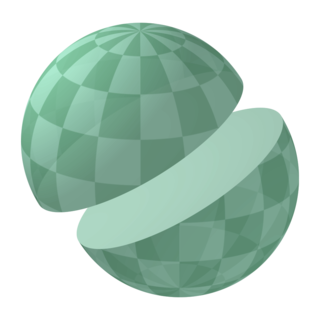
In metric space theory and Riemannian geometry, the Riemannian circle is a great circle equipped with its great-circle distance. It is the circle equipped with its intrinsic Riemannian metric of a compact one-dimensional manifold of total length 2π, or the extrinsic metric obtained by restriction of the intrinsic metric on the sphere, as opposed to the extrinsic metric obtained by restriction of the Euclidean metric to the unit circle in the plane. Thus, the distance between a pair of points is defined to be the length of the shorter of the two arcs into which the circle is partitioned by the two points.

Neo-Riemannian theory is a loose collection of ideas present in the writings of music theorists such as David Lewin, Brian Hyer, Richard Cohn, and Henry Klumpenhouwer. What binds these ideas is a central commitment to relating harmonies directly to each other, without necessary reference to a tonic. Initially, those harmonies were major and minor triads; subsequently, neo-Riemannian theory was extended to standard dissonant sonorities as well. Harmonic proximity is characteristically gauged by efficiency of voice leading. Thus, C major and E minor triads are close by virtue of requiring only a single semitonal shift to move from one to the other. Motion between proximate harmonies is described by simple transformations. For example, motion between a C major and E minor triad, in either direction, is executed by an "L" transformation. Extended progressions of harmonies are characteristically displayed on a geometric plane, or map, which portrays the entire system of harmonic relations. Where consensus is lacking is on the question of what is most central to the theory: smooth voice leading, transformations, or the system of relations that is mapped by the geometries. The theory is often invoked when analyzing harmonic practices within the Late Romantic period characterized by a high degree of chromaticism, including work of Schubert, Liszt, Wagner and Bruckner.
Riemannian most often refers to Bernhard Riemann:

In mathematics, the Riemann sphere, named after Bernhard Riemann, is a model of the extended complex plane, the complex plane plus a point at infinity. This extended plane represents the extended complex numbers, that is, the complex numbers plus a value ∞ for infinity. With the Riemann model, the point "∞" is near to very large numbers, just as the point "0" is near to very small numbers.
Riemann is a German surname. Notable people with this surname include the following:
"Riemannian theory" in general refers to the musical theories of German theorist Hugo Riemann (1849–1919). His theoretical writings cover many topics, including musical logic, notation, harmony, melody, phraseology, the history of music theory, etc. More particularly, the term Riemannian theory often refers to his theory of harmony, characterized mainly by its dualism and by a concept of harmonic functions.
