Related Research Articles

Eleuterio Pagliano was an Italian painter of the Romantic period as well as an activist and fighter of the Risorgimento.

Plinio Nomellini was an Italian painter in the Divisionist style.
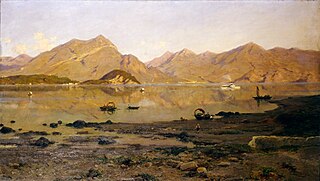
Silvio Poma was an Italian painter, who mainly painting land and lake-side seascapes of the Lombardy lake district.

Luigi Premazzi, also russified as Ludwig Osipovich Premazzi was an Italian painter, mainly of watercolor vedute.
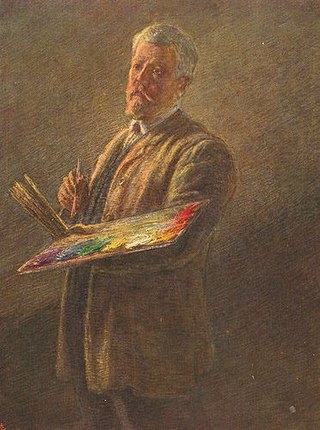
Gaetano Previati (1852–1920) was an Italian Symbolist painter in the Divisionist style.

Enrico Bartezago was an Italian painter, active in Milan, painting genre scenes, Portraits, and watercolors. In the exhibition of Paris of 1878, he displayed L' aia d' una fattoria lombarda. At the Mostra di Venezia of 1887, he exhibited La scimmia. Other works include Mercato a Varallo and Nemici. In 1891–92, he won the Mylius prize from the Academy at Milan for genre painting for his Alpine Pennine.

Alberto Issel (1848–1926) was an Italian painter.

Edoardo Monteforte was an Italian landscape painter.
Angelo Ribossi (1822–1886) was an Italian painter.
Cesare Balbi di Robecco (1854–1939) was an Italian painter, mainly of landscapes and seascapes.
Antonio Melchioni was an Italian painter, of both watercolors and oils. He was eclectic in subjects, but was best known for his genre subjects.
Domenico Pesenti was an Italian painter and antiquarian. He painted mainly vedute.

Raffaele Armando Califano Mundo was an Italian painter.
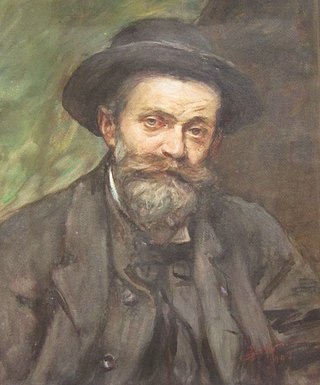
Alessandro Zezzos was an Italian painter of genre scenes, costume scenes, portraits, and vedute, in watercolors and oils.
Eugenio Spreafico was an Italian painter, mainly of landscapes and genre works.
Giuseppe Zannoni was an Italian painter.
Carlo Paolo Agazzi or Carlo Agazzi was an Italian painter of landscapes and still lifes in oil and watercolors. He also made etchings.

Giovanni Pessina (1836—1904) was an Italian painter. Described in contemporary documents as a painter of perspective and an internista, he specialized in vedute of interiors in a precise, realist style.
Virgilio Ripari ) was an Italian painter, mainly depicting genre scenes of women and flowers. His style is described as a late Romantic, often depicting nuns and scene galanti.
Francesco Autoriello was an Italian painter, mainly depicting historical canvases.
References
- ↑ Angelo De Gubernatis cites his birthplace as Angera, a town in the Province of Varese, on the shores of Lake Maggiore in Northern Lombardy.
- ↑ Catalogue Accademia Carrera.
- ↑ Matteucci biography[ dead link ]
- ↑ Fondazione Cariplo biography.
- ↑ Istituto Matteucci biography
- ↑ Dizionario degli Artisti Italiani Viventi: pittori, scultori, e Architetti., by Angelo de Gubernatis. Tipe dei Successori Le Monnier, 1889, page 453.
- ↑ Dictionary of Brescian painters, lists Saporiti as a Brescian painter. Archived 2016-03-04 at the Wayback Machine
 | This article about an Italian painter born in the 19th century is a stub. You can help Wikipedia by expanding it. |