Related Research Articles

Bengal is a historical geographical, ethnolinguistic and cultural term referring to a region in the eastern part of the Indian subcontinent at the apex of the Bay of Bengal. The region of Bengal proper is divided between the modern-day sovereign nation of Bangladesh and the Indian states of West Bengal, and some parts of Assam.

Warren Hastings was a British colonial administrator, who served as the first governor of the Presidency of Fort William (Bengal), the head of the Supreme Council of Bengal, and so the first governor-general of Bengal in 1772–1785. He and Robert Clive are credited with laying the foundation of the British Empire in India. He was an energetic organizer and reformer. In 1779–1784 he led forces of the East India Company against a coalition of native states and the French. In the end, the well-organized British side held its own, while France lost influence in India. In 1787, he was accused of corruption and impeached, but he was eventually acquitted in 1795 after a long trial. He was made a privy councillor in 1814.

The Governor-General of India was the representative of the monarch of the United Kingdom in their capacity as the emperor/empress of India and after Indian independence in 1947, the representative of the monarch of India. The office was created in 1773, with the title of governor-general of the Presidency of Fort William. The officer had direct control only over his presidency but supervised other East India Company officials in India. Complete authority over all of British territory in the Indian subcontinent was granted in 1833, and the official came to be known as the governor-general of India.
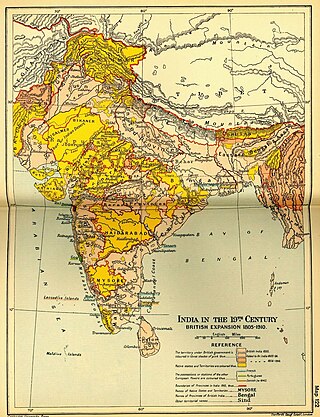
Company rule in India refers to regions of the Indian subcontinent under the control of the British East India Company (EIC). The EIC, founded in 1600, established their first trading post in India in 1612, and gradually expanded their presence in the region over the following decades. During the Seven Years' War, the East India Company began a process of rapid expansion in India which resulted in most of the subcontinent falling under their rule by 1857, when the Indian Rebellion of 1857 broke out. After the rebellion was suppressed, the Government of India Act 1858 resulted in the EIC's territories in India being administered by the Crown instead. The India Office managed the EIC's former territories, which became known as the British Raj.

Sir Charles Wilkins was an English typographer and Orientalist, and founding member of the Asiatic Society. He is notable as the first translator of the Bhagavad Gita into English. He is also the first person to introduce the term Hinduism which would refer to all the different mythologies and cultures of which were existing in India as one. He supervised Panchanan Karmakar to create one of the first Bengali typefaces. In 1788, Wilkins was elected a member of the Royal Society.

William Carey was an English Christian missionary, Particular Baptist minister, translator, social reformer and cultural anthropologist who founded the Serampore College and the Serampore University, the first degree-awarding university in India and cofounded the Serampore Mission Press.

Nathaniel Brassey Halhed was an English Orientalist and philologist.

The Second Anglo-Mysore War was a conflict between the Kingdom of Mysore and the British East India Company from 1780 to 1784. At the time, Mysore was a key French ally in India, and the conflict between Britain against the French and Dutch in the American Revolutionary War influenced Anglo-Mysorean hostilities in India. The great majority of soldiers on the company side were raised, trained, paid and commanded by the company, not the British government. However, the company's operations were also bolstered by Crown troops sent from Great Britain, and by troops from Hanover, which was also ruled by Great Britain's King George III.

The Bengal Presidency, officially the Presidency of Fort William in Bengal, later the Bengal Province, was the largest of all three presidencies of British India during Company rule and later a province of India. At the height of its territorial jurisdiction, it covered large parts of what is now South Asia and Southeast Asia. Bengal proper covered the ethno-linguistic region of Bengal. Calcutta, the city which grew around Fort William, was the capital of the Bengal Presidency. For many years, the governor of Bengal was concurrently the governor-general of India and Calcutta was the capital of India until 1911.

Silchar is a city and the headquarters of the Cachar district of the state of Assam, India. It is second largest city of Assam after Guwahati in terms of area, population and GDP. It is also administrative capital of Barak Valley division. It is located 343 kilometres south east of Guwahati. It was founded by Captain Thomas Fisher in 1832 when he shifted the headquarters of Cachar to Janiganj in Silchar. It earned the moniker "Island of Peace" from Indira Gandhi, the then Prime Minister of India. Silchar is the site of the world's first polo club and the first competitive polo match. In 1985, an Air India flight from Kolkata to Silchar became the world's first all-women crew flight. Silchar was a tea town and Cachar club was the meeting point for tea planters.
Kolkata was a colonial city. The British East India Company developed Calcutta as a village by establishing an artificial riverine port in the 18th century CE. Kolkata was the capital of the British India until 1911, when the capital was relocated to Delhi. Kolkata grew rapidly in the 19th century to become the second most important city of the British Empire after London and was declared as the financial (commercial) capital of the British India. This was accompanied by the fall of a culture that fused Indian philosophies with European tradition.

The Bengal Renaissance, also known as the Bengali Renaissance, was a cultural, social, intellectual, and artistic movement that took place in the Bengal region of the British Raj, from the late 18th century to the early 20th century. Historians have traced the beginnings of the movement to the victory of the British East India Company at the 1757 Battle of Plassey, as well as the works of reformer Raja Rammohan Roy, considered the "Father of the Indian Renaissance," born in 1772. Nitish Sengupta stated that the movement "can be said to have … ended with Rabindranath Tagore," Asia's first Nobel laureate.

The British Raj was the rule of the British Crown on the Indian subcontinent, lasting from 1858 to 1947. It is also called Crown rule in India, or Direct rule in India. The region under British control was commonly called India in contemporaneous usage and included areas directly administered by the United Kingdom, which were collectively called British India, and areas ruled by indigenous rulers, but under British paramountcy, called the princely states. The region was sometimes called the Indian Empire, though not officially. As India, it was a founding member of the League of Nations and a founding member of the United Nations in San Francisco in 1945. India was a participating state in the Summer Olympics in 1900, 1920, 1928, 1932, and 1936.

Pandit Madhusudan Gupta was a Bengali Baidya Brahmin translator and Ayurvedic practitioner who was also trained in Western medicine and is credited with having performed India's first human dissection at Calcutta Medical College (CMC) in 1836, almost 3,000 years after Susruta.
Anglo-Hindu law is the case law that developed in British India, through the interpretation of the Hindu scriptures and customary law in the British courts.
The Calcutta School-Book Society was an organisation based in Kolkata during the British Raj. It was established in 1817, with the aim of publishing text books and supplying them to schools and madrasas in India.
The Serampore Mission Press was a book and newspaper publisher that operated in Serampore, Danish India, from 1800 to 1837.
In the last quarter of the 18th century, Calcutta grew into the first major centre of commercial and government printing. For the first time in the context of South Asia it becomes possible to talk of a nascent book trade which was full-fledged and included the operations of printers, binders, subscription publishing and libraries.

The impeachment of Warren Hastings, the first governor-general of the Bengal Presidency in India, was attempted between 1787 and 1795 in the Parliament of Great Britain. Hastings was accused of misconduct during his time in Calcutta, particularly relating to mismanagement and personal corruption. The impeachment prosecution was led by Edmund Burke and became a wider debate about the role of the East India Company and the expanding empire in India. According to historian Mithi Mukherjee, the impeachment trial became the site of a debate between two radically opposed visions of empire—one represented by Hastings, based on ideas of absolute power and conquest in pursuit of the exclusive national interests of the colonizer, versus one represented by Burke, of sovereignty based on a recognition of the rights of the colonized.

The Bengali–Assamese script, sometimes also known as Eastern Nagri, is an eastern Brahmic script, primarily used today for the Bengali and Assamese language spoken in eastern South Asia. It evolved from Gaudi script, also the common ancestor of the Odia and Trihuta scripts. It is commonly referred to as the Bengali script by Bengalis and the Assamese script by the Assamese, while in academic discourse it is sometimes called Eastern-Nāgarī. Three of the 22 official languages of the Indian Republic—Bengali, Assamese, and Meitei—commonly use this script in writing; Bengali is also the official and national language of Bangladesh.
References
- Jones, Kenneth W. Jones, "Socio Religious Reform Movements in British India". The New Cambridge History of India. 1994. India.
| International | |
|---|---|
| Artists | |
