Related Research Articles

Jugendstil was an artistic movement, particularly in the decorative arts, that was influential primarily in Germany and elsewhere in Europe to a lesser extent from about 1895 until about 1910. It was the German counterpart of Art Nouveau. The members of the movement were reacting against the historicism and neo-classicism of the official art and architecture academies. It took its name from the art journal Jugend, founded by the German artist Georg Hirth. It was especially active in the graphic arts and interior decoration.
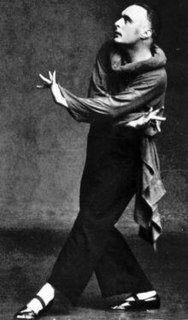
Rudolf von Laban, also known as Rudolf Laban, was an Austro-Hungarian, German and British dance artist, choreographer and dance theorist. He is considered a "founding father of expressionist dance", and a pioneer of modern dance. His theoretical innovations included Laban movement analysis and Labanotation, which paved the way for further developments in dance notation and movement analysis. He initiated one of the main approaches to dance therapy. His work on theatrical movement has also been influential. He attempted to apply his ideas to several other fields, including architecture, education, industry, and management.
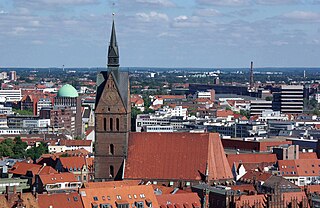
The Marktkirche St. Georgii et Jacobi, commonly known as Marktkirche, is the main Lutheran church in Hanover, Germany. It was built in the 14th century and, together with the nearby Old Town Hall, is considered the southernmost example of the North German brick gothic architectural style. The roof and the vaults of the naves were destroyed in an air raid in 1943 and restored in 1952.
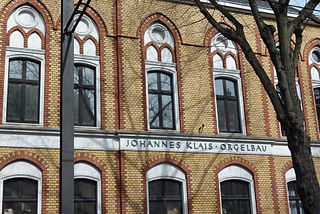
Orgelbau Klais is a German firm that designs, builds and restores pipe organs. It is a family run company, founded in 1882 by Johannes Klais senior and is now run by his great-grandson Philipp Klais. The firm is based in Bonn, Germany, and has completed many large-scale building and restoration projects around the globe in more than a century of organ building.
Hans Henny Jahnn was a German playwright, novelist, and organ-builder.

Rieger Orgelbau is an Austrian firm of organ builders, known generally as Rieger. The firm was founded by Franz Rieger. From 1873 it was known as Rieger & Söhne, and from 1879 as Gebrüder Rieger, after his sons took over. At the end of World War II, the firm was nationalised by the Czech government and merged with another workshop as Rieger-Kloss. The Rieger tradition was also continued by the owners and workers of the original firm, who moved to Austria and founded a new workshop as "Rieger Orgelbau".

Ludwigskirche in Old Saarbrücken, Germany, is a Lutheran baroque-style church. It is the symbol of the city and is considered to be one of the most important Protestant churches in Germany, along with the Dresden Frauenkirche and the St. Michael's Church, Hamburg.
Rudolf von Beckerath was a German master organ builder. He was born in Munich, to the painter Willy von Beckerath, but grew up in Hamburg, where his family moved the year he was born. He initially pursued an interest in mechanical engineering. After encountering the quality of northern German pipe organs, particularly that of master builder Arp Schnitger, von Beckerath's interest shifted. He trained as a cabinet maker at the art school in Hamburg, while studying the fundamentals of organ building on his own. In the cellar of his parents' home, he built a small house-organ, which was heard in a radio broadcast from the house and in concerts there.

Orgelbau Vleugels is a pipe organ company producing organs in modern design and restoring historic instruments. The workshop is located in Hardheim, Germany. The owner is master pipe organ builder Hans-Georg Vleugels. The company has a history spanning over 150 years.
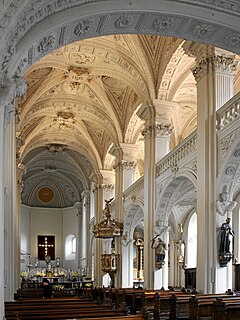
The Church of St. Andreas is a Roman Catholic parish church situated in the center of the German city of Düsseldorf. It is the priory church of the local community of Dominican Friars, who also administer the much older Church of St. Lambert.
Trinity Lutheran Church was founded in 1853 when a few members of Zion Lutheran Church in Cleveland, Ohio, decided to start a new congregation. Reverend J. C. Lindemann was the first pastor at Trinity. The current building used for worship was built in 1873 at the corner of Lorain Avenue and West 30th Street.

The organ of St. Peter and Paul in Cappel was built in 1680 by Arp Schnitger for the St. Johannis-Klosterkirche in Hamburg and has been in Cappel, Lower Saxony since 1816. It is considered to be the most complete and sonically best-preserved organ from the late 17th century in northern Germany. The instrument has two manuals with pedal and 30 stops, of which only two are not entirely old. Helmut Walcha's recordings of Bach's organ works (1950–1952) made this instrument world-famous.

Orgelbau Pieringer is an Austrian organ building company based in the city of Haag in Lower Austria. The founder and owner of the company is the Haag organ builder Johann Pieringer. Orgelbau Pieringer is a reputable organ workshop active for 25 years throughout Austria, Germany and Croatia, as well as a member of International Society of Organbuilders.

Johann Heinrich Wohlien also known as Johann Hinrich Wohlien, or Wohlin and Wollin (1779–1842) was a German master organ builder.
Carl Alexander Schuke was a German organ builder and from 1894 to 1933 owner and manager of the Alexander Schuke Potsdam Orgelbau. The company still exists today.
Hans-Joachim Schuke was a German organ builder. He was the son of the organ builder Alexander Schuke and ran his father's company, the "Alexander Schuke Orgelbauanstalt Potsdam", today the Alexander Schuke Potsdam Orgelbau company, weiter.

Karl Ludwig Alexander Schuke was a German organ builder. The son of the organ builder Alexander Schuke, he continued, together with his brother Hans-Joachim Schuke, to run their father's company in Potsdam until 1953, when he founded another organ building company, the Karl Schuke Berliner Orgelbauwerkstatt in West Berlin. They have built organs internationally in Korea, Australia and the U.S.
Matthias Schuke is a German organ builder.

Willy von Beckerath was a German painter and art professor; associated with the Düsseldorfer Malerschule. He was primarily known for portraits, landscapes and murals. From 1902, he was instrumental in the formation of the Deutsche Werkstätten Hellerau. He designed furniture and furnishings for churches. From 1907 to 1931, he was professor at the Staatliche Kunstgewerbeschule in Hamburg, where he decorated a new assembly hall with a monumental mural over three of its walls, Die ewige Welle.
von Beckerath is a surname. Many people carrying the name are members of the noble German Mennonite Beckerath family.
References
- ↑ "Historic organs: Beckerath Notes". Richards, Fowkes & Co. Retrieved 30 June 2013.
- ↑ "The Company's History". Rudolf von Beckerath Orgelbau. Archived from the original on 26 June 2013. Retrieved 28 June 2013.
