
Canvas is an extremely durable plain-woven fabric used for making sails, tents, marquees, backpacks, shelters, as a support for oil painting and for other items for which sturdiness is required, as well as in such fashion objects as handbags, electronic device cases, and shoes. It is popularly used by artists as a painting surface, typically stretched across a wooden frame.

Antonio Allegri da Correggio, usually known as just Correggio, was the foremost painter of the Parma school of the High Italian Renaissance, who was responsible for some of the most vigorous and sensuous works of the sixteenth century. In his use of dynamic composition, illusionistic perspective and dramatic foreshortening, Correggio prefigured the Baroque art of the seventeenth century and the Rococo art of the eighteenth century. He is considered a master of chiaroscuro.

Annibale Carracci was an Italian painter and instructor, active in Bologna and later in Rome. Along with his brother and cousin, Annibale was one of the progenitors, if not founders of a leading strand of the Baroque style, borrowing from styles from both north and south of their native city, and aspiring for a return to classical monumentality, but adding a more vital dynamism. Painters working under Annibale at the gallery of the Palazzo Farnese would be highly influential in Roman painting for decades.

Francesco Francia, whose real name was Francesco Raibolini was an Italian painter, goldsmith, and medallist from Bologna, who was also director of the city mint.

Giovanni Battista Cima, also called Cima da Conegliano, was an Italian Renaissance painter, who mostly worked in Venice. He can be considered part of the Venetian school, though he was also influenced by Antonello da Messina, in the emphasis he gives to landscape backgrounds and the tranquil atmosphere of his works. Once formed his style did not change greatly. He mostly painted religious subjects, often on a small scale for homes rather than churches, but also a few, mostly small, mythological ones.

The Inspiration of Saint Matthew (1602) is a painting by the Italian Baroque master Michelangelo Merisi da Caravaggio. Commissioned by the French Cardinal Matteo Contarelli, the canvas hangs in Contarelli chapel altar in the church of the French congregation San Luigi dei Francesi in Rome, Italy. It is one of three Caravaggio canvases in the chapel: hanging between the larger earlier canvases of The Martyrdom of Saint Matthew, and The Calling of Saint Matthew. This was not an easy commission for Caravaggio, and at least two of the three paintings had to be either replaced or repainted to satisfy his patron, the Cardinal Del Monte.
Tadeusz Żukotyński was a Polish count, professor, and painter.

Bartolomeo Cavarozzi (1587–1625), occasionally referred to as Bartolomeo Crescenzi, was an Italian caravaggisti painter of the Baroque period. Cavarozzi's work begin receiving increased admiration and appreciation from art historians in the last few decades of the 20th century, emerging as one of the more distinct and original followers of Caravaggio. He received training from Giovanni Battista Crescenzi in Rome and later traveled to Spain alongside his master for a few years where he achieved some renown and was significant in spreading "Caravaggism" to Spain before returning to Italy. His surviving works are predominantly Biblical subjects and still-life paintings, although older references note he "was esteemed a good painter especially of portraits".

The Palais des Beaux-Arts de Lille is a municipal museum dedicated to fine arts, modern art, and antiquities. It is one of the largest art museums in France.

The Abbey of Santa Giustina is a 10th-century Benedictine abbey complex located in front of the Prato della Valle in central Padua, region of Veneto, Italy. Adjacent to the former monastery is the basilica church of Santa Giustina, initially built in the 6th century, but whose present form derives from a 17th-century reconstruction.

The Musée des Beaux-Arts d'Arras is located in the old Abbey of St. Vaast in Arras, in the Nord-Pas-de-Calais, France.

St. Matthew is an oil-on-canvas painting by the Dutch Golden Age painter Frans Hals, painted in 1625 and now in the Odessa Museum of Western and Eastern Art, Odessa.

St. Matthew and the Angel is an oil-on-canvas painting by the Dutch landscape painter Rembrandt. It is an example of Dutch Golden Age painting and is now in the collection of the Louvre.
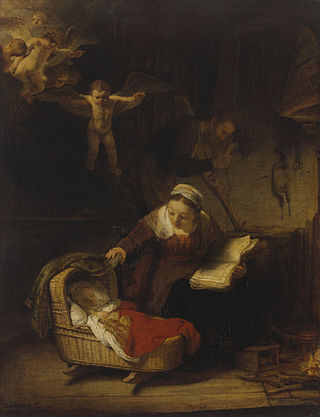
The Holy Family with Angels (1645) is an oil painting on canvas by the Dutch painter Rembrandt. It is an example of Dutch Golden Age painting and is now in the collection of the Hermitage Museum.
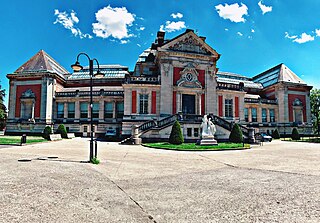
The musée des beaux-arts de Valenciennes is a municipal museum in the French town of Valenciennes. Its collections originated as the collection of the Académie valenciennoise de peinture et de sculpture. It opened to the public for the first time in 1801 and was moved into the town hall in 1834.

Saint Jerome and the Angel of Judgement is an oil on canvas painting by Jusepe de Ribera, signed and dated by the artist in 1626. It was produced as a display for a side chapel next to the high altar of the church of Santissima Trinità delle Monache, which also housed Ribera's Earthly Trinity. After the religious order running the building was suppressed in 1813, the canvas entered the Bourbon Collection and the National Museum of Capodimonte in Naples, where it still hangs today.

The Assassination of Saint Peter Martyr or The Martyrdom of Saint Peter of Verona is a 1530–1535 oil on canvas painting by Moretto da Brescia, now in the Sala dell'Esedra in the Pinacoteca Ambrosiana in Milan.

Saint Matthew and the Angel is an oil on canvas painting by Giovanni Gerolamo Savoldo, executed c. 1530-1535, depicting Saint Matthew, now in the Metropolitan Museum of Art, in New York. It was a major influence on the young Caravaggio.

Saint Matthew and the Angel is a 1621-1622 oil on canvas painting, produced by Guercino during his early years in Rome and now in the Musei Capitolini in Rome.
