
Friedrichshain is a quarter (Ortsteil) of the borough of Friedrichshain-Kreuzberg in Berlin, Germany. From its creation in 1920 until 2001, it was a freestanding city borough. Formerly part of East Berlin, it is adjacent to Mitte, Prenzlauer Berg, Kreuzberg and Lichtenberg.

Jusepe de Ribera was a Spanish painter and printmaker. Ribera, Francisco de Zurbarán, Bartolomé Esteban Murillo, and the singular Diego Velázquez, are regarded as the major artists of Spanish Baroque painting. Referring to a series of Ribera exhibitions held in the late 20th century, Philippe de Montebello wrote "If Ribera's status as the undisputed protagonist of Neapolitan painting had ever been in doubt, it was no longer. Indeed, to many it seemed that Ribera emerged from these exhibitions as not simply the greatest Neapolitan artist of his age but one of the outstanding European masters of the seventeenth century." Jusepe de Ribera has also been referred to as José de Ribera, Josep de Ribera, and Lo Spagnoletto by his contemporaries, early historians, and biographers.

Tenebrism, from Italian tenebroso, also occasionally called dramatic illumination, is a style of painting using especially pronounced chiaroscuro, where there are violent contrasts of light and dark, and where darkness becomes a dominating feature of the image. The technique was developed to add drama to an image through a spotlight effect, and is common in Baroque paintings. Tenebrism is used only to obtain a dramatic impact while chiaroscuro is a broader term, also covering the use of less extreme contrasts of light to enhance the illusion of three-dimensionality.
Lost artworks are original pieces of art that credible sources indicate once existed but that cannot be accounted for in museums or private collections or are known to have been destroyed deliberately or accidentally or neglected through ignorance and lack of connoisseurship.

The Bode Museum, formerly called the Kaiser-Friedrich-Museum, is a listed building on the Museum Island in the historic centre of Berlin. It was built from 1898 to 1904 by order of German Emperor William II according to plans by Ernst von Ihne in Baroque Revival style. The building's front square featured a memorial to German Emperor Frederick III, which was destroyed by the East German authorities. Currently, the Bode-Museum is home to the Skulpturensammlung, the Museum für Byzantinische Kunst and the Münzkabinett. As part of the Museum Island complex, the Bode-Museum was inscribed on the UNESCO World Heritage List in 1999 because of its outstanding architecture and testimony to the development of museums as a cultural phenomenon in the late 19th and early 20th centuries.

The Church and Convent of the Girolamini or Gerolamini is a church and ecclesiastical complex in Naples, Italy. It is located directly across from the Cathedral of Naples on via Duomo. The facade is across the homonymous piazza and street from Santa Maria della Colonna. It is one block west of Via Duomo.

The Clubfoot is a 1642 oil on canvas painting by Jusepe de Ribera. It is housed in the Musée du Louvre in Paris, and was painted in Naples. Art historian Ellis Waterhouse wrote of it as "a touchstone by which we can interpret the whole of Ribera's art".

Aristotle is a 1637 oil painting by Spanish artist Jusepe de Ribera, located in the Indianapolis Museum of Art, which is in Indianapolis, Indiana. It is part of a series of six portraits of ancient philosophers commissioned by the Prince of Liechtenstein in 1636.

Juan Antonio Ribera Fernandez, also Juan Antonio de Ribera was a Spanish painter.
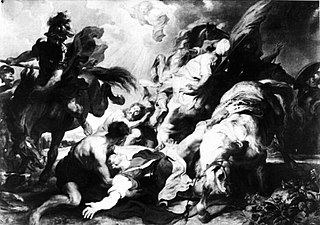
The Conversion of Saint Paul is a 1620s painting by Peter Paul Rubens, now missing or lost. It showed the conversion of Paul the Apostle.
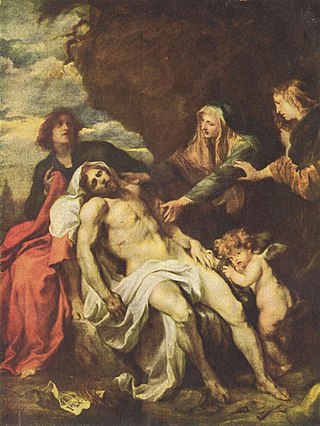
The Deposition or Lamentation over the Dead Christ was a painting by the Flemish painter Anthony van Dyck, produced between 1629 and 1630. It measured 220 cm by 166 cm. Its final owners were the Kaiser Friedrich Museum then the Gemäldegalerie, Berlin, before it was lost in May 1945 in the Friedrichshain flak tower fire. A copy of the work is now in the Gedächtniskapelle of the Deutschordensmünster in Heilbronn.

The Martyrdom of Saint Philip is a painting by Jusepe de Ribera from 1639.

Canan Bayram is a German lawyer and politician. She is a member of the 19th German Parliament (Bundestag). She was a member of the House of Representatives of Berlin from 2006 to 2017, when she was directly elected to the Berlin-Friedrichshain-Kreuzberg – Prenzlauer Berg East electoral district in the 2017 federal election. From 2017 until 2021, she was the only Alliance 90/Green member of parliament to hold a direct mandate rather than being elected from the party list.

Ixion is a 1632 oil painting, signed and dated by Jusepe de Ribera. It shows a scene from Classical mythology, of Ixion being tortured as the eternal punishment meted out by Zeus. It is one of a series of four paintings by Ribera of the four "Furies" or "Condemned" from Greek mythology. It is held by the Museo del Prado in Madrid, along with Ribera's painting of Tityos; the other two, of Sisyphus and Tantalus, are lost.
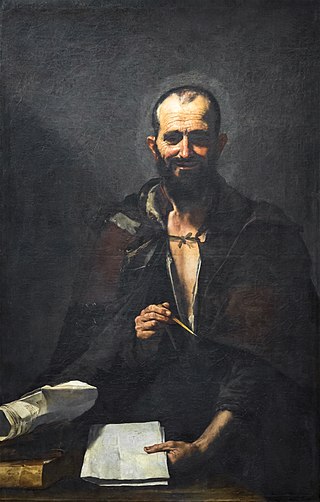
Democritus is an oil on canvas painting by Jusepe de Ribera, executed in 1630, now in the Museo del Prado, in Madrid. It is believed to depict the Ancient Greek philosopher Democritus.

Isaac and Jacob is an oil on canvas painting by Jusepe de Ribera, executed in 1637, which since 1918 has been in the Prado Museum in Madrid.

The Martyrdom of Saint Andrew is a 1628 painting by Jusepe de Ribera. It depicts the martyrdom of Saint Andrew, one of the Twelve Apostles.

The Tornabuoni Altarpiece is a tempera on panel painting by Domenico Ghirlandaio and his studio as the high altarpiece for the Tornabuoni Chapel in Santa Maria Novella. It was begun around 1490 and completed around 1498, four years after the painter's death. It is now split between several museums, with the central panel and two others now in the Alte Pinakothek in Munich.

The Education of Pan is a lost c.1490 tempera on canvas painting by Luca Signorelli. It was in the Kaiser-Friedrich-Museum in Berlin but was moved to the Flakturm Friedrichshain during the Second World War. There it was destroyed in a fire in May 1945 just after the end of the war.
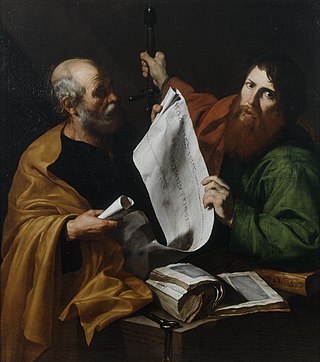
Saint Peter and Saint Paul is a circa 1616 Catholic Baroque painting by the Spanish-born Neapolitan artist Jusepe de Ribera. It is on display in the Musée des Beaux-Arts of Strasbourg, France. Its inventory number is 180.
