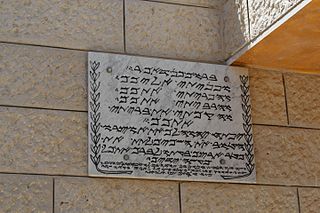
Samaritanism is an Abrahamic, monotheistic, and ethnic religion. It comprises the collective spiritual, cultural, and legal traditions of the Samaritan people, who originate from the Hebrews and Israelites and began to emerge as a relatively distinct group after the Kingdom of Israel was conquered by the Neo-Assyrian Empire during the Iron Age. Central to the faith is the Samaritan Pentateuch, which Samaritans believe is the original and unchanged version of the Torah.
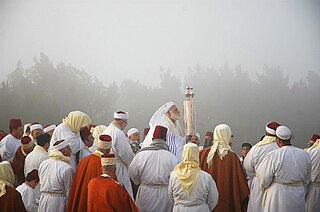
Samaritans, also known as Israelite Samaritans, are an ethnoreligious group who originate from the ancient Israelites. They are native to the Levant and adhere to Samaritanism, an Abrahamic ethnic religion similar to Judaism, but differing in several important aspects.

A synagogue, sometimes referred to as a shul or a temple, is a house of worship in Judaism. Synagogues have a place for prayer where Jews attend religious services or special ceremonies such as weddings, b'nai mitzvah, choir performances, and children's plays. They also have rooms for study, social halls, administrative and charitable offices, classrooms for religious and Hebrew studies, and many places to sit and congregate. They often display commemorative, historic, or modern artwork alongside items of Jewish historical significance or history about the synagogue itself.
Uzzi is a given name. One derivation is biblical, from Uzzî meaning "my strength". The name can also be transliterated as Uzi. It may be a nickname for Uzza/Uzzah, Uzzia/Uzziah, and Uziel/Uzziel.

The Samaritan Torah, commonly called the Samaritan Pentateuch, is a text of the Torah written in the Samaritan script and used as sacred scripture by the Samaritans. It dates back to one of the ancient versions of the Hebrew Bible that existed during the Second Temple period, and constitutes the entire biblical canon in Samaritanism.

Good Samaritan laws offer legal protection to people who give reasonable assistance to those who are, or whom they believe to be injured, ill, in peril, or otherwise incapacitated. The protection is intended to reduce bystanders' hesitation to assist, for fear of being sued or prosecuted for unintentional injury or wrongful death. An example of such a law in common-law areas of Canada: a Good Samaritan doctrine is a legal principle that prevents a rescuer who has voluntarily helped a victim in distress from being successfully sued for wrongdoing. Its purpose is to keep people from being reluctant to help a stranger in need for fear of legal repercussions should they make some mistake in treatment. By contrast, a duty to rescue law requires people to offer assistance and holds those who fail to do so liable.

The parable of the Good Samaritan is told by Jesus in the Gospel of Luke. It is about a traveler who is stripped of clothing, beaten, and left half dead alongside the road. First, a Jewish priest and then a Levite come by, but both avoid the man. Finally, a Samaritan happens upon the traveler. Although Samaritans and Jews were generally antagonistic towards each other, the Samaritan helps the injured man. Jesus is described as telling the parable in response to a provocative question from a lawyer, "And who is my neighbor?", in the context of the Great Commandment. The conclusion is that the neighbor figure in the parable is the one who shows mercy to their fellow man.
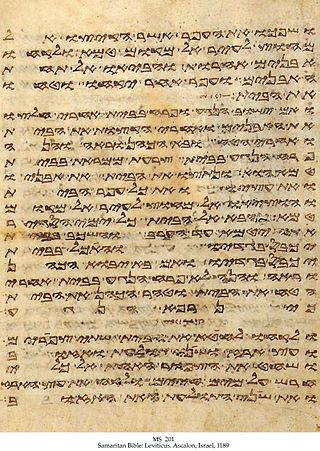
The Samaritan script is used by the Samaritans for religious writings, including the Samaritan Pentateuch, writings in Samaritan Hebrew, and for commentaries and translations in Samaritan Aramaic and occasionally Arabic.
Samaritan Hebrew is a reading tradition used liturgically by the Samaritans for reading the Ancient Hebrew language of the Samaritan Pentateuch, in contrast to Tiberian Hebrew among the Jewish people.
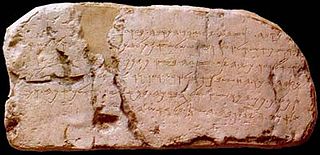
Biblical Hebrew, also called Classical Hebrew, is an archaic form of the Hebrew language, a language in the Canaanite branch of Semitic languages spoken by the Israelites in the area known as the Land of Israel, roughly west of the Jordan River and east of the Mediterranean Sea. The term "Hebrew" (ivrit) was not used for the language in the Hebrew Bible, which was referred to as שְֹפַת כְּנַעַן or יְהוּדִית, but the name was used in Ancient Greek and Mishnaic Hebrew texts.
Good Samaritan usually refers to the Parable of the Good Samaritan, a story in the Gospel of Luke that encourages people to help others who are in danger.

The Paleo-Hebrew script, also Palaeo-Hebrew, Proto-Hebrew or Old Hebrew, is the writing system found in inscriptions of Canaanite languages from the region of Southern Canaan, also known as biblical Israel and Judah. It is considered to be the script used to record the original texts of the Hebrew Bible due to its similarity to the Samaritan script, as the Talmud stated that the Hebrew ancient script was still used by the Samaritans. The Talmud described it as the "Libona'a script", translated by some as "Lebanon script". Use of the term "Paleo-Hebrew alphabet" is due to a 1954 suggestion by Solomon Birnbaum, who argued that "[t]o apply the term Phoenician [from Northern Canaan, today's Lebanon] to the script of the Hebrews [from Southern Canaan, today's Israel-Palestine] is hardly suitable". The Paleo-Hebrew and Phoenician alphabets are two slight regional variants of the same script.
The Samaritans are an ethnoreligious group of the eastern Mediterranean region, originating from connection with ancient Samaria.

Luke 10 is the tenth chapter of the Gospel of Luke in the New Testament of the Christian Bible. It records the sending of seventy disciples by Jesus, the famous parable about the Good Samaritan, and his visit to the house of Mary and Martha. This Gospel's author, who also wrote the Acts of the Apostles, is not named but is uniformly identified by early Christian tradition as Luke the Evangelist.
Passover is a major Jewish holiday that commemorates the Exodus of the Israelite people from Egypt, as described in the Torah.
Samaritan Aramaic, or Samaritan, was the dialect of Aramaic used by the Samaritans in their sacred and scholarly literature. This should not be confused with the Samaritan Hebrew language of the Scriptures. Samaritan Aramaic ceased to be a spoken language some time between the 10th and the 12th centuries, with Samaritans switching to Palestinian Arabic as their vernacular language.

Lourdes Hill College is a Good Samaritan Education secondary day school for girls, located in the inner-eastern Brisbane suburb of Hawthorne, Queensland, Australia. The college also operated as a boarding school until its boarding facilities were closed in 2011.
Good Samaritan Hospital or Good Samaritan Medical Center may refer to:

The Samaritan woman at the well is a figure from the Gospel of John. John 4:4–42 relates her conversation with Jesus at Jacob's Well near the city of Sychar.
Bad Samaritans or Bad Samaritan or variation, may refer to:
