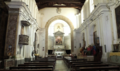
San Domenico, Trapani (Italian: Chiesa di San Domenico) is a medieval Dominican church in the historic centre of Trapani, Sicily. Founded in the 13th century, it formed part of the principal Dominican convent of the city and preserves architectural and artistic elements spanning several centuries.[1]
The church originated in the 13th century, when the Dominican Order established its principal convent in Trapani. The building contained medieval sepulchral fragments and commemorative inscriptions, reflecting its role as a burial place for notable local families.[1]
San Domenico retains several features of Sicilian Gothic, most notably its pointed stone portal and moulded Gothic profiles typical of 13th–14th-century monastic construction. Although the interior has undergone later alterations, traces of the medieval fabric remain visible in its structural lines and decorative elements.[1]
In 1825 Giuseppe Maria di Ferro described San Domenico as a church with a single nave and ten lateral chapels, admired for the simplicity of its architectural forms and the brightness of its main altar.[2]
In the presbytery stood the tomb of Infante Manfredi, son of Frederick III of Aragon. During later restorations the coffin was opened and the skeleton was found intact, clothed in garments embroidered with pearls, with a sword whose hilt and pommel were of solid gold. Nearby was another funerary slab commemorating royal persons who had died of plague after arriving from Africa with the body of Saint Louis IX of France.[2]
Art and decoration
In the fourth chapel on the left Di Ferro recorded a wooden crucifix brought from Soria in Spain by the first Spanish Dominican friars who settled in Trapani, valued primarily for its antiquity. The same chapel belonged to the Ferro family and was richly decorated with inlaid marbles, polychrome flooring, and funerary monuments designed by the Trapanese architect Luciano Gambina.[2]
Behind the high altar, near the Dominican choir, Di Ferro described a marble relief and two paintings: a Saint Raymond of Penyafort by Vito Carrera, signed and dated 1603, and a Saint Thomas Aquinas attributed to a Roman-school painter.[2]
Among the paintings he recorded were a portrait of Ludovico Beltrano by the Palermitan painter Pietro d’Aquila, and a large canvas of Saint Peter Martyr by Carreca, which he considered among the artist’s finest works for its dramatic composition and expressive realism.[2]
Artistic commissions for San Domenico are documented from the early fifteenth century. In 1405 the Sienese painter Nicolaus de Senis was contracted in Palermo to produce an altarpiece for the church depicting the Virgin Mary with Saints Catherine and Nicholas, with Christ and scenes of the Annunciation in the upper panels. This commission attests to the early importance of the convent as a centre of artistic patronage in Trapani.[3]
In 1531 Giovanni Micheletto commissioned Antonello Gagini to design a monumental marble Eucharistic custodia for the convent. Although the work was planned in detail, it was never executed by Antonello. The custodia currently preserved in the church, dated 1562, is of smaller scale and is generally attributed to Giacomo Gagini or to the Gagini workshop. It is decorated with relief scenes of the Last Supper, the Beheading of Saint John the Baptist, and Christ delivering the Keys to Saint Peter, with half-length figures of Saint John the Baptist and Saint Peter at the sides, and God the Father above.[3]
Convent
The church forms part of a larger convent complex (ex convento) which has been progressively restored and reused for civic and cultural functions. In the 2020s the Municipality of Trapani funded rehabilitation works to reopen parts of the complex to public use, including the tower and cloister areas, with the stated aim of expanding the site’s role as a cultural venue.[4]
According to the Municipality of Trapani, the restored convent complex includes a “Sala Grande” with over 200 seats used for conferences and public events, and also hosts the Centro di Aggregazione Giovanile San Domenico per Minori, a youth centre supporting social, educational and cultural activities.[5][6] A 2025 newspaper report described the complex as reopened to the public following regeneration works and selected as a venue for youth-oriented cultural programming in the historic centre.[7]
Part of the documentary material of the Fondo Nunzio Nasi has been kept in storage in the former convent premises and has been undergoing cataloguing work aimed at making it accessible to scholars.[8]
12345Di Ferro, Giuseppe Maria (1825). Guida per gli stranieri in Trapani: con un saggio storico[A Guide for Foreigners to Trapani: With a Historical Essay]. Trapani: Pietro Mannone e Solina. pp.268–272.
↑La città che legge: Trapani[The city that reads: Trapani](PDF) (Report) (in Italian). Centro per il libro e la lettura (CEPPELL). 2023. Retrieved 13 January 2026.
This page is based on this Wikipedia article Text is available under the CC BY-SA 4.0 license; additional terms may apply. Images, videos and audio are available under their respective licenses.