This article is being considered for deletion in accordance with Wikipedia's deletion policy. Please share your thoughts on the matter at this article's entry on the Articles for deletion page. Feel free to improve the article, but the article must not be blanked, and this notice must not be removed, until the discussion is closed. For more information, particularly on merging or moving the article during the discussion, read the guide to deletion. |
| |
| Location | |
|---|---|
President | Giacomo Costa, SJ |
Home base | San Fedele church |
Journals | Social Updates, Peoples |
| Affiliations | Jesuit, Catholic |
| Website | SanFidele |
San Fedele Cultural Foundation is an effort of the Society of Jesus in Milan, Italy, to promote dialogue between the Catholic church and contemporary culture, in the interest of the common good and for the promotion of justice. San Fedele promotes creative, culturally significant works – paintings, sculptures, literature, music, film – for their spiritualizing impact, and to give a voice to those on the margins of society. In support of its goals it also sponsors various forms of discourse, publishes two journals, and maintains a research library.
The Society of Jesus is a scholarly religious congregation of the Catholic Church which originated in sixteenth-century Spain. The members are called Jesuits. The society is engaged in evangelization and apostolic ministry in 112 nations. Jesuits work in education, intellectual research, and cultural pursuits. Jesuits also give retreats, minister in hospitals and parishes, sponsor direct social ministries, and promote ecumenical dialogue.
Milan is a city in northern Italy, capital of Lombardy, and the second-most populous city in Italy after Rome, with the city proper having a population of 1,372,810 while its metropolitan area has a population of 3,243,115. Its continuously built-up urban area has a population estimated to be about 5,270,000 over 1,891 square kilometres. The wider Milan metropolitan area, known as Greater Milan, is a polycentric metropolitan region that extends over central Lombardy and eastern Piedmont and which counts an estimated total population of 7.5 million, making it by far the largest metropolitan area in Italy and the 54th largest in the world. Milan served as capital of the Western Roman Empire from 286 to 402 and the Duchy of Milan during the medieval period and early modern age.
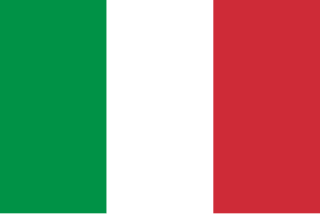
Italy, officially the Italian Republic, is a country in Europe. Located in the middle of the Mediterranean Sea, Italy shares open land borders with France, Switzerland, Austria, Slovenia and the enclaved microstates San Marino and Vatican City. Italy covers an area of 301,340 km2 (116,350 sq mi) and has a largely temperate seasonal and Mediterranean climate. With around 61 million inhabitants, it is the fourth-most populous EU member state and the most populous country in Southern Europe.
San Fedele publishes the monthly magazine Social Updates which since 1950 has given in-depth analysis of the social, political, and ecclesiastical situation in Italy, [1] and also the monthly Peoples which began in 1915 as a report on missionary work of Italian Jesuits and now offers analysis and reflection on international issues. [2]
Galleria San Fedele was founded in 1949 and moved to its present location in 1968. It hosts international artists – Lucio Fontana, Marc Chagall, Robert Ryman, Henri Matisse, and Mario Sironi – and awards the San Fedele Prize for young artists. Besides the training of artists, it promotes justice by reflecting the fundamental issues of contemporary political and social life, with exhibitions relating art to faith and culture and probing the meaning of "beauty" in religious art. It "favors the frontier areas within the experience common to believers and non-believers." [3] It also has a film club and concerts to inspire young filmmakers and composers. San Fedele's diverse activities include courses and conferences on "justice and society" and collaboration with Medicare San Fedele and young couples Centro San Fedele.
Lucio Fontana was an Argentine painter, sculptor and theorist. He is mostly known as the founder of Spatialism.
Marc Zakharovich Chagall was a Russian-French artist of Belarusian Jewish origin. An early modernist, he was associated with several major artistic styles and created works in virtually every artistic format, including painting, book illustrations, stained glass, stage sets, ceramic, tapestries and fine art prints.
Robert Ryman was an American painter identified with the movements of monochrome painting, minimalism, and conceptual art. He was best known for abstract, white-on-white paintings. He lived and worked in New York City.
San Fedele Library was formed in the late 1990s through the merger of five libraries and comprises more than 69,000 volumes, thousands of magazine articles, and 170 foreign journals. along with audio and video materials. The Foundation makes available to researchers its library which includes about 70,000 volumes and 500 active journals. [4]
A recent project of San Fedele in partnership with Heritage House, a private consultancy firm, is course offerings in ethics for business executives, “to foster dialogue between the world of companies, non-profits, institutions, and public administrations, resting on shared common values.” [5]
The voluntary sector or community sector is the duty of social activity undertaken by organizations that are nonprofit organizations and non-governmental. This sector is also called the third sector, in contrast to the public sector and the private sector. Civic sector or social sector are other terms for the sector, emphasizing its relationship to civil society. Given the diversity of organizations that comprise the sector, Peter Frumkin prefers "non-profit and voluntary sector".
Coordinates: 45°27′59.21″N9°11′29.31″E / 45.4664472°N 9.1914750°E

A geographic coordinate system is a coordinate system that enables every location on Earth to be specified by a set of numbers, letters or symbols. The coordinates are often chosen such that one of the numbers represents a vertical position and two or three of the numbers represent a horizontal position; alternatively, a geographic position may be expressed in a combined three-dimensional Cartesian vector. A common choice of coordinates is latitude, longitude and elevation. To specify a location on a plane requires a map projection.