
The church of the Abbey of San Filippo d'Agira is located in Piazza Abbazia #1 in the town of Agira, province of Enna, region of Sicily, Italy. It is also referred to as the Reale Abbazia or royal abbey.
The church of the Abbey of San Filippo d'Agira is located in Piazza Abbazia #1 in the town of Agira, province of Enna, region of Sicily, Italy. It is also referred to as the Reale Abbazia or royal abbey.
The monastery was founded in the 7th or 8th century by Basilian monks. It is dedicated to Philip of Agira, whose hagiography was recalled by Eusebius and the author known as Pseudo-Athanasius. Phillip is said to have been one of the original Christian missionaries to Sicily and putatively was buried beneath this church in Agira. The monastery continued to exist under the Muslim Emirate of Sicily, and monks from here left to found monasteries elsewhere, including in Calabria.
After the Norman conquest of Sicily, the monastery became a Benedictine abbey, and was refurbished by Count Roger I of Sicily between 1095 and 1101. The monastery was suffragan of the first institution of the Latin rite in Jerusalem, the renowned Benedictine abbey affiliated with Santa Maria Latina in Jerusalem. The abbot of the monastery in the Crusader kingdom was forced to move to Sicily with the Muslim capture of Acre in the 1291. A document from 1273 refers to this monastery as San Filippo di Latina. By the 14th century, the abbott of the monastery was represented by members of the Paternò family of Catania; while in the mid-16th century by members of the Aiutamicristo family of Palermo.
However, in the subsequent century, there were concerns about the lax practice of the Benedictine monks and decline of the economic support of the monastery. In 1632 the commendatory abbot, Cardinal Scipione Borghese, replaced the Benedictine fathers with secular priests. The monks were moved to the larger Benedictine Monastery of San Nicolò l'Arena in Catania. By the second half of the 17th century, the church was assigned members of the Colonna da Egidio family. Ultimately in 1862, the monastery was suppressed and in 1924, the church became a parish of the town.
The church building has undergone multiple reconstructions over the centuries. The original Basilian structure likely only possessed a single altar, however a larger church was built in the 15th and 16th century. Among the architects was Cadorna. However, little of this structure remains. The facade collapsed after a storm in 1911, and the present replacement was designed by G. Greco, and built between 1916 and 1928. The facade has six niches with statues of the patrons of Agira. The medallion above the main portal depicts the church of Santa Maria Latina.
The interior has a central nave divided from the aisles by pink marble columns. On the left, an altar houses three panels of a 15th-century polyptych depicting the Madonna and Child, St Benedict, and St Calogerus the Anchorite . Also along the left wall are panels depicting the Nativity and Adoration of the Magi attributed to the late 16th-century Master of the Castelbuono Polyptych. Other paintings in the church and sacristy were commissioned from the late-Baroque painters Olivio Sozzi and Filippo Randazzo. The paintings (1759) by Sozzi include:
The paintings (1745-1746) by Randazzo include:
Inside the church, is a grotto where the putative tomb of St Phillip was discovered in 1596. It putatively had been walled up to hide it during the Arab rule. A sculpted marble figure of the recumbent saint was sculpted in the 16th century, and attributed to Francesco Mendola, a pupil of Antonello Gagini. The apse wooden choir stalls (1818-1822) were engraved by Nicolò Bagnasco with scenes from the Life of St Phillip. The main altar was completed in 1960 by G. Leone; it replaces the former gilded wood altar of the late 18th century. Above the altar is a crucifix carved by friar Umile da Petralia (mid-17th century), and deriving originally from the convent of Santa Maria di Gesù.
The church also houses a life-size 17th-century silver depiction of the bust of the saint (1652) made by Pietro Juvarra, which along with a silver ark containing relics, is paraded through town in processions. The abbey has a collection of written materials, including books from the 15th-century and documents dating from the 11th century. [1] [2] [3]
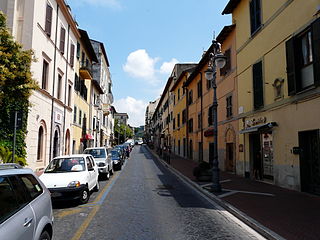
Grottaferrata is a small town and comune in the Metropolitan City of Rome, situated on the lower slopes of the Alban Hills, 20 kilometres south east of Rome. It has grown up around the Abbey of Santa Maria di Grottaferrata, founded in 1004. Nearby communes include Frascati, Rocca di Papa, Marino and Rome.

Casamari Abbey is a Cistercian abbey in the Province of Frosinone, Lazio, Italy, about 10 kilometers east-south-east of Veroli.

The Abbey of Sant'Antimo, Italian: Abbazia di Sant'Antimo, is a former Benedictine monastery located in Castelnuovo dell'Abate, in the comune of Montalcino, Tuscany, central Italy. It is approximately 10 km from Montalcino about 9 km from the Via Francigena, the pilgrim route to Rome. After many years of disuse, the abbey was reoccupied in 1992 by a small community of Premonstratensian Canons Regular. Since January 2016, the occupants are a community of monks of the Olivetan Benedictine order.

Cervara Abbey is a former abbey in Santa Margherita Ligure, Liguria region, northern Italy. It is on the coastal road to Portofino. The abbey complex is a designated National Monument of Italy.

Novalesa Abbey is a Benedictine monastery in the Metropolitan City of Turin, Piedmont, Italy. It was founded in 726, and dedicated to Saint Peter and Saint Andrew.
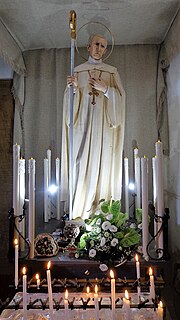
Hugh of Noara or of Novara, also known as Ugo of Novara and Hugo of Novara, was a Cistercian monk and a disciple of Bernard of Clairvaux. French by birth, he served as the first abbot of Novara Abbey, Sicily, where he remained until his death in 1170.

The Abbey of Saint Scholastica, also known as Subiaco Abbey, is located just outside the town of Subiaco in the Province of Rome, Region of Lazio, Italy; and is still an active Benedictine abbey, territorial abbey, first founded in the 6th century AD by Saint Benedict of Nursia. It was in one of the Subiaco caves that Benedict made his first hermitage. The monastery today gives its name to the Subiaco Congregation, a grouping of monasteries worldwide that makes up part of the Order of Saint Benedict.

The Abbey of Santa Giustina is a 10th-century Benedictine abbey complex located in front of the Prato della Valle in central Padua, region of Veneto, Italy. Adjacent to the former monastery is the basilica church of Santa Giustina, initially built in the 6th century, but whose present form derives from a 17th-century reconstruction.
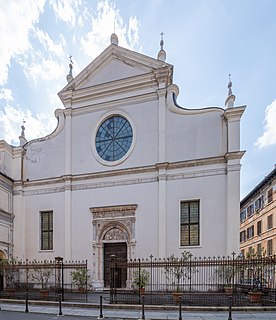
The church of Santa Maria delle Grazie in Brescia is located on at the west end of Via Elia Capriolo, where it intersects with the Via delle Grazie. Built in the 16th century and remodeled in the 17th century, it still retains much of its artwork by major regional artists, including one of its three canvases by Moretto. The other two are now held at the Pinacoteca Tosio Martinengo. The interior is richly decorated in Baroque fashion. Adjacent to the church is the Sanctuary of Santa Maria delle Grazie, a neo-gothic work.
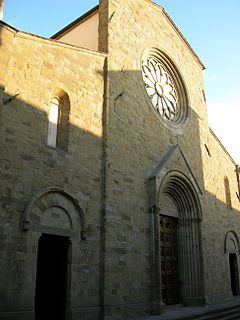
The Cathedral of Sansepolcro is a Catholic church in Sansepolcro, Tuscany, central Italy.

Trisulti Charterhouse is a former Carthusian monastery or charterhouse, now owned by the Cistercians, in Collepardo, province of Frosinone, central Italy. It is located on the slopes of Monte Rotonaria, a peak of the Monti Ernici, at 825 meters above sea level. It was consecrated in 1211, becoming a national monument in 1873.

Monastero di Santa Lucia is an architectural complex in the town of Adrano, in the Province of Catania, region of Sicily, Italy. The former Benedictine monastery currently serves as an elementary school, and attached to it is the Giovanni Verga high school. In front of the facade is a polygenal public park known as either Giardino della Vittoria or Villa Comunale.

The Abbey of San Lorenzo is a Roman Catholic basilica church, formerly part of a Benedictine monastery, located on Via San Demetrio #4 in San Lorenzo in Campo, province of Pesaro e Urbino, region of Marche, Italy. It was elevated to a basilica church in 1943 by basilica by Pope Pius XII.

The Abbey of San Magnus is a monastery and church at the base of Monte Arcano, outside of the town of Fondi in the province of Latina, region of Lazio, Italy.

San Giuliano is a Roman Catholic church and attached convent located on Via Crocifero #36 of Catania, Sicily, southern Italy. It stands across from the Collegio dei Gesuiti, whose church of San Francesco Borgia also faces Crociferi. Two blocks north on Crociferi is the baroque church of San Camillo de Lellis.

Santissima Trinità is a late-Baroque architecture, Roman Catholic church and former monastery (Badia) located on Via Vittorio Emanuele, corner of Via Santissima Trinità in the city Catania, Sicily, southern Italy. The monastery is now a science high school.
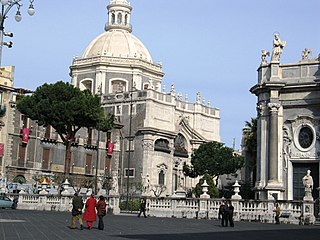
Badia di Sant'Agata or Abbey of St Agatha refers to an 18th-century Roman Catholic church and attached female convent located on Via Vittorio Emanuele #182 in the center of Catania, region of Sicily, southern Italy. The Baroque style church facade is across the street from the left transept of the Cathedral of Catania.
The Pinacoteca Comunale of Piazza Armerina is the civic art gallery of the town of Piazza Armerina, province of Enna, region of Sicily, Italy.

San Salvatore is a Roman Catholic church located in the town of Agira, province of Enna, region of Sicily, Italy.

The Abbey of San Martino delle Scale is a Benedictine monastery and church located in the hills a few kilometers northwest of Monreale, region of Sicily, Italy. Putatively founded in the 7th-century, but destroyed by the Saracens, it was refounded in 1347. Most of the present structures date to the 17th and 18th-centuries, including a large refurbishment by the architect Giuseppe Venanzio Marvuglia.