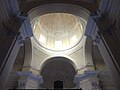
The Basilica di Santa Maria Gloriosa dei Frari, commonly abbreviated to the Frari, is a church located in the Campo dei Frari at the heart of the San Polo district of Venice, Italy. It is the largest church in the city and it has the status of a minor basilica. The church is dedicated to the Assumption of Mary.

The Basilica of San Petronio is a minor basilica and church of the Archdiocese of Bologna located in Bologna, Emilia Romagna, northern Italy. It dominates Piazza Maggiore. The basilica is dedicated to the patron saint of the city, Saint Petronius, who was the bishop of Bologna in the fifth century. Construction began in 1390 and its main facade has remained unfinished since. The building was transferred from the city to the diocese in 1929; the basilica was finally consecrated in 1954. It has been the seat of the relics of Bologna's patron saint only since 2000; until then they were preserved in the Santo Stefano church of Bologna.
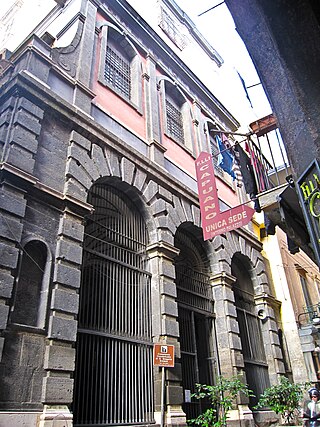
San Gregorio Armeno is a church and a monastery in Naples, Italy. It is one of the most important Baroque complexes in Naples. The church is located on a street of the same name just south of Via dei Tribunali and a few blocks south of the church of San Paolo Maggiore, Naples

Gesù Nuovo is the name of a church and a square in Naples, Italy. They are located just outside the western boundary of the historic center of the city. To the southeast of the spire, one can see a block away the Fountain of Monteoliveto and the piazza of the church of Sant'Anna dei Lombardi. The square is a result of the expansion of the city to the west beginning in the early 16th century under the rule of Spanish viceroy Pedro Alvarez de Toledo. The square of Gesù Nuovo contains three prominent landmarks:

Santa Maria del Carmine is a church in Naples, Italy. It is at one end of Piazza Mercato, the centre of civic life in Naples for many centuries until it was cut off from the rest of the city by urban renewal in 1900. The church was founded in the 13th century by Carmelite friars driven from the Holy Land in the Crusades, presumably arriving in the Bay of Naples aboard Amalfitan ships. Some sources, however, place the original refugees from Mount Carmel as early as the eighth century. The church is still in use and the 75–metre bell tower is visible from a distance even amidst taller modern buildings.

Santa Maria in Campitelli or Santa Maria in Portico is a church dedicated to the Virgin Mary on the narrow Piazza di Campitelli in Rione Sant'Angelo, Rome, Italy. The church is served by the Clerics Regular of the Mother of God.

The Basilica della Santissima Annunziata del Vastato is the Catholic cathedral of Genoa, northern Italy; its decoration employed the major baroque studios and artists in Genoa in the 17th century.

The Basilica of Saint Nicholas of Tolentino is a Roman Catholic church and minor basilica that is part of the Augustinian monastery in the hill-town of Tolentino, province of Macerata, Marche, central Italy. The church is a former cathedral of the Roman Catholic Diocese of Tolentino, suppressed in 1586.

Padua Cathedral, or Basilica Cathedral of Saint Mary of the Assumption, is a Catholic church and minor basilica located on the east end of Piazza Duomo, adjacent to the bishop's palace in Padua, Veneto, Italy.

The Basilica of San Michele Maggiore is a Roman Catholic church in Pavia, region of Lombardy, Italy. The building, dating to the 11-12th centuries, is a well-preserved example of the Lombard-Romanesque style.

Pavia Cathedral is a church in Pavia, Italy, the largest in the city and seat of the Diocese of Pavia. The construction was begun in the 15th century on the site of two pre-existing Romanesque, "twin" cathedrals. The cathedral houses the remains of St. Sirus, first Bishop of Pavia, and a thorn purported to be from the Crown of Thorns worn by Christ. The marble facing of the exterior was never completed.

The Abbey of Santa Giustina is a 10th-century Benedictine abbey complex located in front of the Prato della Valle in central Padua, region of Veneto, Italy. Adjacent to the former monastery is the basilica church of Santa Giustina, initially built in the 6th century, but whose present form derives from a 17th-century reconstruction.

Santissimo Salvatore is a Baroque-style Roman Catholic church in central Bologna, Emilia-Romagna, Italy.

The Church of Pietà dei Turchini is a religious building in Naples, Italy. A smaller church, located on Rua Catalana, was built originally in 1592–1595 by the Confraternity of the Incoronatella. This church was nearly destroyed by an explosion in the Castel Nuovo in 1638. It was rebuilt in 1638–1639, and retitled Santa Maria Incoronatella della Pietà dei Turchini when it acquired a dome. The facade was completed in 1769–70 by Bartolomeo Vecchione.
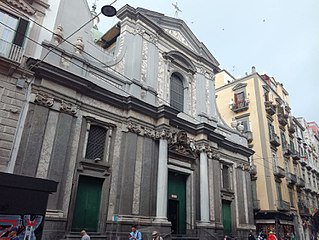
The church of St. Nicholas the Charitable is a church located on via Toledo, almost midway between Piazza Carità and Piazza Dante in Naples, Italy.

Santa Maria Egiziaca a Forcella is a Baroque-style, Roman Catholic church located in the quartiere di Forcella, in the city of Naples, Italy;

The Basilica of Santa Maria Assunta is a 14th-century basilica in Alcamo, province of Trapani, Sicily, southern Italy. It is named after the Assumption.

Santa Caterina d'Alessandria or Saint Catherine of Alexandria is a Roman Catholic church with a main facade on Piazza Bellini, and a lateral Western facade facing the elaborate Fontana Pretoria, in the historic quarter of Kalsa in the city of Palermo, region of Sicily, Italy. In front of the main facade, across the piazza Bellini, rise the older churches of San Cataldo and Santa Maria dell'Ammiraglio, while across Piazza Pretoria is the Theatine church of San Giuseppe and the entrance to the Quattro Canti. Refurbished over the centuries, the church retains elements and decorations from the Renaissance, Baroque, and late-Baroque (Rococo) eras. This church is distinct from the Oratorio di Santa Caterina found in the Olivella neighborhood.
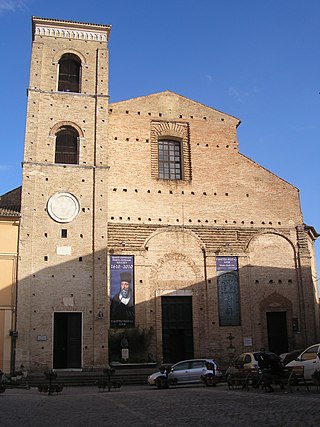
Macerata Cathedral is a Renaissance-style, Roman Catholic cathedral dedicated to the St Julian in the town of Macerata, province of Macerata, region of Marche, Italy.