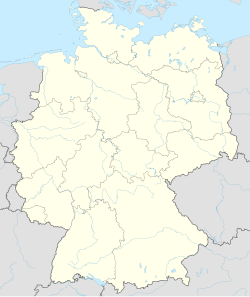
Saxony, officially the Free State of Saxony, is a landlocked state of Germany, bordering the states of Brandenburg, Saxony-Anhalt, Thuringia, and Bavaria, as well as the countries of Poland and the Czech Republic. Its capital is Dresden, and its largest city is Leipzig. Saxony is the tenth largest of Germany's sixteen states, with an area of 18,413 square kilometres (7,109 sq mi), and the sixth most populous, with more than 4 million inhabitants.
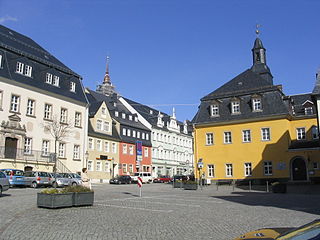
Zschopau, is a town in the Erzgebirgskreis district of Saxony, Germany.
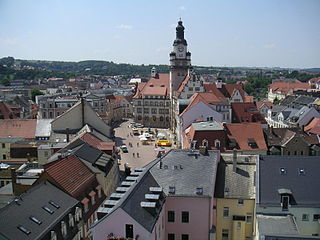
Döbeln is a town in Saxony, Germany, part of the Mittelsachsen district. It sits on the banks of the Freiberger Mulde river.

Marienberg is a town in Germany. It was the district capital of the Mittlerer Erzgebirgskreis in the southern part of Saxony, and since August 2008 it has been part of the new district of Erzgebirgskreis. As of 2020, the town had 16,716 inhabitants.

Wolkenstein is a town in the district Erzgebirgskreis, in Saxony, Germany. It is situated in the Ore Mountains, on the river Zschopau, 22 km southeast of Chemnitz.

The Electorate of Saxony, also known as Electoral Saxony, was a territory of the Holy Roman Empire from 1356 to 1806 initially centred on Wittenberg that came to include areas around the cities of Dresden, Leipzig and Chemnitz. It was a major Holy Roman state, being an electorate and the original protecting power of Protestant principalities until that role was later taken by its neighbor, Brandenburg-Prussia.
Grießbach is a village and a former municipality in the Ore Mountains in Saxony, Germany. It was absorbed into the municipality Venusberg in 1999, and became part of the municipality Drebach in January 2010. It counts approximately 690 inhabitants.
Falkenau is a village and a former municipality in the district of Mittelsachsen, in Saxony, Germany. On 1 October 2011, Falkenau joined the town of Flöha.
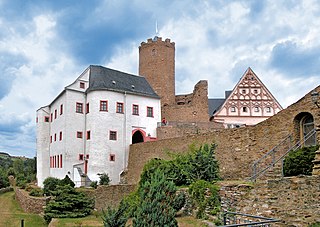
Drebach is a municipality in the district of Erzgebirgskreis, in Saxony, Germany. It consists of the Ortsteile (divisions) Drebach, Grießbach, Im Grund, Scharfenstein, Spinnerei, Venusberg, Wilischthal and Wiltzsch.

The Preßnitz is a right-hand tributary of the Zschopau River in the state of Saxony in eastern Germany and in the Czech Republic. It rises in the Bohemian part of the Ore Mountains near Horní Halže.
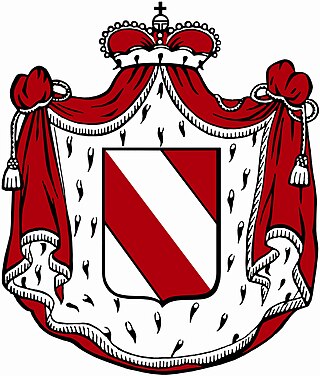
The House of Schönburg is a noble family of princely and historically sovereign rank. It formerly owned large properties in present-day Saxony, Thuringia and Bohemia. As a former ruling and mediatized family, it belongs to the Hochadel. The family today includes two princely and a comital branch.

The Ore Mountain passes are crossings and passages over the crest of the Ore Mountains in Central Europe, over which tracks, roads, railway lines and pipelines run from the Free State of Saxony in the Federal Republic of Germany to Bohemia in the Czech Republic and vice versa.

The Annaberg-Buchholz–Flöha railway, also called the Zschopau Valley Railway (Zschopautalbahn) is a branch line in the German state of Saxony. It links Annaberg-Buchholz lower station and the Vejprty–Annaberg-Buchholz railway line to Flöha, running through the Zschopau Valley via Wolkenstein and Zschopau. It has been operated since 2001 by the DB Regio subsidiary Erzgebirgsbahn.

Dohna Castle on the once important medieval trade route from Saxony to Bohemia was the ancestral castle seat of the Burgraves of Dohna. Of the old, once imposing double castle only a few remnants of the walls remain. The ruins of the old castle are located on the hill of Schlossberg near the subsequent suburb of the town of the same name, Dohna, in the district of Sächsische Schweiz-Osterzgebirge in Saxony, Germany.

Pillnitz Palace is a restored Baroque castle at the eastern end of the city of Dresden in the German state of Saxony. It is located on the right bank of the River Elbe in the former village of Pillnitz. It was the summer residence of many electors and kings of Saxony; it is also known for the Declaration of Pillnitz in 1791.

Kriebstein Castle is a castle in Kriebstein near the town of Waldheim in the German state of Saxony.
The State Palaces, Castles and Gardens of Saxony is a state-owned company with its head office in Dresden. It belongs to the Saxon State Ministry of Finance and has the aim of preserving Saxon cultural heritage whilst respecting cultural and conservation needs. The state-owned company manages several palaces, castles and parks in the Saxony. These include the Zwinger in Dresden, the Albrechtsburg in Meissen and Kriebstein Castle.

Wolf Caspar Klengel, from 1664 von Klengel, was a German architect in Saxony,
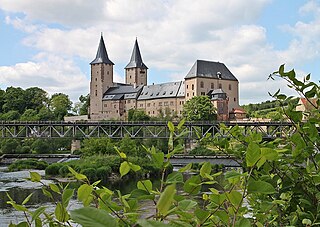
Rochlitz Castle or Rochlitz Palace lies in the west of the town of Rochlitz in the county of Mittelsachsen in the Free State of Saxony. It was built on the site of an imperial castle, erected in the second half of the 10th century, which fell into the possession of the Wettin margraves in 1143. Its appearance, which includes several Romanesque wings, is considerably influenced by its remodelling into a margravial schloss in the fourth quarter of the 14th century. Further conversions and additions followed at the end of the 15th and in the 16th centuries, when the castle became a secondary residenz, dower house and hunting lodge for the Wettin family. The castle or palace was the residence for members of the Saxon princely house eight times. From the 18th century the castle served as an administrative centre ; in 1852 it became a gaol, which necessitated considerable alteration. The museum founded in 1892 was gradually expanded and, today, takes up almost the entire castle.