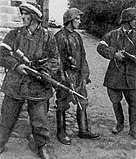
In World War Two, the Polish armed forces were the fourth largest Allied forces in Europe, after those of the Soviet Union, United States, and Britain. Poles made substantial contributions to the Allied effort throughout the war, fighting on land, sea, and in the air.

Kościerzyna is a town in Kashubia in Gdańsk Pomerania region, northern Poland, with some 24,000 inhabitants. It has been the capital of Kościerzyna County in Pomeranian Voivodeship since 1999; previously it was in Gdańsk Voivodeship from 1975 to 1998.
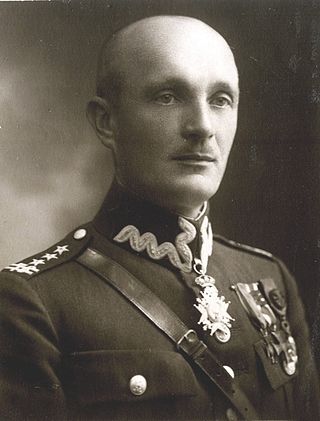
National Armed Forces was a Polish right-wing underground military organization of the National Democracy operating from 1942. During World War II, NSZ troops fought against Nazi Germany and communist partisans. There were also cases of fights with the Home Army.

Ostrów Mazowiecka(listen) is a town in eastern Poland with 23,486 inhabitants (2004). It is the capital of Ostrów Mazowiecka County in Masovian Voivodeship.
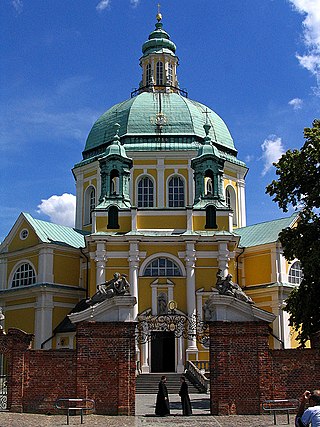
Gostyń is a town in western Poland, seat of the Gostyń County and Gmina Gostyń in the Greater Poland Voivodeship. According to 30 June 2004 data its population was 20,746.

World War II saw the cultivation of underground education in Poland. Secretly conducted education prepared scholars and workers for the postwar reconstruction of Poland and countered German and Soviet threats to eradicate Polish culture.
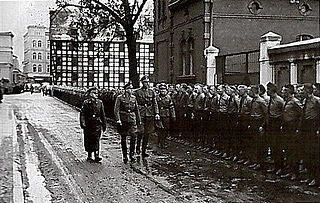
Selbstschutz is the name given to different iterations of ethnic-German self-protection units formed both after the First World War and in the lead-up to the Second World War.

The Polish resistance movement in World War II, with the Polish Home Army at its forefront covered both German and Soviet zones of occupation. The Polish resistance is notable among others for disrupting German supply lines to the Eastern Front, and providing intelligence reports to the British intelligence agencies. It was a part of the Polish Underground State.

The Polish Riflemen's Association known as Związek Strzelecki formed in great numbers prior to World War I. One of the better known associations called "Strzelec" was a Polish paramilitary cultural and educational organization created in 1910 in Lwów as a legal front of Związek Walki Czynnej, and somewhat reinstated in present-day Poland in 1991, after the fall of communism.
Polish culture during World War II was suppressed by the occupying powers of Nazi Germany and the Soviet Union, both of whom were hostile to Poland's people and cultural heritage. Policies aimed at cultural genocide resulted in the deaths of thousands of scholars and artists, and the theft and destruction of innumerable cultural artifacts. ''The maltreatment of the Poles was one of many ways in which the Nazi and Soviet regimes had grown to resemble one another", wrote British historian Niall Ferguson.
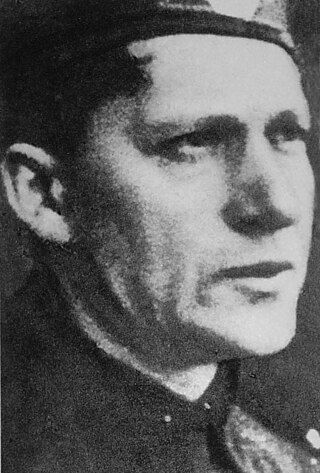
Jan Mazurkiewicz, pseudonym: "Zagłoba", "Socha", "Sęp", "Radosław" was a Polish military leader and politician, colonel of Home Army and brigadier general of the Polish People's Army. Founder of the Secret Military Organization, commander of Kedyw and the Radosław Group during Warsaw Uprising. After the war, he was a political prisoner of the Stalinist period. From 1964 he was vice-president of Society of Fighters for Freedom and Democracy.
Narodowa Organizacja Wojskowa was one of the Polish resistance movements in World War II. Created in October 1939, it did not merge with the Service for Poland's Victory (SZP)/Union of Armed Struggle (ZWZ); later Home Army (AK). Nevertheless, it recognized the Polish government in exile, which was located in London. The National Military Organization was politically related to the National Party (SN). In 1942/1943 it split into two parts; one merged with the Home Army, while another formed the National Armed Forces (NSZ). After the Warsaw Uprising, most of NOW members formed the National Military Union (NZW).

Irena Morzycka-Iłłakowicz was a Polish second Lieutenant of the National Armed Forces and intelligence agent. The daughter of Bolesław Morzycki and Władysława Zakrzewska and the sister of Jerzy, she was also a polyglot who spoke seven languages: Polish, French, English, Persian, Finnish, German and Russian.
Organizacja Wojskowa Związek Jaszczurczy was an organization of Polish resistance in World War II. Created in 1939 and transformed into National Armed Forces in 1942, it represented the far right of the Polish political spectrum and so refused to recognise the internationally recognised Polish Underground State although there was some uneasy tactical cooperation for practical reasons. It also refused to recognise the Soviet-aligned Polish Committee of National Liberation and continued to resist the new Polish communist regime after the war.
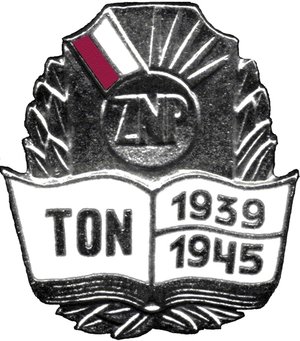
Secret Teaching Organization was an underground Polish educational organization created in 1939 after the German invasion of Poland to provide underground education in occupied Poland during World War II.

Leśno is a village in the administrative district of Gmina Brusy, within Chojnice County, Pomeranian Voivodeship, in northern Poland. It lies approximately 8 kilometres (5 mi) north of Brusy, 30 km (19 mi) north of Chojnice, and 77 km (48 mi) south-west of the regional capital Gdańsk. The village has a population of 669. It is situated on the shores of Leśno Górne and Lesno Dolne lakes.
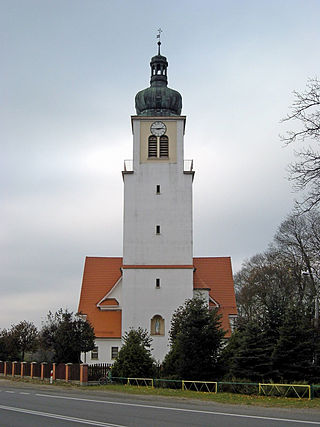
Rytel is a village in the administrative district of Gmina Czersk, within Chojnice County, Pomeranian Voivodeship, in northern Poland. It lies approximately 14 kilometres (9 mi) west of Czersk, 17 km (11 mi) east of Chojnice, and 89 km (55 mi) south-west of the regional capital Gdańsk. It is located within the historic region of Pomerania.
The Pomeranian Griffin secret military organization was a Polish anti-Nazi resistance group active in Pomerania and East Prussia during World War II. A major Polish resistance organization in the Pomerania region, at its height in 1943 it might have had as many as 20,000 members, although only about 500 were active partisans in the forests (leśni).
The Kashubian Griffin, full name Secret Military Organization "Kashubian Griffin", was a Polish anti-Nazi organization during World War II in Gdańsk Pomerania - Kashubia. It was active between December 1939 and the summer of 1941, when it became part of the more general Pomeranian Griffin.
Józef Wrycza was a Roman Catholic priest, social activist, and military chaplain. He was born in what is now Zblewo, Poland to Franciszek and Franciszka (Trocha) Wryca, who were of Kashubian ethnicity. From 1894 to 1899 he attended the Collegium Marianum at Pelplin. He began his high school education at Chełmno and completed it in 1904 at the Collegium Leoninum at Wejherowo, where one of his classmates was the future German SS general Erich von dem Bach-Zelewski. Later that year he began studies at the Pelplin Higher Seminary and, on 23 February 1908, he was ordained a Roman Catholic priest.
 Polish