Related Research Articles
Microsoft Windows is a product line of proprietary graphical operating systems developed and marketed by Microsoft. It is grouped into families and sub-families that cater to particular sectors of the computing industry -- Windows (unqualified) for a consumer or corporate workstation, Windows Server for a server and Windows IoT for an embedded system. Defunct families include Windows 9x, Windows Mobile, Windows Phone, and Windows Embedded Compact.

Microsoft Corporation is an American multinational corporation and technology company headquartered in Redmond, Washington. Microsoft's best-known software products are the Windows line of operating systems, the Microsoft 365 suite of productivity applications, and the Edge web browser. Its flagship hardware products are the Xbox video game consoles and the Microsoft Surface lineup of touchscreen personal computers. Microsoft ranked No. 14 in the 2022 Fortune 500 rankings of the largest United States corporations by total revenue; and it was the world's largest software maker by revenue in 2022 according to Forbes Global 2000. It is considered one of the Big Five American information technology companies, alongside Alphabet, Amazon, Apple, and Meta.

Windows XP is a major release of Microsoft's Windows NT operating system. It was released to manufacturing on August 24, 2001, and later to retail on October 25, 2001. It is a direct upgrade to its predecessors, Windows 2000 for high-end and business users and Windows Me for home users, and is available for any devices running Windows NT 4.0, Windows 98, Windows 2000, or Windows Me that meet the new Windows XP system requirements.

The Next-Generation Secure Computing Base is a software architecture designed by Microsoft which claimed to provide users of the Windows operating system with better privacy, security, and system integrity. NGSCB was the result of years of research and development within Microsoft to create a secure computing solution that equaled the security of closed platforms such as set-top boxes while simultaneously preserving the backward compatibility, flexibility, and openness of the Windows operating system. Microsoft's primary stated objective with NGSCB was to "protect software from software."

AVG AntiVirus is a line of antivirus software developed by AVG Technologies, a subsidiary of Avast, a part of Gen Digital. It is available for Windows, macOS and Android.

Microsoft Defender Antivirus is an antivirus software component of Microsoft Windows. It was first released as a downloadable free anti-spyware program for Windows XP and was shipped with Windows Vista and Windows 7. It has evolved into a full antivirus program, replacing Microsoft Security Essentials in Windows 8 or later versions.

Windows Vista is a major release of the Windows NT operating system developed by Microsoft. It was the direct successor to Windows XP, released five years earlier, which was then the longest time span between successive releases of Microsoft Windows. It was released to manufacturing on November 8, 2006, and over the following three months, it was released in stages to business customers, original equipment manufacturers (OEMs), and retail channels. On January 30, 2007, it was released internationally and was made available for purchase and download from the Windows Marketplace; it is the first release of Windows to be made available through a digital distribution platform.
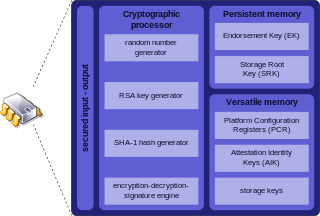
Trusted Platform Module (TPM) is an international standard for a secure cryptoprocessor, a dedicated microcontroller designed to secure hardware through integrated cryptographic keys. The term can also refer to a chip conforming to the standard ISO/IEC 11889.
Network Access Protection (NAP) is a Microsoft technology for controlling network access of a computer, based on its health. It was first included in Windows Vista and Windows Server 2008 and backported to Windows XP Service Pack 3. With NAP, system administrators of an organization can define policies for system health requirements. Examples of system health requirements are whether the computer has the most recent operating system updates installed, whether the computer has the latest version of the anti-virus software signature, or whether the computer has a host-based firewall installed and enabled. Computers with a NAP client will have their health status evaluated upon establishing a network connection. NAP can restrict or deny network access to the computers that are not in compliance with the defined health requirements.
In computer security, executable-space protection marks memory regions as non-executable, such that an attempt to execute machine code in these regions will cause an exception. It makes use of hardware features such as the NX bit, or in some cases software emulation of those features. However, technologies that emulate or supply an NX bit will usually impose a measurable overhead while using a hardware-supplied NX bit imposes no measurable overhead.

BitLocker is a full volume encryption feature included with Microsoft Windows versions starting with Windows Vista. It is designed to protect data by providing encryption for entire volumes. By default, it uses the Advanced Encryption Standard (AES) algorithm in cipher block chaining (CBC) or "xor–encrypt–xor (XEX)-based Tweaked codebook mode with ciphertext Stealing" (XTS) mode with a 128-bit or 256-bit key. CBC is not used over the whole disk; it is applied to each individual sector.
Microsoft Forefront is a discontinued family of line-of-business security software by Microsoft Corporation. Microsoft Forefront products are designed to help protect computer networks, network servers and individual devices. As of 2015, the only actively developed Forefront product is Forefront Identity Manager.

Security and Maintenance is a component of the Windows NT family of operating systems that monitors the security and maintenance status of the computer. Its monitoring criteria includes optimal operation of antivirus software, personal firewall, as well as the working status of Backup and Restore, Network Access Protection (NAP), User Account Control (UAC), Windows Error Reporting (WER), and Windows Update. It notifies the user of any problem with the monitored criteria, such as when an antivirus program is not up-to-date or is offline.
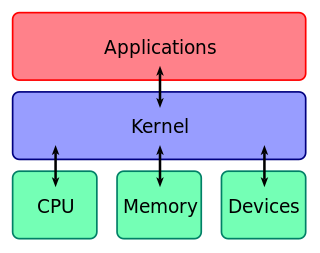
Kernel Patch Protection (KPP), informally known as PatchGuard, is a feature of 64-bit (x64) editions of Microsoft Windows that prevents patching the kernel. It was first introduced in 2005 with the x64 editions of Windows XP and Windows Server 2003 Service Pack 1.
The various versions of Microsoft's desktop operating system, Windows, have received various criticisms since Microsoft's inception.
Microsoft Azure, often referred to as Azure, is a cloud computing platform developed by Microsoft. It offers access, management, and the development of applications and services through global data centers. It also provides a range of capabilities, including software as a service (SaaS), platform as a service (PaaS), and infrastructure as a service (IaaS). Microsoft Azure supports many programming languages, tools, and frameworks, including Microsoft-specific and third-party software and systems.

Microsoft Security Essentials (MSE) is a discontinued antivirus software (AV) product that provides protection against different types of malicious software, such as computer viruses, spyware, rootkits, and Trojan horses. Prior to version 4.5, MSE ran on Windows XP, Windows Vista, and Windows 7, but not on Windows 8 and later versions, which have built-in AV components known as Windows Defender. MSE 4.5 and later versions do not run on Windows XP. The license agreement allows home users and small businesses to install and use the product free of charge.

Windows Server 2016 is the eleventh release of the Windows Server operating system developed by Microsoft as part of the Windows NT family of operating systems. It was developed alongside Windows 10 and is the successor to the Windows 8.1-based Windows Server 2012 R2. The first early preview version became available on October 1, 2014 together with the first technical preview of System Center. Windows Server 2016 was released on September 26, 2016 at Microsoft's Ignite conference and broadly released for retail sale on October 12, 2016. It was succeeded by Windows Server 2019 and the Windows Server Semi-Annual Channel.

Windows Server 2019 is the twelfth version of the Windows Server operating system by Microsoft, as part of the Windows NT family of operating systems. It is the second version of the server operating system based on the Windows 10 platform, after Windows Server 2016. It was announced on March 20, 2018 for the first Windows Insider preview release, and was released internationally on October 2, 2018. It was succeeded by Windows Server 2022 on August 18, 2021.

Microsoft 365 is a product family of productivity software, collaboration and cloud-based services owned by Microsoft. It encompasses online services such as Outlook.com, OneDrive, Microsoft Teams, programs formerly marketed under the name Microsoft Office, enterprise products and services associated with these products such as Exchange Server, SharePoint, and Viva Engage. It also covers subscription plans encompassing these products, including those that include subscription-based licenses to desktop and mobile software, and hosted email and intranet services.
References
- ↑ "SecurityShield". Microsoft Malware Protection Center. Microsoft Corporation. 14 September 2011. Archived from the original on 28 January 2015. Retrieved 18 September 2014.
- ↑ "Security Shield". Archived from the original on 2015-09-24. Retrieved 2013-02-21.
 | This malware-related article is a stub. You can help Wikipedia by expanding it. |