
The Semantic Web, sometimes known as Web 3.0, is an extension of the World Wide Web through standards set by the World Wide Web Consortium (W3C). The goal of the Semantic Web is to make Internet data machine-readable.
In information science, an ontology encompasses a representation, formal naming, and definitions of the categories, properties, and relations between the concepts, data, or entities that pertain to one, many, or all domains of discourse. More simply, an ontology is a way of showing the properties of a subject area and how they are related, by defining a set of terms and relational expressions that represent the entities in that subject area. The field which studies ontologies so conceived is sometimes referred to as applied ontology.
MPEG-7 is a multimedia content description standard. It was standardized in ISO/IEC 15938. This description will be associated with the content itself, to allow fast and efficient searching for material that is of interest to the user. MPEG-7 is formally called Multimedia Content Description Interface. Thus, it is not a standard which deals with the actual encoding of moving pictures and audio, like MPEG-1, MPEG-2 and MPEG-4. It uses XML to store metadata, and can be attached to timecode in order to tag particular events, or synchronise lyrics to a song, for example.
The Web Ontology Language (OWL) is a family of knowledge representation languages for authoring ontologies. Ontologies are a formal way to describe taxonomies and classification networks, essentially defining the structure of knowledge for various domains: the nouns representing classes of objects and the verbs representing relations between the objects.
A modeling language is any artificial language that can be used to express data, information or knowledge or systems in a structure that is defined by a consistent set of rules. The rules are used for interpretation of the meaning of components in the structure of a programming language.
In information science, an upper ontology is an ontology that consists of very general terms that are common across all domains. An important function of an upper ontology is to support broad semantic interoperability among a large number of domain-specific ontologies by providing a common starting point for the formulation of definitions. Terms in the domain ontology are ranked under the terms in the upper ontology, e.g., the upper ontology classes are superclasses or supersets of all the classes in the domain ontologies.
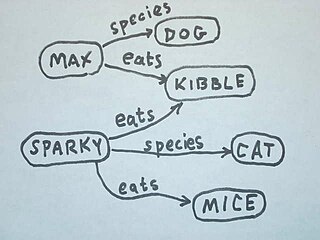
The ultimate goal of semantic technology is to help machines understand data. To enable the encoding of semantics with the data, well-known technologies are RDF and OWL. These technologies formally represent the meaning involved in information. For example, ontology can describe concepts, relationships between things, and categories of things. These embedded semantics with the data offer significant advantages such as reasoning over data and dealing with heterogeneous data sources.
Semantic interoperability is the ability of computer systems to exchange data with unambiguous, shared meaning. Semantic interoperability is a requirement to enable machine computable logic, inferencing, knowledge discovery, and data federation between information systems.
The CIDOC Conceptual Reference Model (CRM) provides an extensible ontology for concepts and information in cultural heritage and museum documentation. It is the international standard (ISO 21127:2023) for the controlled exchange of cultural heritage information. Galleries, libraries, archives, museums (GLAMs), and other cultural institutions are encouraged to use the CIDOC CRM to enhance accessibility to museum-related information and knowledge.
Frames are an artificial intelligence data structure used to divide knowledge into substructures by representing "stereotyped situations".
Knowledge Discovery Metamodel (KDM) is a publicly available specification from the Object Management Group (OMG). KDM is a common intermediate representation for existing software systems and their operating environments, that defines common metadata required for deep semantic integration of Application Lifecycle Management tools. KDM was designed as the OMG's foundation for software modernization, IT portfolio management and software assurance. KDM uses OMG's Meta-Object Facility to define an XMI interchange format between tools that work with existing software as well as an abstract interface (API) for the next-generation assurance and modernization tools. KDM standardizes existing approaches to knowledge discovery in software engineering artifacts, also known as software mining.
The concept of the Social Semantic Web subsumes developments in which social interactions on the Web lead to the creation of explicit and semantically rich knowledge representations. The Social Semantic Web can be seen as a Web of collective knowledge systems, which are able to provide useful information based on human contributions and which get better as more people participate. The Social Semantic Web combines technologies, strategies and methodologies from the Semantic Web, social software and the Web 2.0.
The Semantics of Business Vocabulary and Business Rules (SBVR) is an adopted standard of the Object Management Group (OMG) intended to be the basis for formal and detailed natural language declarative description of a complex entity, such as a business. SBVR is intended to formalize complex compliance rules, such as operational rules for an enterprise, security policy, standard compliance, or regulatory compliance rules. Such formal vocabularies and rules can be interpreted and used by computer systems. SBVR is an integral part of the OMG's model-driven architecture (MDA).
WSML or Web Service Modeling Language is a formal language that provides a syntax and semantics for the Web Service Modeling Ontology (WSMO).
Observations and Measurements (O&M) is an international standard which defines a conceptual schema encoding for observations, and for features involved in sampling when making observations. While the O&M standard was developed in the context of geographic information systems, the model is derived from generic patterns proposed by Fowler and Odell, and is not limited to geospatial information. O&M is one of the core standards in the OGC Sensor Web Enablement suite, providing the response model for Sensor Observation Service (SOS).
Business semantics management (BSM) encompasses the technology, methodology, organization, and culture that brings business stakeholders together to collaboratively realize the reconciliation of their heterogeneous metadata; and consequently the application of the derived business semantics patterns to establish semantic alignment between the underlying data structures.

Core architecture data model (CADM) in enterprise architecture is a logical data model of information used to describe and build architectures.
The Semantic Sensor Web (SSW) is a marriage of sensor web and semantic Web technologies. The encoding of sensor descriptions and sensor observation data with Semantic Web languages enables more expressive representation, advanced access, and formal analysis of sensor resources. The SSW annotates sensor data with spatial, temporal, and thematic semantic metadata. This technique builds on current standardization efforts within the Open Geospatial Consortium's Sensor Web Enablement (SWE) and extends them with Semantic Web technologies to provide enhanced descriptions and access to sensor data.
This article documents the effort of the Health Level Seven(HL7) community and specifically the former HL7 Architecture Board (ArB) to develop an interoperability framework that would support services, messages, and Clinical Document Architecture(CDA) ISO 10871.
The Open Semantic Framework (OSF) is an integrated software stack using semantic technologies for knowledge management. It has a layered architecture that combines existing open source software with additional open source components developed specifically to provide a complete Web application framework. OSF is made available under the Apache 2 license.


