Early life
His mother was Pelageya Alekseevna, don Cossack. His father was Isidor p., Eleonskii and was a petty bourgeois. Five years after his birth the family moved to Sulin (Donbass). At age 10 Sam lost his mother.
In 1921-1922 he joined the All-Union Leninist Young Communist League. He was resistant to studying at the Rabfak, and then at Moscow Higher Technical School at the faculty of electrical engineering.
Student Bauman Kataev invented an amplifier at all frequencies. He organized and led the circle in which he studied under Vladimir A. Kotelnikov.
In 1929 he received a diploma as an electrical engineer for radio. He began working in VEI, where he studied under radiophysicist B. A. Vvedensky. That year Kataev submitted a patent application for "Device for the electrical telescope in natural colors" (reproduced sequentially with the cathode ray tube and emerging on the screen in a natural multicolor picture).
On September 24, 1931, Vladimir K. Zworykin used an iconoscope made by Kataev, applied for a patent and received the Copyright certificate of the USSR No. 29.865.
In 1931 he transmitted the first television image.
In 1932, he led the development of a vacuum tube with magnetic focusing of the electron beam.
In 1933 he refined his iconoscope. He received patents for the transfer of "electronic image" with conductive photocathode on dielectric (dated September 30, 1933 with priority from February 20, 1932).
In 1936 he traveled in the U.S. where he exchange experiences with Zvorykina. Kataev gave him the book Cathode-ray TV tubes (M., Svyazist, 1936).
In 1940, he edited Fundamentals of Television.
In 1944, with a group of specialists, he offered the world's first standard television broadcasting on 625 lines.
In 1949 he proposed using the moon as a passive repeater.
In 1957 proposed the use of satellites for TV transmission.
Until 1987 he worked at the Department of Television at the Moscow electrotechnical Institute of communications,
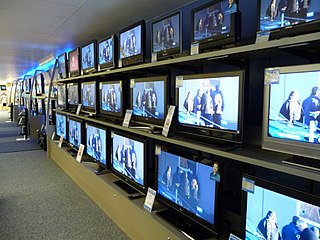
Television (TV) is a telecommunication medium for transmitting moving images and sound. Additionally, the term can refer to a physical television set rather than the medium of transmission. Television is a mass medium for advertising, entertainment, news, and sports. The medium is capable of more than "radio broadcasting," which refers to an audio signal sent to radio receivers.

John Logie Baird was a Scottish inventor, electrical engineer, and innovator who demonstrated the world's first mechanical television system on 26 January 1926. He went on to invent the first publicly demonstrated colour television system and the first viable purely electronic colour television picture tube.

Philo Taylor Farnsworth was an American inventor and television pioneer. He made the critical contributions to electronic television that made possible all the video in the world today. He is best known for his 1927 invention of the first fully functional all-electronic image pickup device, the image dissector, as well as the first fully functional and complete all-electronic television system. Farnsworth developed a television system complete with receiver and camera—which he produced commercially through the Farnsworth Television and Radio Corporation from 1938 to 1951, in Fort Wayne, Indiana.
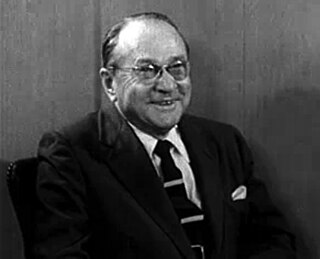
Vladimir Kosma Zworykin was a Russian-American inventor, engineer, and pioneer of television technology. Zworykin invented a television transmitting and receiving system employing cathode-ray tubes. He played a role in the practical development of television from the early thirties, including charge storage-type tubes, infrared image tubes and the electron microscope.

Allen Balcom DuMont, also spelled Du Mont, was an American electronics engineer, scientist and inventor who improved the cathode-ray tube in 1931 for use in television receivers. Seven years later he manufactured and sold the first commercially practical television set to the public. In June 1938, his Model 180 television receiver was the first all-electronic television set sold to the public, a few months prior to RCA's first TV set in April 1939. In 1946, DuMont founded the first television network to be licensed, the DuMont Television Network, by linking station WABD in New York City to station W3XWT, which later became WTTG, in Washington, D.C. WTTG was named for Dr. Thomas T. Goldsmith, DuMont's Vice President of Research, and his best friend. DuMont's successes in television picture tubes, TV sets and components and his involvement in commercial TV broadcasting made him the first millionaire in the business.
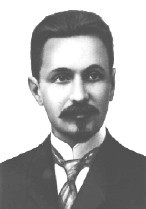
Boris Lvovich Rosing was a Russian scientist and inventor of television.

Video camera tubes are devices based on the cathode-ray tube that were used in television cameras to capture television images, prior to the introduction of charge-coupled device (CCD) image sensors in the 1980s. Several different types of tubes were in use from the early 1930s, and as late as the 1990s.
The year 1933 in science and technology involved some significant events, listed below.

An image dissector, also called a dissector tube, is a video camera tube in which photocathode emissions create an "electron image" which is then swept up, down and across an anode to produce an electrical signal representing the visual image. It employs magnetic fields to keep the electron image in focus, and later models used electron multiplier to pick up the electrons. The term had also been used for other kinds of early video camera tubes. Dissectors were used only briefly for research in television systems before being replaced by different much more sensitive tubes based on the charge-storage phenomenon like the iconoscope during the 1930s. Despite the camera tubes based on the idea of image dissector technology falling quickly and completely out of use in the field of Television broadcasting, they continued to be used for imaging in early weather satellites and the Lunar lander, and for star attitude tracking in the Space Shuttle and the International Space Station.
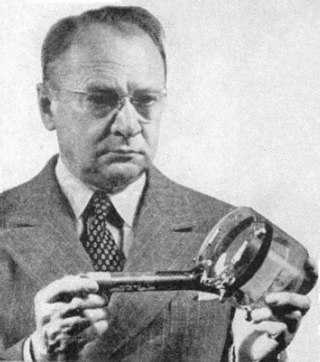
The iconoscope was the first practical video camera tube to be used in early television cameras. The iconoscope produced a much stronger signal than earlier mechanical designs, and could be used under any well-lit conditions. This was the first fully electronic system to replace earlier cameras, which used special spotlights or spinning disks to capture light from a single very brightly lit spot.
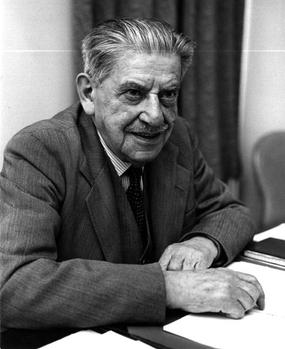
Sir Isaac Shoenberg was a British electronic engineer born in Belarus who was best known for his role in the history of television. He was the head of the EMI research team that developed the 405-line, the first fully electronic television system to be used in regular broadcasting when it was introduced with the BBC Television Service in 1936. It was later adopted by other TV organizations around the world.

The concept of television is the work of many individuals in the late 19th and early 20th centuries. The first practical transmissions of moving images over a radio system used mechanical rotating perforated disks to scan a scene into a time-varying signal that could be reconstructed at a receiver back into an approximation of the original image. Development of television was interrupted by the Second World War. After the end of the war, all-electronic methods of scanning and displaying images became standard. Several different standards for addition of color to transmitted images were developed with different regions using technically incompatible signal standards. Television broadcasting expanded rapidly after World War II, becoming an important mass medium for advertising, propaganda, and entertainment.

Kálmán Tihanyi, or in English language technical literature often mentioned as Coloman Tihanyi or Koloman Tihanyi was a Hungarian physicist, electrical engineer and inventor. One of the early pioneers of electronic television, he made significant contributions to the development of cathode ray tubes (CRTs), which were bought and further developed by the Radio Corporation of America, and German companies Loewe and Fernseh AG. He invented and designed the world's first automatic pilotless aircraft in Great Britain. He is also known for the invention of the first infrared video camera in 1929, and coined the first flat panel plasma display in 1936. His Radioskop patent was recognized as a Document of Universal Significance by the UNESCO, and thus became part of the Memory of the World Programme on September 4, 2001.
Boris Pavlovich Grabovsky was a Soviet engineer of Ukrainian descent who invented a first fully electronic TV set that was demonstrated in 1928. In 1925, one of the pioneers of television Boris Rosing advised and helped him apply for a patent of a fully electronic TV set called Telefot. Boris is the son of the Ukrainian poet Pavlo Grabovsky.
Roscoe George was an American electrical engineer, inventor and educator known for his contributions to the development of television technology. He received his BS degree from Purdue University School of Electrical and Computer Engineering in 1922. After completing military service, he received his MS EE degree in 1927, also from Purdue. Roscoe married Rosa Smith on December 19, 1917.
Werner Flechsig was a German physicist and television pioneer.
This is a list of American television-related events in 1931.
This is a list of American television-related events in 1933.
This is a list of American television-related events in 1932.


