Related Research Articles
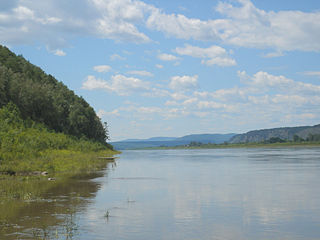
The Amur River or Heilong River is a perennial river in Northeast Asia, forming the natural border between the Russian Far East and Northeast China. The Amur proper is 2,824 km (1,755 mi) long, and has a drainage basin of 1,855,000 km2 (716,000 sq mi). If including its main stem tributary, the Argun, the Amur is 4,444 km (2,761 mi) long, making it the world's tenth longest river.

Armstrong Redwoods State Natural Reserve is a state park of California in the United States established to preserve 805 acres (326 ha) of coast redwoods. The reserve is located in Sonoma County, just north of Guerneville.

The Treaty of Nerchinsk of 1689 was the first treaty between the Tsardom of Russia and the Qing dynasty of China. The Russians gave up the area north of the Amur River as far as the Stanovoy Range and kept the area between the Argun River and Lake Baikal. This border along the Argun River and Stanovoy Range lasted until the Amur Annexation via the Treaty of Aigun in 1858 and the Convention of Peking in 1860. It opened markets for Russian goods in China, and gave Russians access to Chinese supplies and luxuries.
Argun may refer to:

The Argun or Ergune is a 1,620-kilometre (1,010 mi) long river that forms part of the eastern China–Russia border, together with the Amur. Its upper reaches are known as Hailar River in China. The Argun marks the border between Russia and China for about 944 kilometres (587 mi), until it meets the Amur.

Abdul-Halim Abusalamovich Sadulayev was the fourth President of the Chechen Republic of Ichkeria. Sadulayev served little more than a full year as President before being killed in a gun battle with FSB and pro-Russian Chechen forces.

Argun, also known as Ustrada is a town in the Chechen Republic, Russia, located on the Argun River. Population: 29,525 (2010 Russian census); 25,698 (2002 Census); 25,491 (1989 Soviet census); 22,000 (1968).

Transbaikal, Trans-Baikal, Transbaikalia, or Dauria is a mountainous region to the east of or "beyond" (trans-) Lake Baikal in Far Eastern Russia.

There are 18 biosphere reserves in India. They protect larger areas of natural habitat than a typical national park or animal sanctuary, and often include one or more national parks or reserves, along with buffer zones that are open to some economic uses. Protection is granted not only to the flora and fauna of the protected region, but also to the human communities who inhabit these regions, and their ways of life. In total there are 18 biosphere reserves in India.

Hulun Lake or Dalai Lake is a large lake in the Inner Mongolia region of northern China.
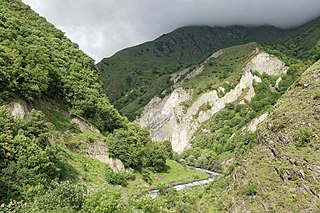
The Argun, also known as Chantiy-Argun, cognate with one of the biggest Chechen teips Chantiy, is a river in the Caucasus. It flows through the northern Caucasus, Georgia, and the Chechen Republic of Russia. It is an affluent of the Sunzha and lies within the river basin of the Terek. It is 148 kilometres (92 mi) long, and has a drainage basin of 3,390 square kilometres (1,310 sq mi). The river has its sources on the northern slopes of the Caucasus in Khevsureti, Georgia. The Argun flows in western Chechnya through Itum-Kalinsky and Shatoysky Districts.

Ethnic Russians or Russian Chinese, are one of the 56 ethnic groups officially recognized in China. Enhe Russian Ethnic Township is the only ethnic township in China designated for China's Russian minority. Russians have been living in China for centuries and are typically the descendants of the Russians who settled in China in the 17th century. Ethnic Russians in China are Chinese citizens. Many of them are descendants of Cossacks. There are currently over 16,000 ethnic Russians in China who have lived their entire life as Chinese citizens. In the census of 1957, there were 9,000 ethnic Russians. The 1978 census counted just 600 Russians, but the figure rose to 2,935 in the 1982 census and 13,504 in the 1990 census.
The Battle of Khankala was a failed attempt by the Chechen separatists to counterattack at the strategic position at Khankala from Grozny and Argun using armoured vehicles.

Montgomery Woods State Natural Reserve is a 1,323-acre state-owned park located in the Coastal Range in Mendocino County, California, United States. The Reserve occupies the headwaters of Montgomery Creek, a tributary of Big River, which flows into the Pacific Ocean at Mendocino Headlands State Park. The virgin groves of Coast Redwood in Montgomery Woods are examples of a now rare upland riparian meadow habitat; most other preserved redwood groves are on broad alluvial plains. The Reserve is accessed from a parking area along Orr Springs Road 13 miles (21 km) west of Ukiah and 15 miles (24 km) east of Comptche. A moderately steep trail from the parking area climbs uphill along Montgomery Creek about three-quarters of a mile. Once in the grove, the trail makes a meandering three miles (4.8 km) loop, with substantial use of boardwalks to protect the fragile forest floor. The reserve was initiated by a 9-acre donation from Robert T. Orr in 1945, with 765 acres donated since 1947 by the Save the Redwoods League.

Medemia argun is a rare species of the palm tree family (Arecaceae) native to Egypt and Sudan. It is the only species in the genus Medemia. The palm's dried dates have been found in ancient Egyptian tombs.

The wildlife of Chechnya includes a range of flora, fauna, and funga as reflected by its varying topographic and climatic conditions, with the Greater Caucasus to the south, the foreland zone the Terek and Sunza river valleys in the west and east, and the rolling plains of Nogai steppe in the north. Lake Kezenoyam in Chechnya is near the border with Dagestan and can sustain plankton growth. Salmo ezenami, a rare species of trout now critically endangered due to introduction of the invasive species European chub, is native only to this lake and is therefore endemic to Lake Kezenoyam.

Argun is a village in Sarajuy-ye Sharqi Rural District, Saraju District, Maragheh County, East Azerbaijan Province, Iran. At the 2006 census, its population was 193, in 27 families.
The 292nd Rifle Division was an infantry division of the Soviet Union's Red Army during World War II, formed three times.

Borasseae is a tribe in the palm subfamily Coryphoideae. The tribe ranges from southern Africa and Madagascar north through the Arabian Peninsula to India, Indochina, Indonesia and New Guinea. Several genera are restricted to islands in the Indian Ocean. The two largest genera, Hyphaene and Borassus, are also the most widespread.

Mübeccel Argun Tek was a Turkish sportswoman, teacher of physical education and radio presenter, who worked for the BBC Turkish in London, United Kingdom.
References
- ↑ World Press Review. Stanley Foundation. 2003. p. 99. Retrieved 20 April 2013.
 | This Chechnya location article is a stub. You can help Wikipedia by expanding it. |