
Qin Shi Huang was the founder of the Qin dynasty and the first emperor of a unified China. From 247 to 221 BC he was Zheng, King of Qin. He became China's first emperor when he was 38 after the Qin had conquered all of the other Warring States and unified all of China in 221 BC. Rather than maintain the title of "king" borne by the previous Shang and Zhou rulers, he ruled as the First Emperor (始皇帝) of the Qin dynasty from 221 BC to 210 BC. His self-invented title "emperor" would continue to be borne by Chinese rulers for the next two millennia.

The Warring States period was an era in ancient Chinese history characterized by warfare, as well as bureaucratic and military reforms and consolidation. It followed the Spring and Autumn period and concluded with the Qin wars of conquest that saw the annexation of all other contender states, which ultimately led to the Qin state's victory in 221 BC as the first unified Chinese empire, known as the Qin dynasty.
Emperor Huai of Jin, personal name Sima Chi (司馬熾), courtesy name Fengdu (豐度), was an emperor of the Jin Dynasty (265-420).

Yue Fei, courtesy name Pengju, was a Chinese military general, calligrapher, and poet who lived during the Southern Song dynasty. His ancestral home was in Xiaoti, Yonghe Village, Tangyin, Xiangzhou, Henan. He is best known for leading Southern Song forces in the wars in the 12th century between Southern Song and the Jurchen-ruled Jin dynasty in northern China before being put to death by the Southern Song government in 1142 under a concocted charge. He was granted the posthumous name Wumu (武穆) by Emperor Xiaozong in 1169, and later granted the posthumous title King of È (鄂王) by Emperor Ningzong in 1211. Widely seen as a patriot and national folk hero in China, since his death Yue Fei has evolved into a paragon of loyalty in Chinese culture.
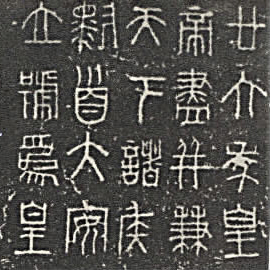
Seal script is an ancient style of writing Chinese characters that was common throughout the latter half of the 1st millennium BC. It evolved organically out of the Zhou dynasty bronze script. The Qin variant of seal script eventually became the standard, and was adopted as the formal script for all of China during the Qin dynasty. It was still widely used for decorative engraving and seals in the Han dynasty. The literal translation of the Chinese name for seal script, 篆書, is decorative engraving script, a name coined during the Han dynasty, which reflects the then-reduced role of the script for the writing of ceremonial inscriptions.
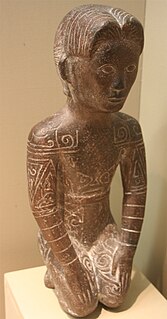
The Baiyue, Hundred Yue, or simply Yue, were various ethnic groups who inhabited the regions of Southern China to Northern Vietnam in the 1st millennium BC and 1st millennium AD. They were known for their short hair, body tattoos, fine swords, and naval prowess.
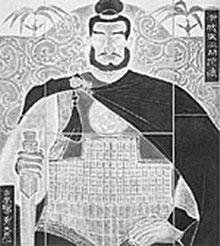
Zhao Tuo or Triệu Đà, was a Qin dynasty Chinese general and first king of Nanyue. He participated in the conquest of the Baiyue peoples of Guangdong, Guangxi and Northern Vietnam. After the fall of the Qin, he established the independent kingdom of Nanyue with its capital in Panyu in 204 BCE. Some traditional Vietnamese history scholars considered him an emperor of Vietnam and the founder of the Triệu dynasty, other historians contested that he was a foreign invader.
King Huiwen of Qin, also known as Lord Huiwen of Qin or King Hui of Qin, given name Si (駟), was the ruler of the Qin state from 338 to 311 BC during the Warring States period of Chinese history and likely an ancestor of Emperor Qin Shi Huang. He was the first ruler of Qin to style himself "King" (王) instead of "Duke" (公).
The Seven Warring States or Seven Kingdoms refers to the seven leading states during the Warring States period of ancient China:
Fàn is a Chinese family name. Is it also one of the most common surnames in Vietnam, where it is written Pham. It is the 46th name on the Hundred Family Surnames poem.
This is a page on cultural depictions of Yue Fei. To read his main article, please see Yue Fei.
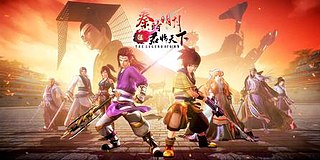
The Legend of Qin, also Qin's Moon, is a CG Chinese animated TV series written by Sayling Wen (温世仁), produced by Robin Shen (沈乐平), and directed by Chen Qianyuan (陈乾元). The story is based on the original story and novel of the same name by Taiwanese writer and entrepreneur Sayling Wen. It is China's first 3D wuxia animation, produced by Sparkly Key Animation Studio in Hangzhou, Zhejiang. The series was first broadcast around Chinese New Year in 2007.

Qin's wars of unification were a series of military campaigns launched in the late 3rd century BC by the Qin state against the other six major Chinese states — Han, Zhao, Yan, Wei, Chu and Qi. During 247–221 BC, Qin emerged as one of the dominant powers of the very strong and powerful Seven Warring States.

As trade was an important source of wealth for the Yue tribes of coastal China, the region south of the Yangtze River attracted the attention of Emperor Qin Shi Huang, and he undertook a series of military campaigns to conquer it. Lured by its temperate climate, fertile fields, maritime trade routes, relative security from warring factions to the west and northwest, and access to luxury tropical products from Southeast Asia, the emperor sent armies to conquer the Yue kingdoms in 221 BC. Military expeditions against the region were dispatched between 221 and 214 BC. It would take five successive military excursions before the Qin finally defeated the Yue in 214 BC.

Qin Shi Huang is a Chinese television series based on the life of Qin Shi Huang, the First Emperor who unified China under the Qin dynasty in 221 BC. The series was filmed between 1999 and 2000 and was first released in 2001 in Hong Kong and Thailand and in 2002 in Singapore. In China, the series was edited and altered by historians and experts before it was approved for broadcast on CCTV-1 in 2007.

The Patriot Yue Fei is a 2013 Chinese television series based on the life of Yue Fei, a Song dynasty general widely regarded as a patriot and national hero in Chinese culture for his role in the Jurchen campaigns against the Song dynasty. While the plot is based on historical sources, it also includes elements of fiction and draws ideas from the novel General Yue Fei (說岳全傳) and other folktales on the general's life.

Sound of the Desert is a 2014 Chinese television series based on the historical romance novel Ballad of the Desert by Tong Hua. It stars Cecilia Liu, Eddie Peng and Hu Ge. The series aired on Hunan TV from 1 October to 27 November 2014.
Kuaiji Commandery, formerly romanized as K‘uai-chi Commandery, was a former commandery of China in the area of Hangzhou Bay. When first established, its capital was at Wu, which became known as "Kuaiji" from this role. The initial territory ran from the south bank of the Yangtze through most of modern Zhejiang to an indeterminate border among the free people of Minyue. Wu and Wuxing commanderies were later formed between the Yangtze and the north shore of Hangzhou Bay; the administration of the remainder of Kuaiji Commandery was then removed to the site of the former Yue capital in modern Shaoxing's Yuecheng District, which also became known as Kuaiji from this role. By the Tang, Hangzhou was also separated and Kuaiji ran from a little north of the Zhe River in the west to Ningbo in the east.
The Legend of Qin, a.k.a.Qin's Moon, may refer to:
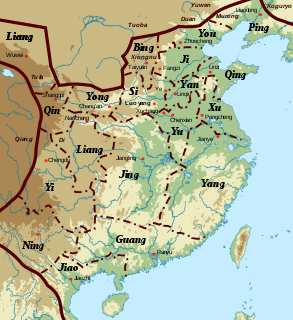
The military history of the Jin dynasty encompasses the period of Chinese military activity from 266 AD to 420 AD. The Jin dynasty is usually divided into the Western and Eastern Jin eras. Western Jin lasted from its usurpation of Cao Wei in 266 to 316 when the Uprising of the Five Barbarians split the empire and created a number of barbarian states in the north. The Jin court fled to Jiankang, starting the era of Eastern Jin, which ended in 420 when it was usurped by Liu Yu, who founded the Liu Song dynasty.
