
Joseph ben Ephraim Karo, also spelled Yosef Caro, or Qaro, was the author of the last great codification of Jewish law, the Beit Yosef, and its popular analogue, the Shulhan Arukh. To this end he is often referred to as HaMechaber or "The Author" and as Maran or "Our Master".
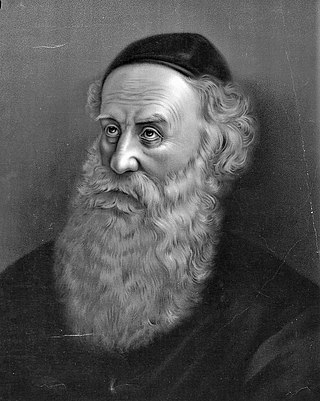
Shneur Zalman of Liadi was a rabbi and the founder and first Rebbe of Chabad, a branch of Hasidic Judaism. He wrote many works, and is best known for Shulchan Aruch HaRav, Tanya, and his Siddur Torah Or compiled according to the Nusach Ari.

Dov Ber ben Avraham of Mezeritch, also known as the Maggid of Mezeritch or Mezeritcher Maggid, was a disciple of Rabbi Israel ben Eliezer, the founder of Hasidic Judaism, and was chosen as his successor to lead the early movement. Dov Ber is regarded as the first systematic exponent of the mystical philosophy underlying the teachings of the Baal Shem Tov, and through his teaching and leadership, the main architect of the movement. He established his base in Mezhirichi, which moved the centre of Hasidism from Medzhybizh, where he focused his attention on raising a close circle of disciples to spread the movement. After his death the third generation of leadership took their different interpretations and disseminated across appointed regions of Eastern Europe, rapidly spreading Hasidism beyond Ukraine, to Poland, Galicia and Russia.

Aharon Lichtenstein was an Orthodox rabbi and rosh yeshiva who was an authority in Jewish law (Halakha).

Shlomo Riskin is an Orthodox rabbi, and the founding rabbi of Lincoln Square Synagogue on the Upper West Side of New York City, which he led for 20 years; founding chief rabbi of the Israeli settlement of Efrat in the Israeli-occupied West Bank; former dean of Manhattan Day School in New York City; and founder and Chancellor of the Ohr Torah Stone Institutions, a network of high schools, colleges, and graduate Programs in the United States and Israel.

A maggid, also spelled as magid, is a traditional Jewish religious itinerant preacher, skilled as a narrator of Torah and religious stories. A chaplain of the more scholarly sort is called a darshan. The title of maggid mesharim probably dates from the sixteenth century.

Chernobyl is a Hasidic dynasty that was founded by Grand Rabbi Menachem Nachum Twersky, known by the name of his work as the Meor Einayim. The dynasty is named after the northern Ukrainian town of Chernobyl, where Rabbi Nachum served as the maggid. The lineage has continued to exist to this day, although not always with the name Chernobyl. Today there are several rebbes named Chernobyl. The central court is in Bnei Brak, headed by Rabbi Menachem Nachum Twersky.

Slonim is a Hasidic dynasty originating in the town of Slonim, which is now in Belarus. Today, there are two Slonimer factions. Slonim, based in Jerusalem, and the Slonim community in Bnei Brak. They are two distinct groups today, and have many differences between them.
Menachem Mendel of Vitebsk (1730?–1788), also known as Menachem Mendel of Horodok, was an early leader of Hasidic Judaism. Part of the third generation of Hassidic leaders, he was the primary disciple of the Maggid of Mezeritch. From his base in Minsk Menachem Mendel was instrumental in spreading Hasidism throughout Belarus.

Machnovka is a Hasidic dynasty Chernobyl dynastic group of families.

Paysach J. Krohn is an Orthodox Jewish rabbi, mohel, author, and lecturer on topics related to ethics and spiritual growth. He is the author of the "Maggid" series of books for ArtScroll, inspired by the stories of Rabbi Sholom Schwadron, who was known as the "Maggid of Yerushalayim". He also authored a seminal work on bris milah, also published by ArtScroll.

Yisroel Hopstein (1737–1814), also known as the Maggid of Kozhnitz, was the founder of Kozhnitz Hasidism, and a noted hasidic leader in Poland during the late 18th and early 19th century. He was a student of both the Magid/Dov Ber of Mezeritch and Elimelech of Lizhensk, and wrote many books on Chassidus and Kabbalah. He is sometimes referred to as "the Avodat Yisrael" for his works.
Vidal of Tolosa, alternate spelling Vidal de Toulouse, was a Spanish rabbi and scholar of the late 14th century, and is often referred to by the sobriquet, Harav Ha-Maggid, or the Maggid Mishneh, named for his magnum opus by that name.
The Sunderland Talmudical College, popularly known as Sunderland Yeshiva, was founded in the city of Sunderland in the United Kingdom in October 1946 by Rabbi Aryeh Leib Grossnass and Rabbi Zushe Waltner at the initiative of Rabbi Eliyahu Eliezer Dessler. It re-located to Gateshead in June 1988, albeit keeping its original name, due to the dwindling size of the Jewish community in Sunderland, particularly the Orthodox section of the community. In its early years it catered for students from North Africa. The student body currently numbers at close to 90 (2024). Students are mainly English; however, there are also students from Switzerland, Belgium and the USA.
Yeshiva Bais Moshe, is a Haredi Jewish High School and Seminary (Yeshiva) in Scranton, Pennsylvania. It was founded in 1965 by its Roshei HaYeshiva (Deans) - Rabbi Chaim Bressler and Rabbi Yaakov Schnaidman, disciples of the late Rabbi Aaron Kotler, founder and Rosh HaYeshiva of Beth Medrash Govoha in Lakewood, New Jersey.

Sholom Mordechai Hakohen Schwadron was a Haredi rabbi and orator. He was known as the "Maggid of Jerusalem" for his fiery, inspirational mussar talks. Some of the stories he told about the character and conduct of Torah leaders and tzadikim of previous generations were incorporated in the "Maggid" series of books by Rabbi Paysach Krohn, whom Rabbi Schwadron mentored.
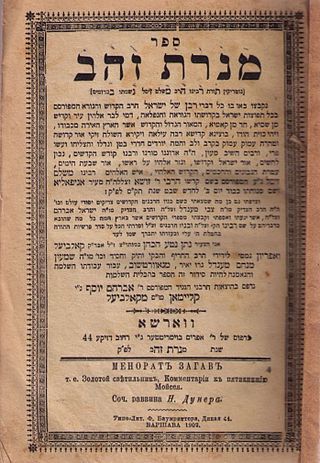
Abraham Dov Bär ben David Flahm was the editor and publisher of the Dubner Maggid.
Rabbi Meshulam Zusha of Hanipol or Meshulum Zusil of Anipoli (1718–1800), Reb Zusha, Reb Zushe, The Rebbe Reb Zusha was an early Hasidic luminary and well-known tzaddik. He was one of the great Hasidic Rebbes of the third generation and member of the academy circle of the Maggid of Mezeritch.
Rogers Park is an American Hasidic folk rock duo from Chicago, Illinois. Formed in 2011 by childhood friends Yosef Peysin and Mordy Kurtz, the group is named after the Chicago neighborhood where they grew up. Their debut album, The Maggid, was released on January 19, 2016.

Hasidic Judaism in Lithuania is the history of Hasidic Judaism and Hasidic philosophy in Lithuania and parts of modern-day Belarus. Hasidic Judaism in Lithuania began with R. Aaron Perlow of Karlin (Karalin) (1736–1772), R. Menachem Mendel of Vitebsk (1730?–1788) R. Shneur Zalman of Liadi (Lyady) (1745–1812) and to a lesser extent R. Hayim Haykl of Amdur (Indura), all of whom were disciples of R. Dov Ber of Mezeritch (Mezhirichi), who in part was the successor to the R. Israel Baal Shem Tov who founded Hasidic Judaism in Western Ukraine. In its earliest years, Lithuanian Hasidism suffered immense persecution by the Lithuanian Misnagdic rabbinate, who attempted to ban and excommunicate Hasidism on several occasions in Lithuania beginning with R. Elijah b. Solomon Zalman of Vilna (1720–1797), who was the earliest disseminator of anti-Hasidic thought which flourished in Lithuania.


