
The guitar is a fretted musical instrument that typically has six strings. It is usually held flat against the player's body and played by strumming or plucking the strings with the dominant hand, while simultaneously pressing selected strings against frets with the fingers of the opposite hand. A plectrum or individual finger picks may also be used to strike the strings. The sound of the guitar is projected either acoustically, by means of a resonant chamber on the instrument, or amplified by an electronic pickup and an amplifier.

The kora is a stringed instrument used extensively in West Africa. A kora typically has 21 strings, which are played by plucking with the fingers. It combines features of the lute and harp.

A lute is any plucked string instrument with a neck and a deep round back enclosing a hollow cavity, usually with a sound hole or opening in the body. It may be either fretted or unfretted.

String instruments, stringed instruments, or chordophones are musical instruments that produce sound from vibrating strings when a performer plays or sounds the strings in some manner.
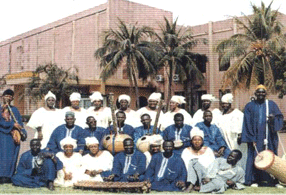
The music of Mali is, like that of most African nations, ethnically diverse, but one influence predominates: that of the ancient Mali Empire of the Mandinka. Mande people make up around 50% of Mali's population; other ethnic groups include the Fula (17%), Gur-speakers 12%, Songhai people (6%), Tuareg and Moors (10%).

Xalam is a traditional stringed musical instrument from West Africa with 1-5 strings.

The kobza, also called bandurka is a Ukrainian folk music instrument of the lute family, a relative of the Central European mandora. The term kobza however, has also been applied to a number of other Eastern European instruments distinct from the Ukrainian kobza.

The yueqin, also called a moon lute or moon guitar, is a traditional Chinese string instrument. It is a lute with a round, hollow soundboard, a short fretted neck, and usually four strings. It is an important instrument in the Peking opera orchestra, often taking the role of main melodic instrument in lieu of the bowed string section.

The citole was a string musical instrument, closely associated with the medieval fiddles and commonly used from 1200–1350. It was known by other names in various languages: cedra, cetera, cetola, cetula, cistola, citola, citula, citera, chytara, cistole, cithar, cuitole, cythera, cythol, cytiole, cytolys, gytolle, sitole, sytholle, sytole, and zitol. Like the modern guitar, it was manipulated at the neck to get different notes, and picked or strummed with a plectrum. Although it was largely out of use by the late 14th century, the Italians "re-introduced it in modified form" in the 16th century as the cetra, and it may have influenced the development of the guitar as well. It was also a pioneering instrument in England, introducing the populace to necked, plucked instruments, giving people the concepts needed to quickly switch to the newly arriving lutes and gitterns. Two possible descendant instrument are the Portuguese guitar and the Corsican Cetera, both types of cittern.

The Jola or Diola are an ethnic group found in Senegal, the Gambia, and Guinea-Bissau. Most Jola live in small villages scattered throughout Senegal, especially in the Lower Casamance region. The main dialect of the Jola language, Fogni, is one of the six national languages of Senegal.

The akonting is the folk lute of the Jola people, found in Senegal, Gambia, and Guinea-Bissau in West Africa. It is a banjo-like instrument with a skin-headed gourd body, two long melody strings, and one short drone string, akin to the short fifth "thumb string" on the five-string banjo.
Daniel Laemouahuma Jatta is a Jola scholar and musician from Mandinary, Gambia, who pioneered the research and documentation of the akonting, a Jola folk lute, as well as the related Manjago folk lute, the buchundu, in the mid-1980s. Prior to Jatta's work, these instruments were largely unknown outside the rural villages of the Senegambia region of West Africa.
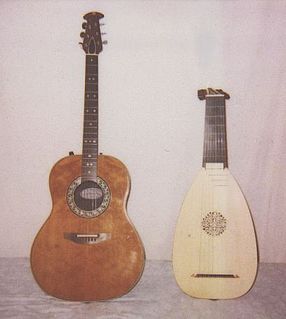
Plucked string instruments are a subcategory of string instruments that are played by plucking the strings. Plucking is a way of pulling and releasing the string in such a way as to give it an impulse that causes the string to vibrate. Plucking can be done with either a finger or a plectrum.

An acoustic guitar is a musical instrument in the string family. When a string is plucked its vibration is transmitted from the bridge, resonating throughout the top of the guitar. It is also transmitted to the side and back of the instrument, resonating through the air in the body, and producing sound from the sound hole. The original, general term for this stringed instrument is guitar, and the retronym 'acoustic guitar' distinguishes it from an electric guitar, which relies on electronic amplification. Typically, a guitar's body is a sound box, of which the top side serves as a sound board that enhances the vibration sounds of the strings. In standard tuning the guitar's six strings are tuned (low to high) E2 A2 D3 G3 B3 E4.

The ngoni is a string instrument and a traditional West African guitar. Its body is made of wood or calabash with dried animal skin head stretched over it. The ngoni, which can produce fast melodies, appears to be closely related to the akonting and the xalam. This is called a jeli ngoni as it is played by griots at celebrations and special occasions in traditional songs called fasas in Mandingo. Another larger type, believed to have originated among the donso is called the donso ngoni. This is still largely reserved for ceremonial purposes. The donso ngoni, or "hunter's harp," has six strings. It is often accompanies singing along with the karagnan, a serrated metal tube scraped with a metal stick. The donso ngoni was mentioned by Richard Jobson in the 1620s, describing it as the most commonly used instrument in the Gambia. He described it as an instrument with a great gourd for a belly at the bottom of a long neck with six strings.

The mandore is a musical instrument, a small member of the lute family, teardrop shaped, with four to six courses of gut strings and pitched in the treble range. Considered a French instrument, with much of the surviving music coming from France, it was used across "Northern Europe" including Germany and Scotland. Although it went out of style, the French instrument has been revived for use in classical music. The instrument's most commonly played relatives today are members of the mandolin family and the bandurria.
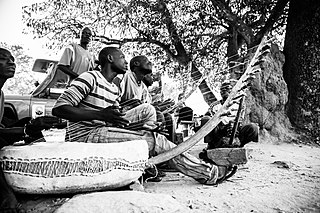
African Harps, particularly arched or "bow" harps, are found in several Sub-Saharan African music traditions, particularly in the north-east. Used from early times in Africa, they resemble the form of harps in ancient Egypt with a vaulted body of wood, parchment faced, and a neck, perpendicular to the resonant face, on which the strings are wound.

A lute guitar or German lute is a stringed musical instrument, common in Germany from around 1850. The instrument has a regular six-stringed guitar setup on a lute bowl, however there are many theorboed variants with up to 11 strings.

The Seperewa, also known as Seprewa or Sanku, is a Ghanaian harp-lute, similar to the Dagaare/Sisaala koriduo, the Mandé kora, the Gere duu, and Baoule aloko.

Lutes are stringed musical instruments that include a body and "a neck which serves both as a handle and as a means of stretching the strings beyond the body".

