
The double bass, also known simply as the bass, amongst other names, is the largest and, therefore, lowest-pitched chordophone in the modern symphony orchestra. Similar in structure to the cello, it has four, although occasionally five, strings.

The guitar is a fretted musical instrument that typically has six strings. It is usually held flat against the player's body and played by strumming or plucking the strings with the dominant hand, while simultaneously pressing selected strings against frets with the fingers of the opposite hand. A plectrum or individual finger picks may also be used to strike the strings. The sound of the guitar is projected either acoustically, by means of a resonant chamber on the instrument, or amplified by an electronic pickup and an amplifier.
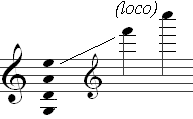
A mandolin is a stringed musical instrument in the lute family and is generally plucked with a pick. It most commonly has four courses of doubled strings tuned in unison, thus giving a total of eight strings. A variety of string types are used, with steel strings being the most common and usually the least expensive. The courses are typically tuned in an interval of perfect fifths, with the same tuning as a violin. Also, like the violin, it is the soprano member of a family that includes the mandola, octave mandolin, mandocello and mandobass.
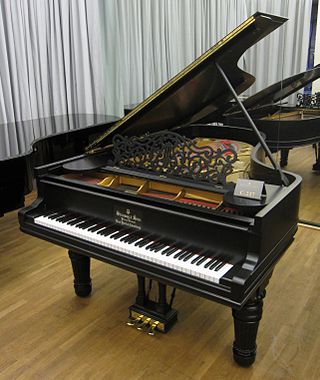
The piano is a keyboard instrument that produces sound when pressed on the keys. Most modern pianos have a row of 88 black and white keys: 52 white keys for the notes of the C major scale and 36 shorter black keys raised above the white keys and set further back, for sharps and flats. This means that the piano can play 88 different pitches, spanning a range of a bit over seven octaves. The black keys are for the "accidentals", which are needed to play in all twelve keys.

A regular expression is a sequence of characters that specifies a match pattern in text. Usually such patterns are used by string-searching algorithms for "find" or "find and replace" operations on strings, or for input validation. Regular expression techniques are developed in theoretical computer science and formal language theory.
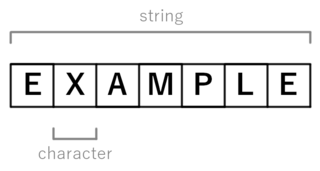
In computer programming, a string is traditionally a sequence of characters, either as a literal constant or as some kind of variable. The latter may allow its elements to be mutated and the length changed, or it may be fixed. A string is generally considered as a data type and is often implemented as an array data structure of bytes that stores a sequence of elements, typically characters, using some character encoding. String may also denote more general arrays or other sequence data types and structures.
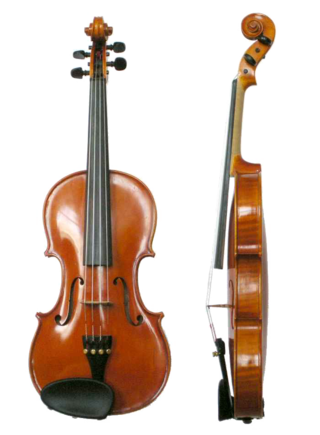
The violin, sometimes known as a fiddle, is a wooden chordophone in the violin family. Most violins have a hollow wooden body. It is the smallest and thus highest-pitched instrument (soprano) in the family in regular use. The violin typically has four strings, usually tuned in perfect fifths with notes G3, D4, A4, E5, and is most commonly played by drawing a bow across its strings. It can also be played by plucking the strings with the fingers (pizzicato) and, in specialized cases, by striking the strings with the wooden side of the bow.

String instruments, stringed instruments, or chordophones are musical instruments that produce sound from vibrating strings when a performer plays or sounds the strings in some manner.

The sitar is a plucked stringed instrument, originating from the Indian subcontinent, used in Hindustani classical music. The instrument was invented in medieval India, flourished in the 18th century, and arrived at its present form in 19th-century India. Khusrau Khan, an 18th-century figure of the Mughal Empire has been identified by modern scholarship as the inventor of the sitar. According to most historians, he developed the sitar from the setar, an Iranian instrument of Abbasid or Safavid origin. Another view supported by a minority of scholars is that Khusrau Khan developed it from Veena.
Cosmic strings are hypothetical 1-dimensional topological defects which may have formed during a symmetry-breaking phase transition in the early universe when the topology of the vacuum manifold associated to this symmetry breaking was not simply connected. Their existence was first contemplated by the theoretical physicist Tom Kibble in the 1970s.
In information theory, linguistics, and computer science, the Levenshtein distance is a string metric for measuring the difference between two sequences. Informally, the Levenshtein distance between two words is the minimum number of single-character edits required to change one word into the other. It is named after the Soviet mathematician Vladimir Levenshtein, who considered this distance in 1965.
Bosonic string theory is the original version of string theory, developed in the late 1960s and named after Satyendra Nath Bose. It is so called because it contains only bosons in the spectrum.
In theoretical physics, type I string theory is one of five consistent supersymmetric string theories in ten dimensions. It is the only one whose strings are unoriented and the only one which contains not only closed strings, but also open strings.
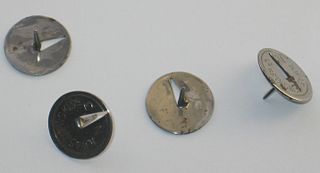
A tack piano is an altered version of an ordinary piano, in which objects such as thumbtacks or nails are placed on the felt-padded hammers of the instrument at the point where the hammers hit the strings, giving the instrument a tinny, more percussive sound. It is used to evoke the feeling of a honky-tonk piano.

Guitar tunings are the assignment of pitches to the open strings of guitars, including classical guitars, acoustic guitars, and electric guitars. Tunings are described by the particular pitches that are made by notes in Western music. By convention, the notes are ordered and arranged from the lowest-pitched string to the highest-pitched string, or the thickest string to thinnest, or the lowest frequency to the highest. This sometimes confuses beginner guitarists, since the highest-pitched string is referred to as the 1st string, and the lowest-pitched is the 6th string.

A string is the vibrating element that produces sound in string instruments such as the guitar, harp, piano, and members of the violin family. Strings are lengths of a flexible material that a musical instrument holds under tension so that they can vibrate freely, but controllably. Strings may be "plain", consisting only of a single material, like steel, nylon, or gut, or wound, having a "core" of one material and an overwinding of another. This is to make the string vibrate at the desired pitch, while maintaining a low profile and sufficient flexibility for playability.
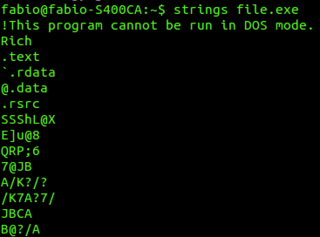
In computer software, strings is a program in Unix, Plan 9, Inferno, and Unix-like operating systems that finds and prints the strings of printable characters in files. The files can be of regular text files or binary files such as executables. It can be used on object files and core dumps. strings is mainly useful for determining the contents of non-text files.
ISO/IEC 14651:2016, Information technology -- International string ordering and comparison -- Method for comparing character strings and description of the common template tailorable ordering, is an ISO/IEC standard specifying an algorithm that can be used when comparing two strings. This comparison can be used when collating a set of strings. The standard also specifies a datafile specifying the comparison order, the Common Tailorable Template, CTT. The comparison order is supposed to be tailored for different languages, since different languages have incompatible ordering requirements. One such tailoring is European ordering rules (EOR), which in turn is supposed to be tailored for different European languages.
Strings of Steel is a 1926 action film serial directed by Henry MacRae. The film is considered to be lost.

In music for stringed instruments, especially guitar, an open chord is a chord that includes one or more strings that are not fingered. An open string vibrates freely, whereas a fingered string will be partially dampened unless fingered with considerable pressure, which is difficult for beginner players. In an open chord, the unfingered strings are undampened, and the player is able to exert maximum pressure on the fretted strings, to avoid unwanted dampening. On a regular six-string guitar, an open chord can have from one to six open strings sounding. In contrast, all of the strings are fingered for a barre chord, which requires greater technique to be allowed to ring freely. To dampen a barre chord, a player simply needs to relax the fingers. Fully dampening an open chord requires the player to roll the fingers of the left hand over the open strings, or else dampen with the right hand.


